
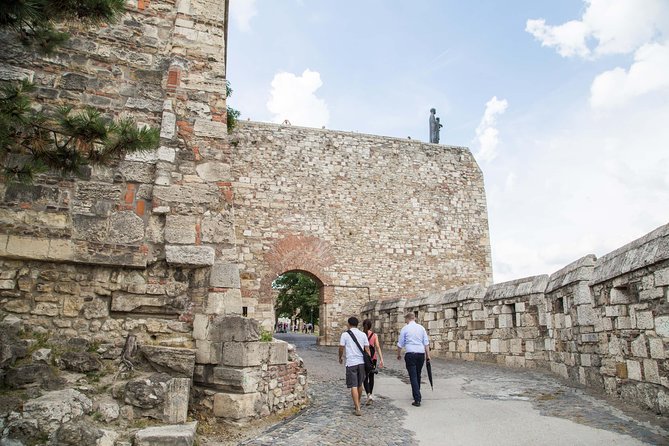
Reviewed · BUDA CASTLE TOURS
Budapest Castle Walk
Budapest’s Buda Castle district is more than a pretty hilltop with postcard views. Its lanes trace the rise of the medieval royal court, Ottoman rule, Habsburg rebuilding, Jewish life, and the terrible Siege of Budapest in 1945. This three-hour walk gives you a clear way into that long story, with stops at Matthias Church and the Fisherman’s Bastion.
I like the small-group format, capped at eight people, because it gives you a better chance to ask questions in tight courtyards and old lanes. I also like that the church entrance and a coffee or other drink are included. The main drawback is the price, $125 per person, which is a serious sum for a walking tour, especially if you mainly want photographs and a quick overview.
In This Review
- Key points to know before booking
- Why Buda Castle deserves a guided walk
- Starting at the Zero Kilometre Stone
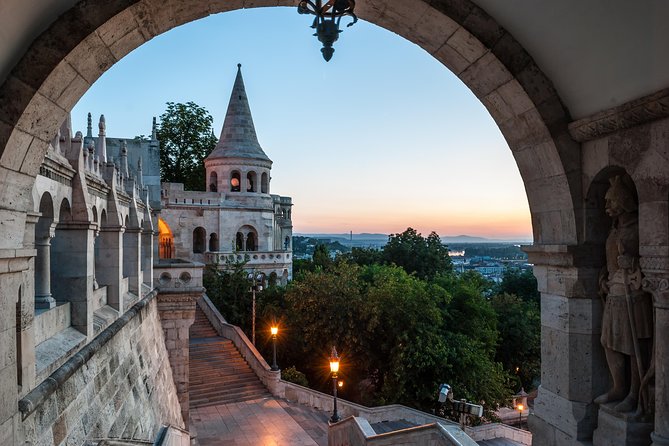
- Fisherman’s Bastion and the first city views
- Matthias Church, royal ceremonies, and wartime damage
- The Royal Palace and National Széchényi Library
- Castle Garden and Várkert Bazaar by the Danube
- Jewish heritage, courtyards, and overlooked corners
- The WWII bunker and the Siege of Budapest
- What the small group changes
- Is $125 a fair price?
- Timing, clothing, and practical planning
- Who should book the Budapest Castle Walk?
- FAQ
- How long is the Budapest Castle Walk?
- What time does the tour start?
- Where does the tour meet?
- Where does the tour finish?
- What is included in the price?
- Are museum entrances included?
- How large is the standard group?
- Can I book a private tour?
- Is the tour available all year?
- Can I cancel for a full refund?
Key points to know before booking
- The route connects Budapest’s major Buda sights: You see Fisherman’s Bastion, Matthias Church, the Royal Palace, National Széchényi Library, Castle Garden, and Várkert Bazaar.
- The history reaches beyond royalty: The walk covers Ottoman and Habsburg rule, Jewish heritage, medieval ruins, and the destruction caused by World War II.
- The group stays small: The standard small-group option accepts a minimum of two and a maximum of eight people.
- A church visit is built in: Entrance to Matthias Church is included, along with time to see its interior and colorful tiled roof.
- The tour begins at 3 pm: Meet at the Zero Kilometre Stone near Clark Ádám tér and finish near Matthias Church.
- Allow some flexibility: The walk is planned for three hours but can run longer if you are not pressed for time.
Why Buda Castle deserves a guided walk
Buda Castle is easy to visit badly. You can ride up, take a few pictures, walk around the palace, and leave with the impression that you have seen a grand church and a fine view. That misses the point. The district has been repeatedly destroyed and rebuilt, and almost every street corner carries evidence of a different period.
The hill first became a royal center in the 1200s. Hungary’s court arrived in the following century, and Buda grew into an important European city in the 15th century. Later came Ottoman rule, Habsburg control, rebuilding in baroque and neo-Renaissance styles, and the devastation of 1945.
A guide matters here because the visible buildings do not always tell the whole story. A modern-looking wall may follow a medieval line. A restored facade may conceal wartime damage. A quiet square may once have been part of a busy Jewish neighborhood.
This walk is built around those connections. You are not simply moving from landmark to landmark. You are learning how the neighborhood changed, why it looks the way it does, and what has disappeared.
More buda castle tours in Budapest:
- Budapest: Buda Castle Cave Tour
★ 4.7 · 5,677 reviews - Budapest: Buda Castle District Vampires and Myths Night Tour
★ 4.6 · 3,830 reviews - Budapest: Buda Castle Walk with Saint Stephen’s Hall
★ 4.5 · 3,012 reviews
Starting at the Zero Kilometre Stone
The tour starts at the Zero Kilometre Stone on Clark Ádám tér at 3 pm. This is a useful meeting point near the base of Castle Hill and close to public transportation. It also gives the guide a natural place to explain how Buda’s hill relates to the Danube and the rest of Budapest.
From here, expect an uphill walk and a route through cobbled streets. The district is charming, but it is not flat or perfectly smooth. Wear shoes with a firm grip, especially if the stones are wet. The tour is about three hours, so you should also arrive with enough water and avoid scheduling a tight dinner reservation immediately afterward.
The walk can stretch beyond three hours when the group has time for questions. Tell the guide at the beginning if you must leave at a particular time. That small conversation can help keep the route comfortable rather than rushed.
Fisherman’s Bastion and the first city views

Fisherman’s Bastion is one of the tour’s first major stops. Its terraces give you broad views over the Danube and Pest, making this a good place to get your bearings. The stop itself is listed as about 10 minutes, though the guide can use the setting to explain the history of the hill and the eras that shaped the neighborhood.
The streets around the bastion follow the curve of the hill. They have seen conflict since the first royal residence was built here in the mid-13th century. That fact gives the area a different feel from an ordinary historic quarter. The streets are attractive, but they also reflect centuries of military pressure, royal power, religious change, and urban rebuilding.
The guide places special attention on three themes: the Jewish population that once lived here, Hungarian royalty, and the Habsburg Empire. That focus is useful because royal architecture can dominate your first impression of Buda Castle. The Jewish story adds a needed human scale, showing that this was also a place where ordinary families worked, worshipped, and built community.
The views are a clear high point, but they are not the whole reason to stop here. Your guide can explain what you are looking at and connect the panorama to the political history of Buda.
Matthias Church, royal ceremonies, and wartime damage
Matthias Church is the main interior visit, and admission is included in the tour price. You have about 20 minutes here, enough to see the inside and pay attention to the famous multicolored tiled roof from outside.
The church was the coronation site of many Hungarian kings. That makes it one of the most important places on the hill, not just one of the prettiest. Its appearance also reflects the district’s repeated changes. Medieval, Ottoman, Habsburg, and later restoration periods all left marks on the building and its surroundings.
The church stop also brings the story into the 20th century. You hear about the Siege of Budapest, when German and Russian forces fought through Buda in 1945. The district suffered enormous destruction, and many buildings were rebuilt after the war. The guide’s discussion of wartime damage helps you read the reconstructed streets with more care.
Twenty minutes is not enough for a long, quiet church visit. If you want to study every architectural detail, you may prefer to return on your own. For a walking tour, though, the included entrance is valuable. You get more than an exterior view without having to arrange a separate visit.
A few more Budapest trips to weigh up
- Big Bus Budapest Hop-On Hop-Off Bus and Walking Tour
★ 3.5 · 2,206 reviews - Budapest: Buda Castle District Walking Tour
★ 4.6 · 2,108 reviews - Budapest City Landmarks Walking Tour in 2 Hours
★ 5.0 · 2,048 reviews - 3-Hour Orientation Walking Tour of Buda and Pest
★ 4.8 · 1,834 reviews
The Royal Palace and National Széchényi Library

The Royal Palace is the district’s great anchor. The tour explains how the arrival of the royal court began a long golden period for Buda, even though the palace complex has been destroyed and rebuilt many times.
The National Széchényi Library is included in this part of the route. The listed stop lasts about 10 minutes, and the focus is on the role of the royal court and the many layers of construction around it. You should not expect a full library visit or a museum tour. The point is to understand the palace area as a changing center of power.
One unusual detail is that no royals ever resided in the National Széchényi Library building itself, despite its connection to the former court area. Details like this keep the walk from becoming a simple list of kings and dates.
The palace area can feel grand but somewhat formal. A guide helps by explaining what was here before the latest reconstruction and why the present appearance does not represent one single historical era. For me, that is one of the tour’s strongest ideas: Buda Castle is not a perfectly preserved medieval town. It is a rebuilt district with several pasts visible at once.
Castle Garden and Várkert Bazaar by the Danube
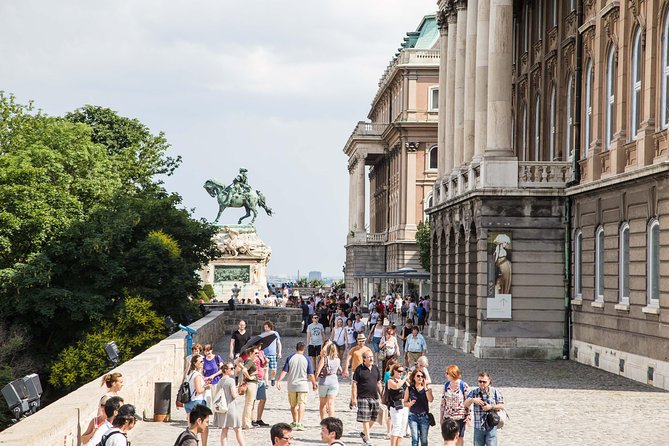
Castle Garden is another short stop, listed at about 10 minutes. The area remains connected to government and public life, with the Hungarian president living in the district alongside a few hundred ordinary residents in centuries-old buildings.
That contrast is worth noticing. Buda Castle is not only a monument zone. It is still a neighborhood, a workplace, and a place where people live among buildings that have witnessed major events.
The route also takes you around the restored neo-Renaissance Várkert Bazaar beside the Danube. This gives the walk a change of pace after the hilltop lanes and palace grounds. The building complex links Castle Hill with the river and offers another view of how Budapest has restored important parts of its historic fabric.
The Várkert Bazaar is especially useful for understanding the relationship between the castle and the riverfront. You can see how the royal district was connected to the city below, rather than treating Buda Castle as an isolated mountaintop attraction.
Jewish heritage, courtyards, and overlooked corners
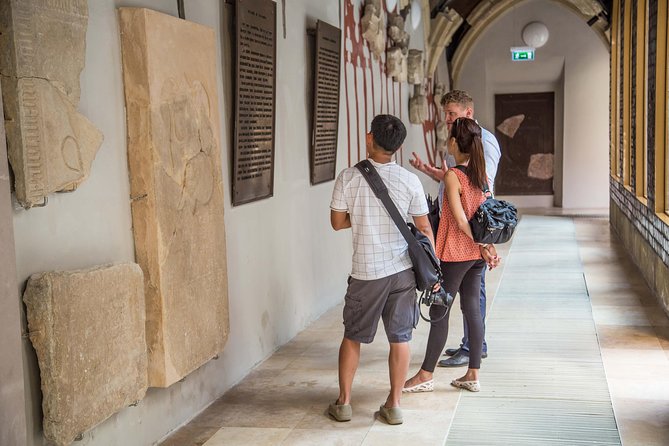
One of the most valuable parts of the tour is its attention to places that are easy to pass without noticing. The guide points out old streets, a former synagogue site, courtyards, gardens, palaces, and statues.
The Jewish history of the district deserves this attention. Buda became a melting pot of nationalities during its rise as a European city, and a significant Jewish population lived here. The remains of that community are not always obvious in today’s restored setting. A guide can point to the street pattern and former sites, then explain how war and later rebuilding changed the neighborhood.
The hidden courts and gardens also help break up the major sights. They are quieter than the main viewpoints and often better places to ask questions. You may find that these smaller spaces give you a clearer sense of everyday Buda than the grand palace facade does.
Do not expect every corner to be open for a long stop. The value is in learning what you are seeing while moving through the district. If you enjoy architecture, old urban plans, and overlooked details, this portion may be more rewarding than the standard photo stops.
The WWII bunker and the Siege of Budapest
The World War II section adds weight to the afternoon. You visit a bunker and hear about the siege of Budapest, when German and Russian forces fought in the streets in 1945.
The fighting caused severe damage across Buda Castle. The palace and neighborhood were destroyed and rebuilt several times, with postwar reconstruction leaving a strong mark on the current district. The bunker helps make that history physical. Instead of hearing only about dates and armies, you encounter a place connected to the civilian and military experience of the siege.
This is not presented as a separate museum visit. The tour does not include entrance to museums, and the bunker portion is part of the walking route. If you want a longer examination of wartime Budapest, you will need a different or additional visit.
Still, the stop makes the architecture easier to understand. A polished square and a reconstructed palace can hide how much of the district was lost. The guide’s explanation gives you a more honest view of Buda Castle, one that includes destruction as well as beauty.
What the small group changes
The standard group has a maximum of eight people, with at least two required for the tour to operate. That is a useful size for a district with narrow streets, courtyards, and several points where questions naturally come up.
A small group also makes it easier to hear the guide and stay together. You can choose a private option if you want a customized route, or select the group option intended for larger parties. The private format may make sense for families or groups with a strong interest in Jewish heritage, architecture, royal history, or World War II.
No guide names are provided for this experience, so you cannot request a particular guide based on the available information. What is clear is that the tour uses an English-speaking local guide and includes many stops for photographs and questions.
The small-group setting is not a guarantee of a private experience. Eight people is still a group, and the route has a set structure. But it should feel more personal than a large sightseeing walk.
Is $125 a fair price?
At $125 per person, this is not a budget way to see Buda Castle. You are paying for a three-hour guided route, a local English-speaking guide, the entrance fee to Matthias Church, and one coffee or another drink.
The value depends on how much context you want. If you only need directions to the church and Fisherman’s Bastion, you can explore the district independently for far less. The price becomes easier to justify if you want the Jewish heritage sites, the wartime story, the palace history, and the less obvious courtyards explained as one connected narrative.
The small maximum also matters. You are not paying for a private tour, but you are getting a group of no more than eight on the standard option. Group discounts and private upgrades are available, though the exact discount or private-tour price is not provided here.
The included drink is a pleasant break, but it should not determine your decision. The real value is the guide’s ability to turn scattered ruins and rebuilt buildings into a readable story.
Timing, clothing, and practical planning
The afternoon departure at 3 pm works well if you want to spend the morning elsewhere in Budapest. It also places the tour in a useful slot for a day that begins in Pest and moves to Buda later.
The district has cobbled streets and a hill, so comfortable walking shoes matter. Most people can take part, but you should be prepared for three hours on foot and some uphill movement. Public transportation is nearby at the starting point.
Confirmation is provided when you book, and the experience operates year-round. A minimum of two people is required, so the tour can be canceled after confirmation if that minimum is not met. In that case, you are offered another option or a full refund.
One practical warning comes from the booking experience described in the available feedback: the departure time was not clear at the time of purchase, and contacting the provider by phone proved difficult. The current details specify a 3 pm start, but I would still check your confirmation carefully before the day of the walk and make sure you know the meeting point at Clark Ádám tér.
Free cancellation is available up to 24 hours before the start time. Changes or cancellations inside that window are not accepted for a refund.
Who should book the Budapest Castle Walk?
I would choose this tour if you want Buda Castle explained rather than simply photographed. It suits you best if you care about how medieval, Ottoman, Habsburg, Jewish, royal, and wartime stories overlap in one compact district.
It is also a good match for a first visit to Budapest, especially if you want an organized introduction before returning to the palace or church on your own. The included Matthias Church entrance and coffee make the three-hour format feel complete.
I would think twice if you dislike hills, cobblestones, or guided sightseeing. The $125 price is high for a basic orientation, and the tour does not include museum entrances beyond Matthias Church. You should also leave extra time afterward in case the guide allows the walk to run long.
Book it if the historical explanation is the main attraction. Skip it if your priority is a quick castle visit, a self-guided stroll, or the lowest possible cost.
FAQ
How long is the Budapest Castle Walk?
The walk lasts approximately three hours, though it can run longer if the group is not in a rush.
What time does the tour start?
The tour starts at 3 pm.
Where does the tour meet?
You meet at the Zero Kilometre Stone on Clark Ádám tér, 1013 Budapest, near the base of Castle Hill.
Where does the tour finish?
The tour finishes at Matthias Church at Szentháromság tér 2, 1014 Budapest.
What is included in the price?
The tour includes an English-speaking local guide, one coffee or another drink, many photo and question stops, and entrance to Matthias Church.
Are museum entrances included?
No. Museum entrances are not included. Entrance to Matthias Church is included.
How large is the standard group?
The small-group tour has a minimum of two people and a maximum of eight.
Can I book a private tour?
Yes. A private option is available and can be customized.
Is the tour available all year?
Yes. The tour is available year-round.
Can I cancel for a full refund?
Yes, if you cancel at least 24 hours before the local start time. Cancellations or changes made less than 24 hours before the start are not refunded.
Just added around Budapest
- From Budapest: Guided Tour of Eger with Wine Tasting★ 4.5 · 6 reviews
- Budapest: Private Walking Tour with a Local Guide★ 3.6 · 6 reviews
- Budapest: Danube River Views Bike Ride★ 4.8 · 23 reviews
- Trash Art Museum: Hungary’s First Scrap Metal Exhibition★ 4.3 · 72 reviews
- Walk to recent and aged spiritual sanctuaries near Budapest★ 5.0 · 5 reviews
- Budapest: 3-Hour Trabant Sightseeing Tour★ 4.7 · 28 reviews
- True Crime Walking Tour in the Buda Castle district★ 5.0 · 26 reviews
- Audio visual multi-sensory chefs journey dinner experience★ 5.0 · 3 reviews
Buda Castle Tours, compared.

Buda Castle District Vampires and Myths Night Tour
Read our review →


Buda Castle District Dark History, Legends and Vampire Night Tour
Read our review →
Buda Castle District Walking Tour with a Historian
Read our review →
Browse the lists this tour appears in