Reviewed · GUIDED
Budapest: Guided Tour of the House of Music, Hungary
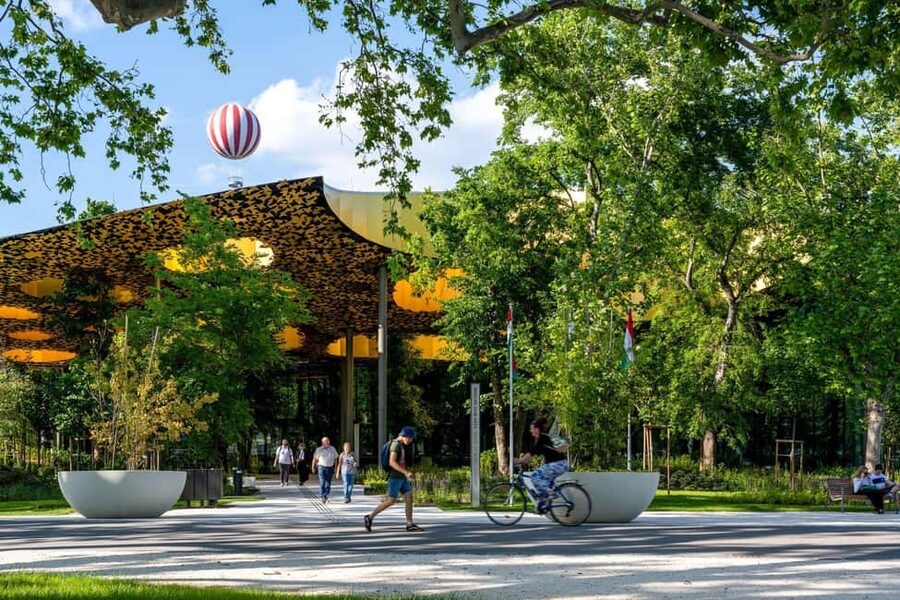
The House of Music Hungary is less a box containing exhibits than a piece of architecture designed to behave like music. Its undulating roof, punched with circular openings, seems to float above the glass walls while City Park appears to continue right through the building. For anyone who enjoys modern architecture, this one-hour tour offers a close look at a memorable Budapest landmark.
I like two things right away: the tour explains how the building’s beauty serves a purpose, from natural light to acoustics, and it gives you access to spaces many casual visitors might miss, including the concert hall, library and archives. English-speaking guides such as Dora have been praised for their clear explanations and warm energy. The main consideration is that this is an architecture tour, not a full music-museum visit. Exhibitions, the Sound Dome, and Creative Sound Space are not included.
In This Review
- Key points at a glance
- Why the House of Music deserves an hour
- Meeting your guide inside the glass foyer
- Looking up at the floating roof
- Glass walls that bring City Park indoors
- The spiral staircase and the open interior
- Concert hall, library, and archives
- How the building handles sound
- Sustainability beneath the visual drama
- What your $13 buys
- Who should book this tour
- Practical details before you go
- Should you book the House of Music tour?
- FAQ
- Where does the House of Music tour begin?
- Where does the tour end?
- How long does the guided tour last?
- What language is the tour conducted in?
- Is the tour wheelchair accessible?
- Are exhibitions included in the tour?
- Are the Sound Dome and Creative Sound Space included?
- Is the concert hall included?
- Can children under 15 join the tour?
Key points at a glance

- A roof made of leaves and light: Thousands of leaf-like metal elements form the canopy and create the building’s most striking feature.
- Designed by Sou Fujimoto: The Japanese architect planned the House of Music as a continuation of City Park, with open edges and large glass surfaces.
- A spiral staircase worth seeing: The staircase is both a practical route through the building and one of its strongest visual details.
- More than an exterior photo stop: The tour includes the foyer, concert hall, library and archives, outdoor areas, and gift shop.
- Acoustics explained on site: The guide connects the building’s shape, materials, and roof to the quality of sound inside.
- A short tour with a narrow focus: At $13 per person, it is affordable, but you are paying for guided architecture access rather than the complete museum program.
Why the House of Music deserves an hour
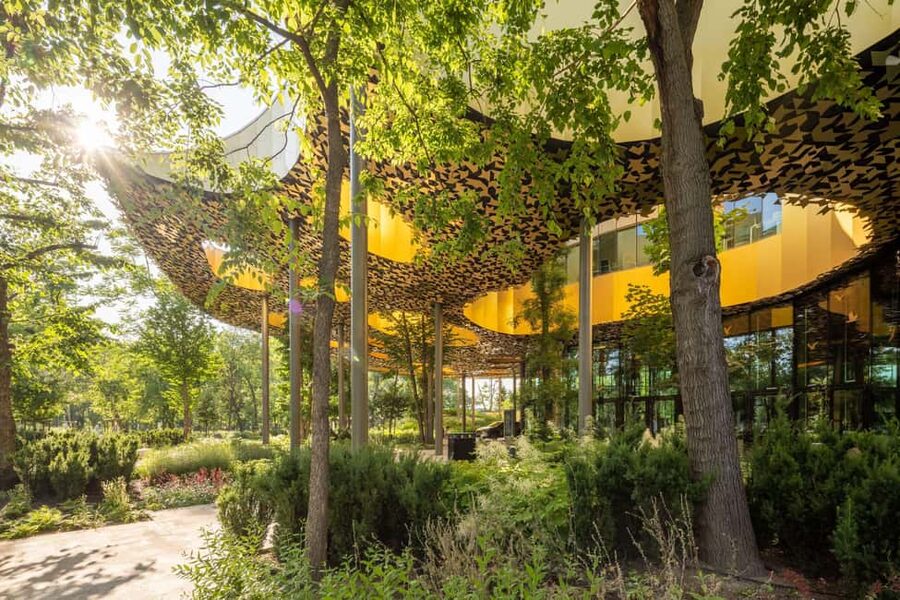
Budapest has no shortage of grand old buildings, but the House of Music Hungary offers a very different kind of pleasure. It is modern, open, and closely tied to the park around it. The design does not try to hide its structure behind a traditional facade. Instead, you see concrete, wood, glass, metal, and open space working together.
The building was designed by Japanese architect Sou Fujimoto. His idea was to blur the boundary between building and park. That explains the broad glass walls and the way trees and sky remain part of your view as you move indoors.
I find that approach especially useful for visitors who want more than a quick photograph. The guide helps you understand why the building looks the way it does. The roof is not simply an artistic flourish. Its openings help bring daylight into the interior, while its shape and materials contribute to the building’s acoustic performance.
The tour lasts one hour, so it fits neatly into a City Park afternoon. You will not spend half a day here, and that is part of the appeal. You get a focused explanation of the architecture, then have plenty of time for other sights in the park.
A few more Budapest trips to weigh up
- Budapest: Parliament Building Entry Ticket and Audio Guide
★ 4.5 · 3,844 reviews - Budapest: Opera House Guided Tour
★ 4.6 · 1,533 reviews - Budapest Small-Group Guided Tour on MonsteRoller e-Scooter
★ 5.0 · 1,517 reviews
Meeting your guide inside the glass foyer
The tour begins inside the foyer. This spacious entrance area is a useful starting point because it lets you see the building’s main design ideas at once. Glass brings in the park, open levels give the interior a sense of air, and the materials keep the space from feeling cold.
The foyer also gives the guide room to explain how the building works as a public place. It is not only a container for displays. Its open areas are intended for community use, music education, and movement between different parts of the building.
Guides speak English. Dora is one guide associated with this experience, and she has been singled out for her clear explanations, friendly manner, and positive energy. Another highly praised guide was described as a woman with white hair and colorful highlights, though her name was not known. Guide assignments can vary, but the strong point is clear: the quality of the explanation matters here, and a good guide turns unusual shapes into understandable design choices.
Start by giving yourself a moment in the foyer before trying to photograph everything. Look upward, across the glass, and toward the open areas. The building makes its first impression through space rather than through decoration.
Looking up at the floating roof
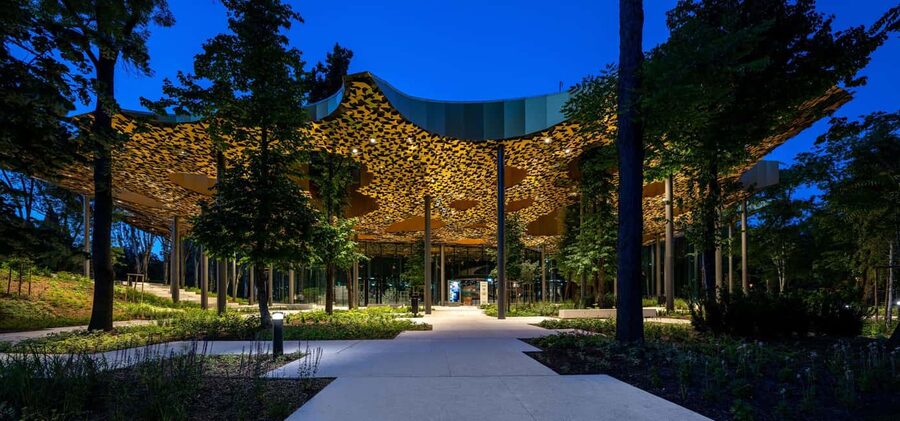
The exterior roof is the House of Music’s signature. It has an irregular, gently rolling form rather than a flat top. Thousands of leaf-like metal elements create a canopy that appears light and organic, even though it is a substantial part of the building.
Circular openings puncture the roof. These openings bring pieces of the sky and nearby trees into view, and they help natural light reach the interior. The result is a building that changes as daylight shifts. You are not looking at a sealed structure with a fixed appearance. The park and weather remain part of the visual experience.
The guide explains that the roof also helps with acoustics. Its form was planned along with the performance spaces, so the building’s most famous visual feature is tied to its musical purpose. That connection is one of the best reasons to take the guided tour instead of simply walking around outside.
Pay attention to the contrast between the delicate metal leaves and the solid concrete portions of the building. The roof gives the impression of motion, while the concrete anchors everything. The wooden details inside then add warmth. Together, these materials keep the architecture from feeling like a technical exercise.
Glass walls that bring City Park indoors
The extensive glass walls are not just there for a dramatic view. They support the central idea of the building as a continuation of City Park. From inside, you can see trees, open space, and changing light. From outside, the building reveals activity within.
I like this part of the tour because it changes the way you read the building. A conventional museum often turns its back on the surroundings to protect its displays. Here, the building keeps looking outward. That makes the park a partner in the experience.
The effect also gives the House of Music a more relaxed character. Even when you are discussing concrete, sound control, and engineering, the views stop the building from feeling too stern. You are constantly reminded that this cultural center belongs in the park.
There is a practical limit, though. A one-hour visit cannot explain every structural feature in technical detail. If you are an architecture specialist, you may want more time or more access to restricted areas. For most visitors, the level of detail should be enough to appreciate the building without turning the tour into a lecture.
Same riverbank, a completely different kind of day:
- Budapest: Unlimited Prosecco, Beer and Aperol Spritz Cruise
★ 4.8 · 25,310 reviews - Budapest: Széchenyi Spa Day Ticket with Optional Upgrades
★ 4.3 · 23,911 reviews - Budapest: Nighttime or Daytime Sightseeing Cruise
★ 4.2 · 21,062 reviews - Budapest: 1-Hour Evening Sightseeing Cruise with Drink
★ 4.5 · 8,330 reviews
The spiral staircase and the open interior
The spiral staircase is one of the tour’s visual highlights. It is a true piece of architectural theater, giving you a strong sense of movement as you pass between levels. Stairs often disappear into the background of a building. Here, the staircase becomes part of the experience.
The open interior makes the staircase even more effective. Instead of moving through a series of tight corridors, you get views across different levels and toward the park. The design encourages you to pause and look back at spaces you have just crossed.
The building uses exposed concrete and detailed wooden elements. Concrete provides a firm, modern base, while wood softens the interior and helps create a more welcoming tone. The guide can point out how these materials support both the look and the sound of the building.
If you have limited mobility, the tour is wheelchair accessible. The architecture still has plenty to offer without climbing every stair, but the tour’s route and exact viewing points may depend on the day’s access arrangements. The important point is that accessibility is built into the experience rather than treated as an afterthought.
Concert hall, library, and archives
The guided visit includes a look at the concert hall, library and archives. These areas show how the House of Music functions beyond its public foyer and outdoor setting.
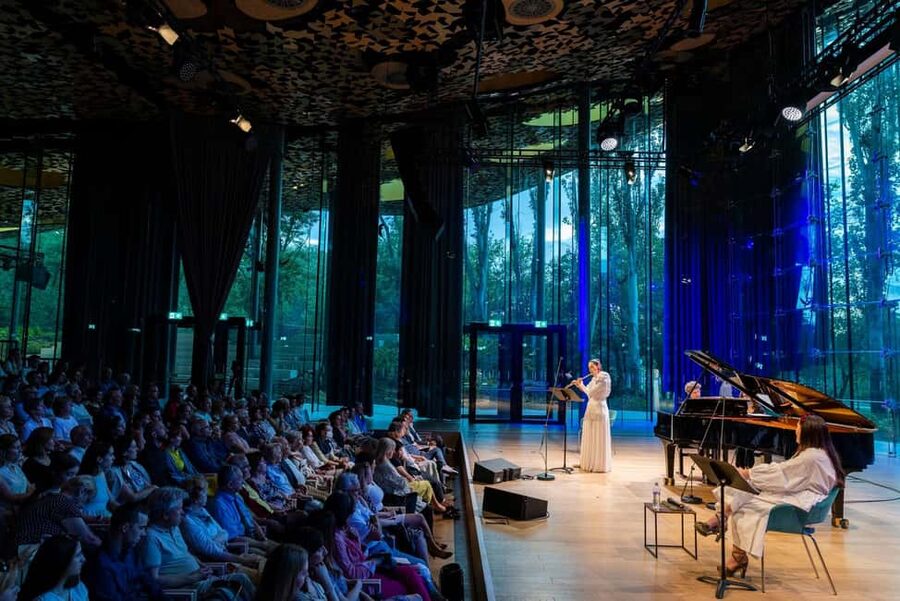
The concert hall is especially important because it gives context to the discussion of acoustics. You will not attend a performance as part of this one-hour tour, but you can learn how the shape of the room, the building materials, and the wider structure were planned to support sound quality.
That distinction matters when you book. If your main goal is to hear live music, this is not a concert ticket. If your goal is to understand how a music building is planned, the concert hall visit adds real value.
The library and archives offer another angle. They point to the House of Music as a place for study, research, and preservation, not only entertainment. The tour does not include every function of these spaces in equal depth, but seeing them helps you understand the building’s wider role in music education and culture.
The gift shop is also included in the visit. It is a small but useful final stop if you want a physical reminder of the building or its musical theme. The tour ends back at the foyer, so you are not left trying to find your way out from a different part of the complex.
How the building handles sound
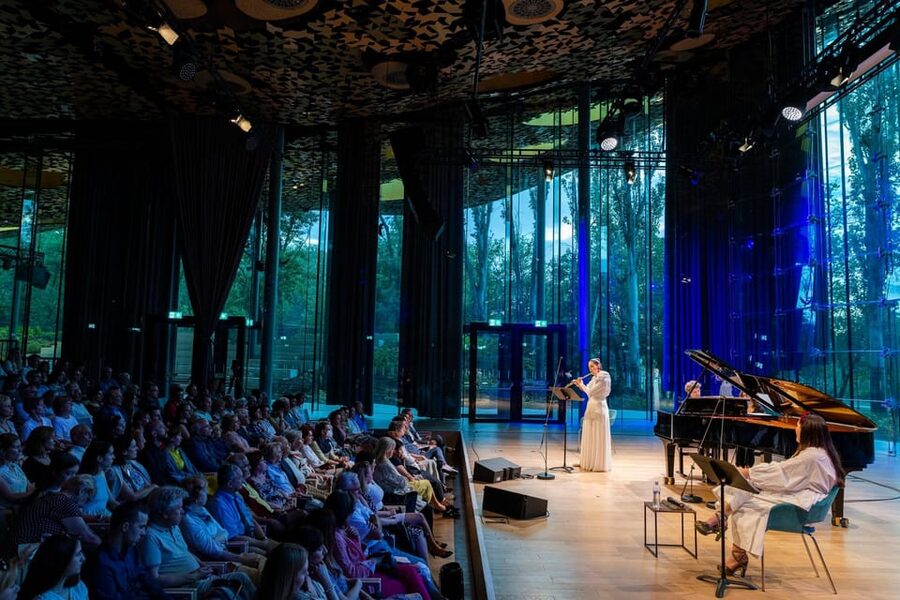
The House of Music is designed around music, and the guide gives acoustics a central place in the explanation. The building’s form, materials, roof, and performance areas were considered together to help manage sound.
This is where a guided visit offers something a casual walk-through cannot. You can see a curved surface or a broad concrete wall, but you may not know what it does. The guide connects those details to sound quality and explains why an attractive feature can also have an engineering job.
The public areas matter, too. Music buildings need to work when people are moving, talking, learning, and gathering. The open spaces were planned for community engagement and music education, not only for quiet performances.
You should keep your expectations realistic. Without a concert or a visit to the Sound Dome, you will learn about the building’s acoustic goals rather than experience every sound-focused feature directly. That is still worthwhile, but it makes this tour best for curious architecture and design fans rather than anyone seeking a complete interactive music day.
Sustainability beneath the visual drama
The House of Music’s design is easy to admire for its roof and glass, but the less visible systems also matter. The building uses geothermal energy and rainwater harvesting.
These features give the tour a practical side. The architecture is not only about making a bold public statement. It also addresses how a modern cultural building can use energy and water more carefully.
The guide’s explanation helps connect sustainability to the building’s location. A structure set in a major park must respond to its surroundings responsibly. The open design, natural lighting, and environmental systems all support the idea of a building that works with its setting rather than ignoring it.
You should not expect a full technical tour of every mechanical system. The available information points to these sustainability features as part of the architectural story, not as a separate engineering inspection. Still, they add substance to what might otherwise be a purely visual visit.
What your $13 buys
At $13 per person, this is one of the easier cultural additions to fit into a Budapest itinerary. The value comes from access and interpretation. You are not simply paying to enter a foyer and take pictures. You have an English-speaking guide explaining the building’s design, acoustics, materials, public purpose, and relationship with City Park.
The price looks strongest if you already plan to visit the park. The House of Music can serve as a focused stop between other City Park sights, and the one-hour format does not consume your whole afternoon.
The value is weaker if you expect admission to every music-related attraction in the building. Exhibitions, the Sound Dome, and Creative Sound Space are not included. You will need to treat those as separate experiences, with separate access requirements.
For architecture enthusiasts, the price is easy to justify. For someone who only wants a general museum visit, check what you want to see before booking. The included spaces are substantial, but the tour is specifically about the building and its role in music and community life.
Who should book this tour
I would recommend it most strongly to:
- People who enjoy modern architecture and unusual public buildings.
- Visitors interested in how design affects acoustics and natural light.
- Anyone already planning time in Budapest’s City Park.
- Adults who prefer a short, guided experience over a long museum visit.
- Visitors who want to see the concert hall, library and archives without committing to a performance.
The age rule is important. The activity is not suitable for children under 15, so families with younger children should choose another City Park stop.
The tour is also a good match for visitors who appreciate explanation. If you only want a quick exterior photograph, you can see much of the roof and glass from outside. The guided visit earns its price by explaining what you are seeing.
Practical details before you go
The meeting point is inside the foyer, and the tour returns there at the end. Check the available starting times when you book, since the duration is fixed at one hour but departure times vary.
The tour is conducted in English. Pets are not allowed, although assistance dogs are permitted. The activity is wheelchair accessible.
You can cancel up to 24 hours in advance for a full refund, and the reserve-now, pay-later option lets you hold a place without paying immediately. Those policies are helpful if your Budapest schedule is still taking shape.
Try to arrive ready to look both up and out. The roof and staircase reward upward glances, while the glass walls and park setting reward a slower look outward. A phone or camera is useful, but do not let photography replace the guide’s explanation of how the building works.
Should you book the House of Music tour?
Book it if you want a clear, compact introduction to one of Budapest’s most unusual modern buildings. The floating roof, circular openings, spiral staircase, glass walls, park views, and acoustic planning give the hour plenty to discuss.
Skip it if you mainly want exhibitions, interactive sound installations, or a live performance. Those are not part of this tour. At $13, though, the price is fair for an English guided look at the architecture, especially when you are already visiting City Park.
For the best fit, think of this as an architecture walk indoors, with music as its subject and City Park as its partner. Dora and other strong guides can add the practical explanations that make the building more than an eye-catching roof. If that sounds like your kind of Budapest stop, this short tour is a sensible booking.
FAQ
Where does the House of Music tour begin?
The tour begins inside the foyer of the House of Music Hungary.
Where does the tour end?
The activity ends back at the meeting point in the foyer.
How long does the guided tour last?
The guided tour lasts one hour. Starting times vary, so check availability when booking.
What language is the tour conducted in?
The live guided tour is conducted in English.
Is the tour wheelchair accessible?
Yes, the activity is wheelchair accessible.
Are exhibitions included in the tour?
No. Entry to the exhibitions is not included.
Are the Sound Dome and Creative Sound Space included?
No. Access to the Sound Dome and Creative Sound Space is not included.
Is the concert hall included?
Yes. The tour includes a look at the concert hall, along with the library and archives, outdoor areas, foyer, and gift shop.
Can children under 15 join the tour?
No. The activity is not suitable for children under 15.
Just added around Budapest
- From Budapest: Guided Tour of Eger with Wine Tasting★ 4.5 · 6 reviews
- Budapest: Private Walking Tour with a Local Guide★ 3.6 · 6 reviews
- Budapest: Danube River Views Bike Ride★ 4.8 · 23 reviews
- Trash Art Museum: Hungary’s First Scrap Metal Exhibition★ 4.3 · 72 reviews
- Walk to recent and aged spiritual sanctuaries near Budapest★ 5.0 · 5 reviews
- Budapest: 3-Hour Trabant Sightseeing Tour★ 4.7 · 28 reviews
- True Crime Walking Tour in the Buda Castle district★ 5.0 · 26 reviews
- Audio visual multi-sensory chefs journey dinner experience★ 5.0 · 3 reviews
Guided, compared.

Parliament Building Entry Ticket and Audio Guide
Read our review →

Budapest Small-Group Guided Tour on MonsteRoller e-Scooter
Read our review →


Budapest Danube Cruise with Drink, Audio Guide, Margaret Island
Read our review →
Danube River Sightseeing Cruise with Audio Guide
Read our review →