Reviewed · PRIVATE
Rise Against the Soviet: The 1956 Revolution – Private Tour
The most moving part of this private Budapest tour is seeing where ordinary people took on a Soviet-backed government with little more than courage, stolen guns, and homemade firebombs. You move from the massacre site at Kossuth Lajos Square to the resistance stronghold at Corvin Cinema, following the uprising through real places rather than a classroom lecture.
I like the way the tour connects 1956 to the wider story of Hungarian politics, from the 1848 revolution through the fall of Communism in 1990. I also like the personal angle: guides Peter and Miklos have been praised for explaining what life felt like before and after the revolt, not just reciting dates. The main drawback is time. Three hours can introduce the subject well, but it may feel too short if you already know the basics and want every battlefield and political detail.
In This Review
- Key points at a glance
- Why Budapest’s 1956 story works best on location
- Kossuth Lajos Square and the cost of protest
- The White House and Imre Nagy near Margaret Bridge
- Bem Square and the first spark of mass protest
- Sándor Petőfi and the language of rebellion
- Radio Budapest and the fight for a voice
- Corvin Cinema and the young resistance
- A private format that changes the pace
- What the $228.66 price really means
- What to bring and how to get more from it
- Who should book this Budapest history tour?
- FAQ
- How long does the Rise Against the Soviet tour last?
- How many people can join the private tour?
- Is hotel pickup available in Budapest?
- Is the tour offered in English?
- Are public transportation tickets included?
- What is included in the tour price?
- Can I cancel for a full refund?
Key points at a glance
- Follow the revolt across both sides of the Danube: The route links Parliament, Margaret Bridge, Bem Square, the Radio Budapest building, and Corvin Cinema.
- Hear personal accounts of Communist-era Hungary: Guides including Peter and Miklos add firsthand perspective on life before and after 1956.
- Visit places tied to the fighting: Kossuth Square recalls a government massacre, while Corvin köz marks one of the uprising’s main resistance centers.
- See political symbols that still matter: The Imre Nagy statue and Sándor Petőfi statue connect the 1956 revolt with Hungary’s older struggles for freedom.
- Travel by a mix of walking and public transport: This lets you cover more ground than a central walking tour, but you need a moderate level of fitness.
- Pay one private-group price: The cost is $228.66 for up to five people, making the value much better for a full group than for one person alone.
Why Budapest’s 1956 story works best on location
Hungary’s 1956 Revolution lasted only a short time, but it left marks all over Budapest. A guide can explain the political crisis, Soviet control, student protests, armed resistance, and eventual defeat. The city itself adds the missing sense of scale.
You are not simply looking at memorials. You are moving between places where speeches were made, crowds gathered, government forces fired on civilians, and young residents fought tanks. That physical connection is the tour’s main strength.
The story also reaches beyond October and November 1956. A strong guide will explain how the uprising grew out of earlier Hungarian struggles, including the 1848 revolution, and how its defeat shaped the country until the end of Communist rule in 1990. This wider setting matters because the revolt did not appear from nowhere.
Still, you should know what kind of experience this is. It is a concentrated historical tour, not a general introduction to Budapest. You will see important parts of the city, but the focus stays on politics, protest, repression, and resistance. If you want cafés, architecture, or broad sightseeing, this will not be the best use of your morning.
A few more Budapest trips to weigh up
- Private Budapest TukTuk Tour: Custom Route, Hotel Pickup
★ 5.0 · 1,307 reviews - Budapest Essentials Private Tour Highlights and Hidden Gems
★ 5.0 · 861 reviews - Budapest Private Tuk Tuk Half-Day Tour
★ 5.0 · 606 reviews
Kossuth Lajos Square and the cost of protest
The tour begins at Kossuth Lajos Square, home to the Hungarian Parliament. The square is impressive on its own, but the guide directs your attention to a far darker event.
During a mass demonstration in 1956, dozens of people were massacred there by government forces. The open space and grand buildings make the violence difficult to picture, which is why the guide’s explanation matters. You learn how a public gathering turned into a deadly confrontation and why the site remains important in Hungary’s memory.
Allow about 25 minutes here. There is no admission charge, and the stop works well as an opening because it sets up the central question of the tour: how did a protest for reform become an armed revolution?
You should expect a serious tone. This is not a quick photo stop outside Parliament. The value comes from hearing what happened at the square and understanding how state power was used against its own citizens.
The White House and Imre Nagy near Margaret Bridge
From Parliament, the route continues toward Margaret Bridge and the Danube. Here you see a building once known as the White House, the former headquarters of Hungary’s Communist government.
The nickname sounds harmless, but the site represented the party machinery that controlled the country. Seeing it after Kossuth Square gives you a useful contrast: one location recalls citizens in the street, while the other points to the political system they challenged.
You also visit the statue of Imre Nagy, the prime minister associated with the 1956 Revolution. Nagy supported a more independent path for Hungary during the uprising. He was later executed, making his statue an especially important place to discuss the revolt’s aftermath.
This stop takes about 20 minutes. It is brief, so ask questions if you want more detail about Nagy’s political role or the government’s response. The guide’s ability to explain people, not just buildings, makes a real difference here.
The Danube setting also helps you understand the route as a city tour. You are crossing between political centers on both sides of the river rather than remaining in one museum district.
Bem Square and the first spark of mass protest
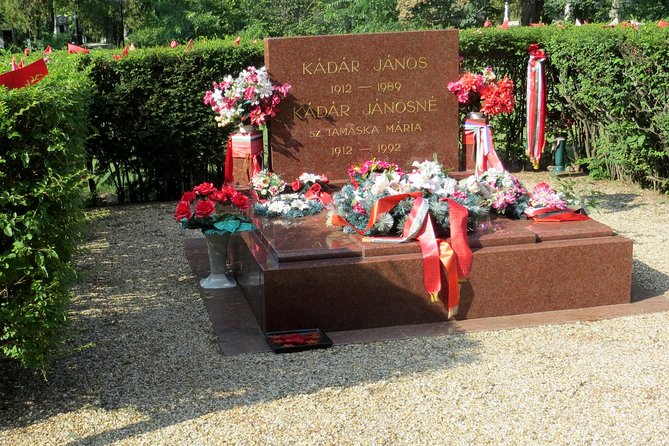
At Bem Square, the story shifts from government power to public mobilization. In 1956, about 200,000 Hungarian students gathered here in a demonstration originally organized in support of Polish workers.
That detail is crucial. The revolt began with political demands and solidarity, not as a fully formed military campaign. Students, workers, intellectuals, and other citizens gradually pushed for changes that the Communist government and Soviet leadership could not accept.
The Bem József Memorial gives the square a strong symbolic focus. It recalls the Polish connection and the wider pressure for freedom across Eastern Europe. Your guide can help you see why a rally here became one of the defining moments of the uprising.
The stop lasts around 30 minutes, making it one of the fuller visits on the route. Afterward, you go to Bambi Eszpresszó on the Buda side. The café has continued operating since the 1960s and retains its older interior and atmosphere.
Bambi is a useful change of pace. Instead of another monument, you see a place linked to everyday life under Communism, especially for Buda’s intellectual community. Food and drinks are not included, so you pay for anything you order. Even if you do not stop for refreshments, the café adds texture to a subject that can otherwise become a string of dates and battles.
Same riverbank, a completely different kind of day:
- Budapest: Unlimited Prosecco, Beer and Aperol Spritz Cruise
★ 4.8 · 25,310 reviews - Budapest: Széchenyi Spa Day Ticket with Optional Upgrades
★ 4.3 · 23,911 reviews - Budapest: Nighttime or Daytime Sightseeing Cruise
★ 4.2 · 21,062 reviews - Budapest: 1-Hour Evening Sightseeing Cruise with Drink
★ 4.5 · 8,330 reviews
Sándor Petőfi and the language of rebellion
The Sándor Petőfi statue brings the tour back to Hungary’s earlier revolutionary tradition. Petőfi was a leading figure in the 1848 revolution, and his poems became linked with the country’s long struggle against government control.
That connection gave the statue a role beyond remembrance. It became a meeting place for political events and demonstrations, including those that followed decades later.
In 1956, actor Sinkovits Imre came to the statue and recited Petőfi’s revolutionary words. He was later arrested and imprisoned. The episode shows how public speech itself could become an act of defiance.
You spend about 15 minutes here. It is a short stop, but it helps explain why national symbols mattered so much during the uprising. People were not only demanding new policies. They were drawing on older ideas about national independence and public liberty.
I would pay close attention to the guide’s explanation at this point. Without context, a statue can seem like a standard city sight. With context, it becomes part of a continuing political conversation.
Radio Budapest and the fight for a voice
The next stop is the Magyar Rádió building, also called Radio Budapest, along narrow Sándor Bródy Street. The building is somewhat removed from the city’s larger thoroughfares, which makes the approach feel different from the monumental spaces near Parliament.
In 1956, the radio building became one of the main centers of fighting. Revolutionaries tried to gain access to the station and appeal to the outside world for help. Control of the radio mattered because it meant control of the message. In a revolt facing a powerful state and Soviet military forces, communication was a weapon.
You have about 20 minutes here. The building’s importance may not be obvious from the street, so this is another stop where storytelling carries the visit. Ask your guide how the fighting developed and why the station became such a target.
This part of the route also explains one limitation of a short tour. You are seeing the place, but you are not spending hours reconstructing every stage of the battle. If you have studied 1956 closely, you may want to ask in advance whether the guide can give more time to the Radio Budapest episode.
Corvin Cinema and the young resistance
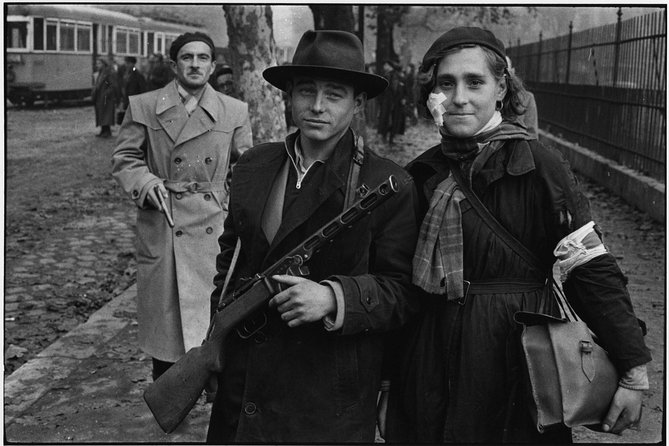
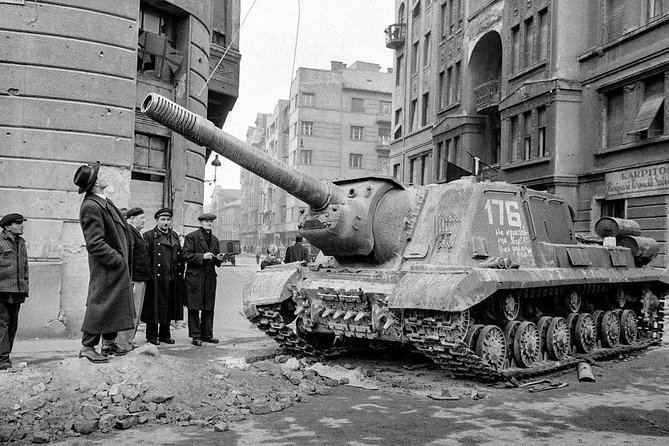
Corvin köz, beside Corvin Cinema, is the tour’s most direct encounter with the armed side of the revolution. Local young people made this area a major resistance center. They used Molotov cocktails and guns taken from soldiers against Soviet tanks.
The image is stark because these fighters were badly outmatched. Their resistance did not defeat the Soviet invasion, but it became one of the strongest symbols of popular courage during the uprising.
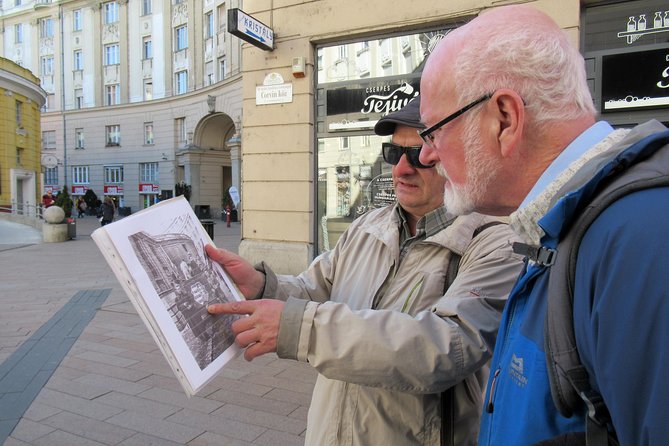
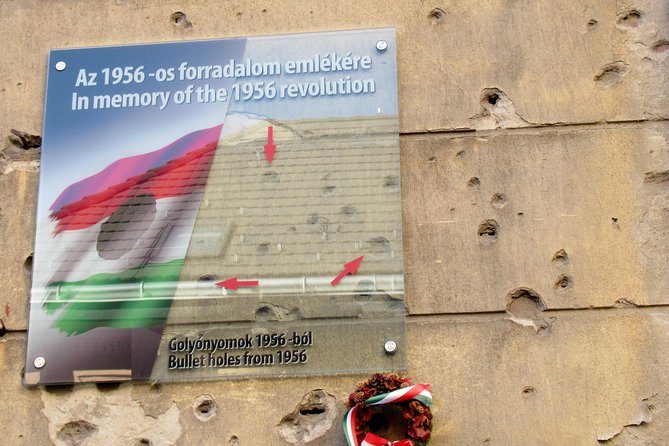
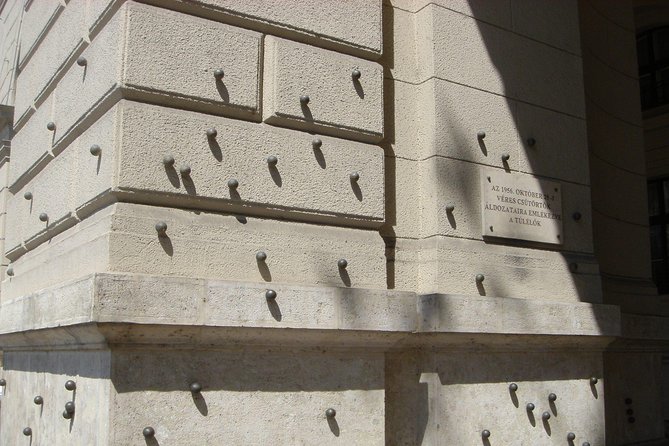
The guide explains the battles, the Soviet invasion, and what followed. You also see reminders of the fighting in the area, which gives the closing stop a physical weight that a lecture cannot match.
Plan on about 30 minutes here. Corvin Cinema is in the southeast part of Budapest, so finishing here means the tour covers a fair amount of ground. The route combines walking with public transportation, including tram rides according to the tour experience described by past participants. You will need to buy your own public transportation tickets or pass.
One notable addition mentioned by people who took this experience is an underground memorial connected with the 1956 Revolution. Since the listed route centers on Corvin Cinema, confirm with your guide whether that memorial is included on your particular outing. It could be an especially worthwhile part of the final section.
A private format that changes the pace
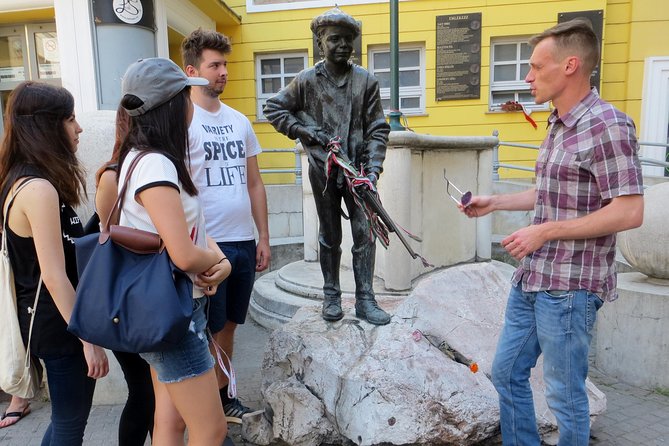
This is a private activity for your group only, with a maximum of five people. That setup is valuable for a subject this serious. You can ask direct questions, slow down for an older family member, or spend more time on the parts of the story that matter to you.
One family visited with a 91-year-old father who had escaped Hungary during the revolution. The guide adjusted the pace and shaped the discussion around his connection to the events. That is exactly where private touring can work better than a large group departure.
The experience is offered in English. Pickup can be arranged from your Budapest hotel or from a central meeting point agreed upon beforehand. Since the route uses public transport and includes walking, you should have a moderate level of physical fitness. Service animals are allowed, and the route is near public transportation.
The tour takes about three hours. One outing lasted roughly half an hour longer than the advertised time, but you should treat three hours as the planning figure. The subject is large enough that a history-minded person may wish for a longer version.
What the $228.66 price really means
The price is $228.66 per group of up to five people. For five people, that works out to about $45.73 each. For two people, it is about $114.33 per person. For a solo visitor, the private format is expensive.
The value depends heavily on group size and your interest in the topic. A group of four or five receives a personal guide, hotel pickup or an agreed central meeting point, handouts, and a Communist-era souvenir. There are no entry fees at the listed stops, but you pay separately for drinks, food, and public transportation.
Compared with a standard sightseeing tour, the price is not low. Compared with a private specialist guide, it can be reasonable for a full group, especially if you want to ask many questions or have a family connection to Hungarian history.
The 4.7 rating from 11 reviews and 91 percent recommendation figure suggest a strong reception, but the sample is small. The praise focuses on clear explanations, personal insight, flexibility, and the mix of walking with tram rides. One less favorable assessment found the tour too general for someone who had already studied the revolution. That is a fair warning: the tour works best as a guided introduction with room for questions, not as a complete scholarly survey.
What to bring and how to get more from it
Wear comfortable shoes. You will move between several districts, walk around public spaces, and use public transportation. Carry a little water, and budget separately for a café drink at Bambi if you want one.
Read the handouts during or after the tour. They are included to support the explanations, and they give you something to use when you later visit museums or memorials on your own.
Tell the guide at the start how much you already know. If you are new to Hungarian history, you may want the broader explanation from 1848 through 1990. If you have studied 1956, say so and ask for more detail on the fighting at Radio Budapest, the role of Imre Nagy, the Soviet invasion, or the resistance at Corvin köz.
You can also explain any mobility concern before setting off. The guide has adjusted the pace for an older participant before, and a private tour gives you more flexibility than a fixed group schedule.
Who should book this Budapest history tour?
I would recommend it most strongly to history buffs, students of Cold War Europe, and anyone with a family connection to Hungary. It is also a good fit if you have already seen Budapest’s main sights and want to understand the political forces behind the city’s modern identity.
The tour is especially useful if you prefer places and stories to formal museum displays. You see Parliament, squares, statues, a former party headquarters, a radio station, and a cinema tied to resistance. Each stop adds another part of the story.
I would be more cautious if you want a detailed military study of the revolution. The three-hour schedule covers a lot of territory, and one experience was considered too broad, with important sites passed without enough time. Tell the guide your priorities before beginning.
At $228.66, I think the tour makes the most sense for three to five people. A couple should book it only if the private format and subject matter are worth the higher per-person cost. Free cancellation is available until 24 hours before the start time, which gives you some room to adjust plans.
FAQ
How long does the Rise Against the Soviet tour last?
The tour lasts approximately three hours. One outing ran about 30 minutes longer than the advertised duration, but you should plan around a three-hour schedule.
How many people can join the private tour?
The price covers up to five people, and only your group participates.
Is hotel pickup available in Budapest?
Yes. You can arrange pickup from your Budapest hotel or agree on a central meeting point.
Is the tour offered in English?
Yes, the experience is offered in English.
Are public transportation tickets included?
No. You pay separately for public transportation tickets or a pass, as well as any food or drinks.
What is included in the tour price?
The price includes handouts and a souvenir related to Communism. Admission fees are free at the listed stops.
Can I cancel for a full refund?
Yes, if you cancel at least 24 hours before the experience start time. Cancellations made less than 24 hours before the start time are not refunded, and changes within that period are not accepted.
Just added around Budapest
- From Budapest: Guided Tour of Eger with Wine Tasting★ 4.5 · 6 reviews
- Budapest: Private Walking Tour with a Local Guide★ 3.6 · 6 reviews
- Budapest: Danube River Views Bike Ride★ 4.8 · 23 reviews
- Trash Art Museum: Hungary’s First Scrap Metal Exhibition★ 4.3 · 72 reviews
- Walk to recent and aged spiritual sanctuaries near Budapest★ 5.0 · 5 reviews
- Budapest: 3-Hour Trabant Sightseeing Tour★ 4.7 · 28 reviews
- True Crime Walking Tour in the Buda Castle district★ 5.0 · 26 reviews
- Audio visual multi-sensory chefs journey dinner experience★ 5.0 · 3 reviews
Private, compared.
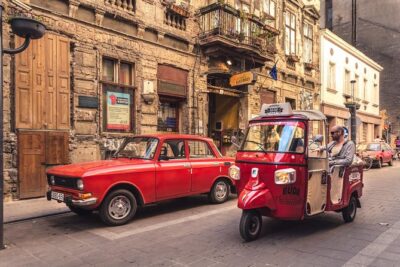
Private Budapest TukTuk Tour: Custom Route, Hotel Pickup
Read our review →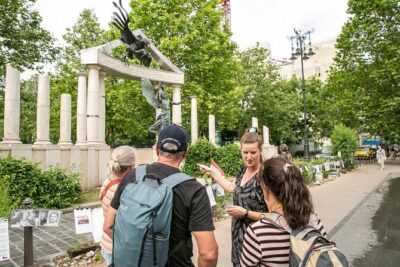
Budapest Essentials Private Tour Highlights and Hidden Gems
Read our review →
Budapest One Way Private Transfer to or from Airport
Read our review →
Budapest Private Luxury Sightseeing Tour with Guide and Transport
Read our review →
Private Budapest City tour with Classic Russian Jeep or G-Wagon!
Read our review →
Budapest Private Full Day City Sightseeing Tour Walking or by Car
Read our review →