
Reviewed · STREET ART
Street Art and Alternative Tour in Budapest
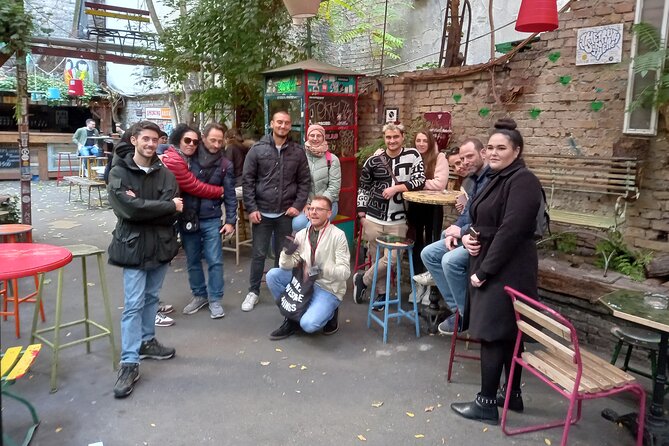
Budapest’s street art is not only about giant painted walls. On this small-group walk through District VII, ET points out stickers, tiny interventions, sculptures, murals, and other pieces you could easily miss while rushing between sights. The art often carries a political or social message, so the tour is as much about reading the city as looking at it.
I like two things here. First, ET brings a personal connection to Budapest’s art scene and explains the ideas behind the work, not just the names of artists. Second, the group is capped at eight people, which suits a discussion-based tour and makes it easier to stop, ask questions, and look closely.
The main consideration is the walking. You spend about two hours on foot, moving slowly through narrow streets rather than sitting back on a bus. That is a strength for anyone who enjoys street-level detail, but it may feel less appealing if you want a quick overview of Budapest’s major landmarks.
In This Review
- Key points at a glance
- Why this Budapest walk feels different
- Starting at Telep-Art Galéria on Madách Imre út
- Reading Budapest’s small street art
- District VII, politics, and a changing neighborhood
- A guide who makes the walk conversational
- Ending at Szimpla Kert, Budapest’s famous ruin bar
- Is $36.20 a fair price?
- Who should book this experience
- Practical details before you go
- FAQ
- Where does the Street Art and Alternative Tour in Budapest start?
- Where does the tour end?
- How long does the tour last?
- What language is the tour offered in?
- How many people can join the tour?
- Is the tour suitable for most people?
- Can I cancel for a full refund?
- Should you book this Budapest street art walk?
Key points at a glance
- Small group of eight: The limited size helps ET keep the walk conversational and responsive.
- More than large murals: Expect attention to stickers, bronze sculptures, smart-art images, wall paintings, and small pieces placed in easy-to-miss spots.
- A political and social angle: The tour explains how local events and public debate influence Budapest’s artists.
- District VII setting: You explore an area associated with alternative culture, ending at Szimpla Kert, Budapest’s oldest ruin bar.
- About two hours on foot: Wear comfortable shoes and expect a slow walk through narrow streets.
- English with guide ET: The tour is designed for questions and discussion, not a memorized speech delivered at speed.
Why this Budapest walk feels different
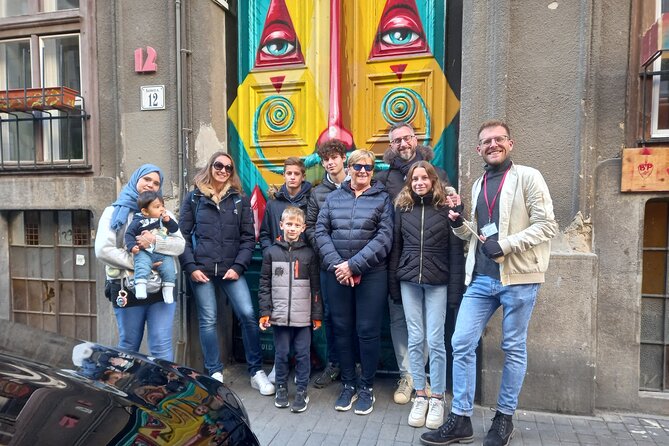
Many city walks take you from one famous building to the next. This one asks you to slow down and examine the surfaces between them. A sticker on a utility box, a small object fixed to a wall, or a painted image tucked above eye level can become the starting point for a conversation about public space and local life.
That change in pace matters. You are not simply photographing attractive artwork. You are learning where to look, how to interpret a piece, and why an artist may choose a sticker, a sculpture, or a large wall as the medium.
The art can also be surprising. One review describes expecting beautiful paintings but finding that the messages mattered more than decoration. That is a useful warning. If you want only polished murals for your photo collection, this may not be the right tour. If you enjoy art that asks questions or takes a critical view of the world, it should offer more to think about.
ET’s approach is interactive. He explains the art, gives historical context about the area, answers questions, and adjusts the conversation to the group. The tour can bring together people from different countries and backgrounds, and the small size gives those conversations room to develop.
A few more Budapest trips to weigh up
- Budapest: Street Art and Underground Movements Walking Tour
★ 5.0 · 238 reviews - Alternative Street Art Free Walking Tour of Budapest
★ 4.5 · 53 reviews - Budapest: Alternative Street Art & Jewish Tour
★ 4.8 · 49 reviews
Starting at Telep-Art Galéria on Madách Imre út
The meeting point is Telep-Art Galéria at Madách Imre út 8 in Budapest’s District VII. This is a useful place to begin because the tour starts within an art-focused setting rather than at a standard city monument.
You should allow enough time to find the gallery before the start. The meeting point is near public transportation, but the supplied details do not identify a particular station or tram line. Use the address carefully and check your meeting instructions before setting out.
Once the walk begins, the pace is deliberately slow. ET leads you along narrow streets and draws your attention to works you might pass without noticing. The route is not presented as a fixed list of grand attractions. Instead, it responds to the art visible in the neighborhood and to the interests of the people in the group.
That makes the experience feel less like a checklist. It also means you should not expect every departure to look exactly the same. ET has explained that he varies the walk, and weekday groups may receive a version shaped around the people taking part.
Reading Budapest’s small street art
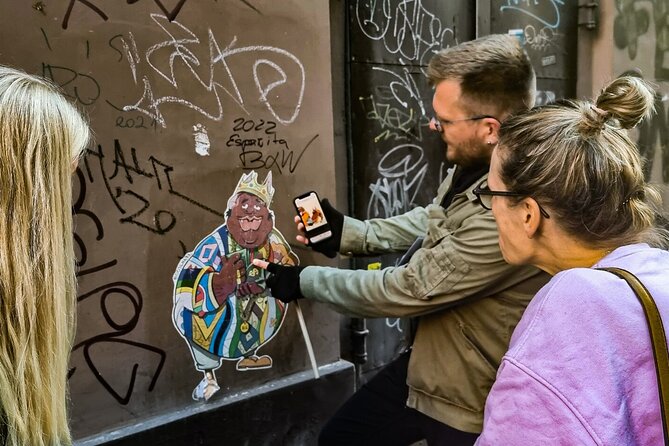
The most useful lesson is learning to scan the whole street. Look above shopfronts, around corners, on boxes, near doorways, and along walls. The tour encourages you to notice work at different scales, including pieces that are easy to overlook even when you are standing close by.
The types of art discussed can include:
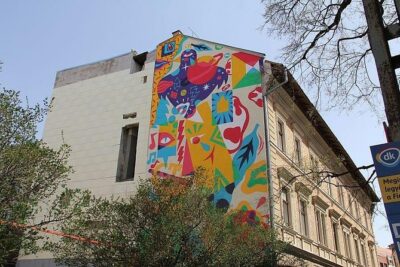
- Large wall paintings
- Stickers and pasted images
- Bronze sculptures
- Smart-art images
- Small public interventions
- Art placed on boxes and other everyday surfaces
The point is not to treat these as a simple catalogue. ET connects the forms to the ideas behind them. A sticker can spread quickly and be replaced easily. A wall painting makes a larger public statement. A tiny object may reward only the people who happen to notice it.
You may also find that the work is not always pretty in the usual sense. Some pieces are playful, some are critical, and some may be deliberately rough or temporary. ET’s explanations help you understand why that variety matters.
This is where the tour can change the rest of your time in Budapest. After learning to look for small marks and visual messages, you are likely to notice more street art on your own. The walk gives you a way of seeing, not just a set of photographs.
District VII, politics, and a changing neighborhood
District VII supplies the setting for the tour’s alternative character. The discussion reaches beyond art technique into the political events and social changes that have influenced local artists.
That context is one of the strongest reasons to choose this experience. Street art often responds to what is happening around it, and ET explains how artists use different media to express opinions. The focus is not limited to one political position or one kind of message. Instead, the tour opens a discussion about how public art can question, criticize, or comment on the world.
You should expect history to appear as background rather than as a separate lecture. ET connects the artwork to the area and explains how the neighborhood is changing. This gives you a different view of District VII, beyond its bars and nightlife.
The result is a walk with some substance. You still get the fun of spotting unexpected art, but you also gain a clearer sense of how creative work reflects local debate and daily life.
Same riverbank, a completely different kind of day:
- Budapest: Unlimited Prosecco, Beer and Aperol Spritz Cruise
★ 4.8 · 25,310 reviews - Budapest: Széchenyi Spa Day Ticket with Optional Upgrades
★ 4.3 · 23,911 reviews - Budapest: Nighttime or Daytime Sightseeing Cruise
★ 4.2 · 21,062 reviews - Budapest: 1-Hour Evening Sightseeing Cruise with Drink
★ 4.5 · 8,330 reviews
A guide who makes the walk conversational
ET is the central part of this experience. He is involved in Budapest’s art scene and brings obvious enthusiasm to the subject. His role is not simply to identify an artist or point toward a wall. He explains the meaning behind the work and supplies context about Budapest and the wider European street-art scene.
That personal connection gives the tour a more flexible feel. You can ask questions, compare different interpretations, and follow an interesting thread instead of waiting for the guide to finish a fixed speech.
ET also shares art-related resources and Instagram pages with the group. That is useful if you want to continue exploring after the walk, though the tour itself remains the main event rather than a promotional introduction to social media accounts.
The varied group format can work well. People with different ages, nationalities, and levels of art experience can bring different questions to the conversation. Families are also able to take part, and most people can participate according to the activity information.
Still, you should be comfortable with discussion. If you prefer a silent walk with only short facts, ET’s interactive style may feel more involved than expected. For most people interested in the subject, that is a benefit.
Ending at Szimpla Kert, Budapest’s famous ruin bar
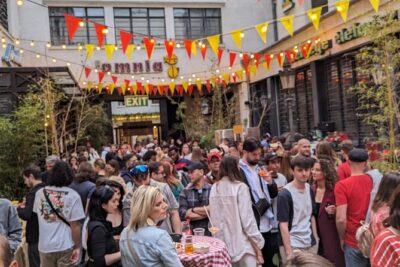
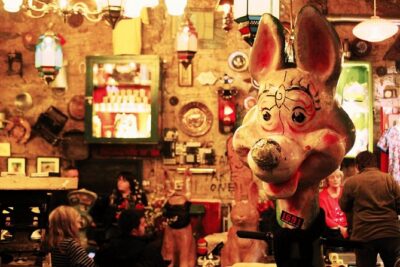
The walk finishes at Szimpla Kert on Kazinczy Street. It is described as the oldest ruin bar in Budapest and one of the city’s symbols.
This is a smart ending point. The tour begins at an art gallery and finishes in a place closely linked with Budapest’s alternative culture. You can stop for a drink or continue exploring the neighborhood afterward, but any food or drinks at the ruin bar are not stated as part of the tour, so plan to pay separately.
The ending also gives the experience a natural shape. You start by looking at art in a gallery setting, then move into public streets, and finish in a venue known for its unusual atmosphere. It connects the formal and informal sides of Budapest’s creative life without pretending that they are the same thing.
Szimpla Kert is also a practical landmark for the rest of your day. Since the tour ends there, you do not need to return to the starting point. Check your onward route before the walk if you have a timed reservation elsewhere.
Is $36.20 a fair price?
At $36.20 per person, this is not the cheapest way to spend two hours in Budapest, but the value depends on what you want from a city walk.
You are paying for a specialist subject, a guide with a personal connection to the local art scene, and a maximum group size of eight. That small group matters more here than it would on a simple sightseeing stroll because the experience depends on questions, shared observations, and stopping to examine details.
The tour also gives you access to interpretation. You could walk through District VII for free, but you would not necessarily know why certain works matter, what messages they carry, or how they connect to political and social changes.
I would consider the price reasonable for travelers who already know Budapest’s main sights and want a more focused experience. It is also a good choice for a first day if you enjoy seeing a city through its creative culture rather than beginning with palaces and museums.
The value is weaker if you are mainly looking for a large number of famous murals or a broad tour of central Budapest. This is a specialized walk, not a complete introduction to the city.
Who should book this experience
I would point this tour toward:
- People interested in street art, stickers, design, and public sculpture
- Artists, photographers, and creative travelers
- Visitors curious about politics and social change in Budapest
- Repeat visitors looking for a different side of District VII
- First-time visitors who enjoy local culture more than standard sightseeing
- Families who can manage two hours of walking
- Anyone who likes asking questions and discussing what they see
You do not need formal art training. The tour is built around looking, listening, and asking questions. A basic interest in how cities express themselves through art is enough.
You may want to skip it if you have difficulty walking for two hours, dislike narrow urban streets, or want a tightly timed schedule with many major landmarks. The pace is slow because the details require attention, and that can feel too gradual if you prefer to cover ground quickly.
Practical details before you go
The tour lasts approximately two hours and is offered in English. It uses a mobile ticket, and confirmation is provided at the time of booking.
The group maximum is eight people. The experience is near public transportation, and service animals are allowed. Most people can participate, but the walk does involve moving through narrow streets, so comfortable footwear is a sensible choice.
The tour is often booked about 25 days ahead. That does not guarantee every date will sell out, but the small capacity makes early planning sensible, especially if your Budapest schedule is fixed.
Free cancellation is available up to 24 hours before the local start time for a full refund. Cancellations or changes made less than 24 hours before the start are not accepted for a refund.
FAQ
Where does the Street Art and Alternative Tour in Budapest start?
The tour starts at Telep-Art Galéria, Madách Imre út 8, 1075 Budapest, Hungary.
Where does the tour end?
The walk ends at Szimpla Kert, Kazinczy u. 14, 1075 Budapest, Hungary.
How long does the tour last?
The tour lasts approximately two hours.
What language is the tour offered in?
The tour is offered in English.
How many people can join the tour?
The group has a maximum of eight participants.
Is the tour suitable for most people?
Most people can participate, and service animals are allowed. The experience is a walking tour through narrow streets, so you should be comfortable walking for about two hours.
Can I cancel for a full refund?
Yes. You can cancel at least 24 hours before the local start time for a full refund. Changes or cancellations made less than 24 hours before the start are not accepted for a refund.
Should you book this Budapest street art walk?
Book it if you want to notice the Budapest that sits just outside the standard sightseeing route. ET offers more than a mural-hunting stroll. He helps you read stickers, sculptures, wall paintings, and small public artworks as signs of the city’s arguments, humor, creativity, and change.
The strongest reason to go is the combination of specialist subject and small-group discussion. The main reason to hesitate is the limited scope: this is a two-hour District VII art walk, not a general Budapest tour.
For artists, curious first-time visitors, and anyone who likes a city with a little roughness and debate, the $36.20 price is fair. Bring comfortable shoes, arrive ready to look closely, and leave Szimpla Kert with a new habit: checking the walls, boxes, corners, and doorways that most people walk past.
Just added around Budapest
- From Budapest: Guided Tour of Eger with Wine Tasting★ 4.5 · 6 reviews
- Budapest: Private Walking Tour with a Local Guide★ 3.6 · 6 reviews
- Budapest: Danube River Views Bike Ride★ 4.8 · 23 reviews
- Trash Art Museum: Hungary’s First Scrap Metal Exhibition★ 4.3 · 72 reviews
- Walk to recent and aged spiritual sanctuaries near Budapest★ 5.0 · 5 reviews
- Budapest: 3-Hour Trabant Sightseeing Tour★ 4.7 · 28 reviews
- True Crime Walking Tour in the Buda Castle district★ 5.0 · 26 reviews
- Audio visual multi-sensory chefs journey dinner experience★ 5.0 · 3 reviews
Street Art, compared.
Street Art and Underground Movements Walking Tour
Read our review →
Alternative Street Art Free Walking Tour of Budapest
Read our review →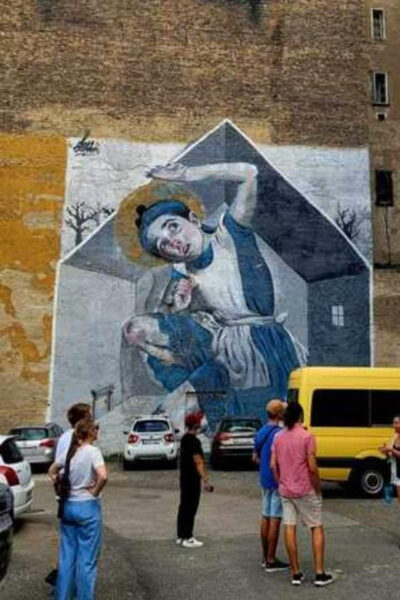
Budapest Vibe: Ruin Bars, Street Art and Culture Tour
Read our review →
Original Budapest Alternative Street Art & Jewish Tour
Read our review →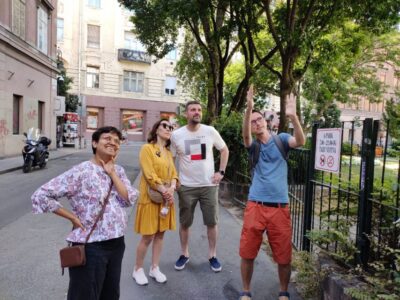
Budapest Urban Art – Private Street Art Tour with a Drink in a Ruin Bar
Read our review →Browse the lists this tour appears in