
Reviewed · JEWISH HERITAGE TOURS
A Journey through Jewish Budapest – Walking Tour
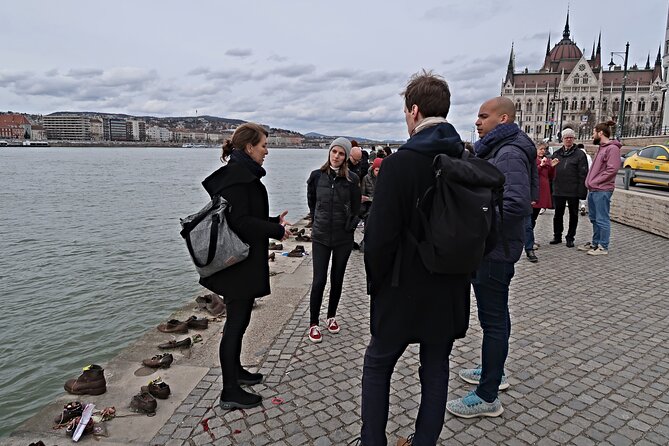
The most moving part of this tour comes at the end, when you reach the Shoes on the Danube Bank memorial. The small iron shoes make a quiet, direct statement about the Jews murdered here during World War II. Before that, you trace Jewish life through three important synagogues and the former Pest Ghetto.
I like the three-hour length, which gives you enough time for history without taking up an entire day. I also like the small format, advertised for six people, though the booking information also gives a maximum of eight. The main drawback is cost: at $126.16 per person, you still pay separately for the synagogue entries.
The tour suits you best if you want context, not just photographs. Guides such as Orsolya, Agi, Veronika, and Endre have been singled out for strong historical knowledge, clear storytelling, and useful local advice, including where to try flódni, a traditional Jewish-Hungarian cake.
In This Review
- Key points to know before booking
- Starting across from Budapest’s Great Synagogue
- Dohány Street Synagogue, the grand opening chapter
- Kazinczy Street and the last traces of the ghetto
- Rumbach Street and Budapest’s Jewish denominations
- Walking toward the Danube memorial
- The guides make the difference
- What $126.16 buys you
- Timing, clothing, and practical details
- Who should book this Budapest walk?
- Should you book it?
- FAQ
- How long does the walking tour last?
- Where does the tour begin?
- Where does the tour end?
- What time does the tour start?
- Which synagogues are included?
- Are synagogue entrance tickets included?
- What should I wear?
- Is cancellation free?
Key points to know before booking
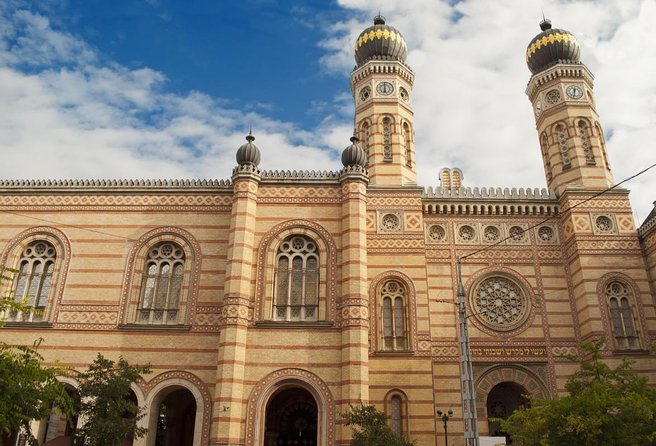
- Three major synagogues: Visit the Dohány Street, Kazinczy Street, and Rumbach Street synagogues when their interiors are open.
- A historian at your side: The tour includes a historian guide and may be led by guides such as Orsolya, Agi, Veronika, or Endre.
- A serious final stop: The walk ends at the Shoes on the Danube Bank memorial, where the wartime story becomes especially personal.
- Small-group format: The experience is advertised as limited to six people, with other booking details stating a maximum of eight.
- Plan for extra entry fees: Tickets to the Dohány, Rumbach, and Kazinczy synagogues are not included.
- Dress with care: Shoulders and knees should be covered when entering the Dohány and Kazinczy synagogues.
Starting across from Budapest’s Great Synagogue
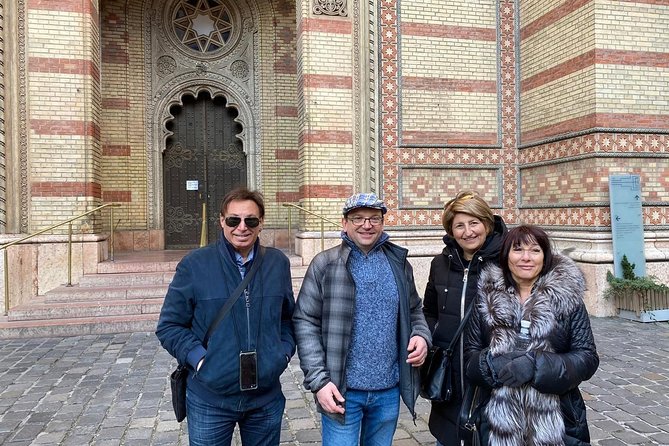
You meet at Kamara Café on Dohány Street, directly opposite the Great Synagogue. The listed start time is 10:00 a.m., and pickup is offered from the café meeting point. After booking, you receive the guide’s photograph, telephone number, and biography, which is useful when you are standing in a busy part of central Budapest.
The meeting area is easy to reach by public transport. You do not need a private car, and a walking tour makes sense here because many of the important sites sit close together in the old Jewish Quarter.
The first section deals with the Jewish communities of Budapest, including the districts now known as VII and VIII. You will hear about religious life, community institutions, architecture, and the way Jewish residents lived in the city over the centuries. The best part of having a historian guide is the chance to ask how the buildings fit into the wider story of Hungary, rather than simply memorizing dates.
The operator presents this as a journey through both the former Pest Ghetto and the Buda Castle district. The detailed route provided for the experience centers on the Pest synagogues and ends by the Danube, so you should confirm the exact route if the Buda Castle area is especially important to you.
More jewish heritage tours in Budapest:
- Budapest Jewish Heritage Memorial Walking Tour & Synagogue Entry
★ 5.0 · 568 reviews - Budapest: Jewish Heritage Guided Tour with Synagogue Ticket
★ 4.8 · 533 reviews - Jewish Quarter of Budapest Walking Tour
★ 4.7 · 369 reviews
Dohány Street Synagogue, the grand opening chapter
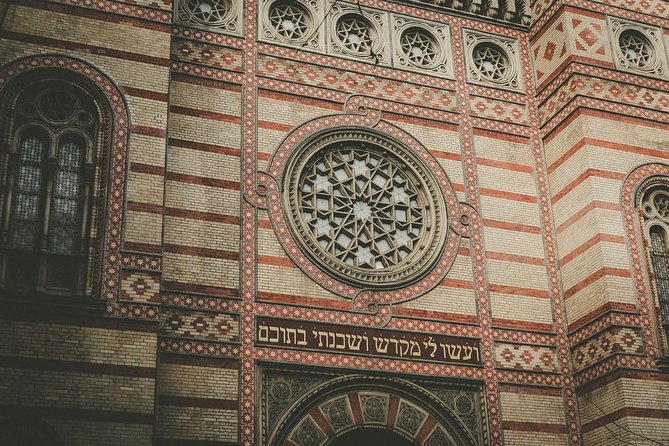
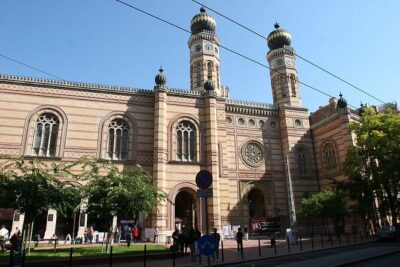
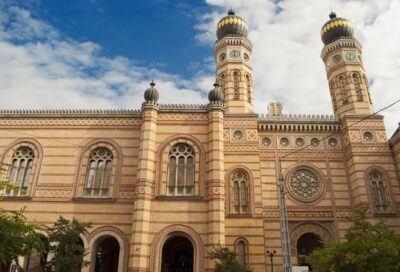
The Dohány Street Synagogue is the tour’s first major stop. At about 30 minutes, you have time to look at the building and hear about its role in Budapest’s Jewish life. The synagogue is described as the largest temple in Europe, and its Moorish Revival design gives the visit a strong visual start.
You also visit the Temple of Heroes, the Jewish Museum, and the Memorial Park within the complex. That combination matters. The synagogue shows the public and religious face of the community, while the museum and memorial spaces give you a closer look at memory, loss, and daily life.
A Jewish Studies Scholar assists with this part of the visit. That can be especially valuable if you have little background in Jewish religious traditions or Hungarian Jewish history. Guides have also been praised for explaining the area in a way that connects the building to the neighborhood around it.
Allow extra time and money here. Admission is not included in the tour price, and the itinerary specifies that tickets to the Dohány Synagogue must be purchased separately. The listed 30 minutes refers to the scheduled stop, not necessarily the full amount of time you might want if you plan to study the museum displays.
This is also where clothing matters. Visitors are asked to cover their shoulders and knees at the Dohány Synagogue. Dress modestly from the start, especially if you are joining the morning departure and do not want to stop and change before entering.
Kazinczy Street and the last traces of the ghetto
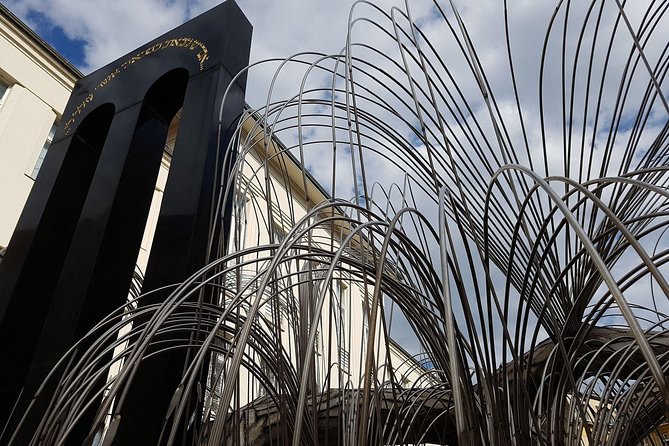
From Dohány Street, you walk to Kazinczy Street. This section takes about 35 minutes and adds several layers to the story. You pass the Ghetto Wall Memorial, erected in 2014, and learn about the former Pest Ghetto.
The memorial is a useful reminder that the ghetto was not an abstract wartime idea. It occupied real streets that you can walk today. A guide can help you understand how the area changed, what happened to its Jewish population, and how present-day Budapest remembers that period.
You also pass a luxurious mikve, or Jewish ritual bath, before reaching the Art Nouveau Orthodox synagogue on Kazinczy Street. When the synagogue is open to the public, the tour enters. When it is not, the visit may remain an exterior viewing, so do not book this experience on the assumption that every interior is guaranteed.
The synagogue’s Orthodox identity gives you a chance to compare different Jewish traditions within Budapest. Along with the Dohány Synagogue and Rumbach Street Synagogue, it helps explain why the city’s Jewish community was not one single religious or social group.
Again, entry is extra. Shoulder and knee coverage is requested here as well. The walk itself is not presented as difficult, and most people can participate, but you should be ready to spend three hours on your feet and moving between stops.
Rumbach Street and Budapest’s Jewish denominations
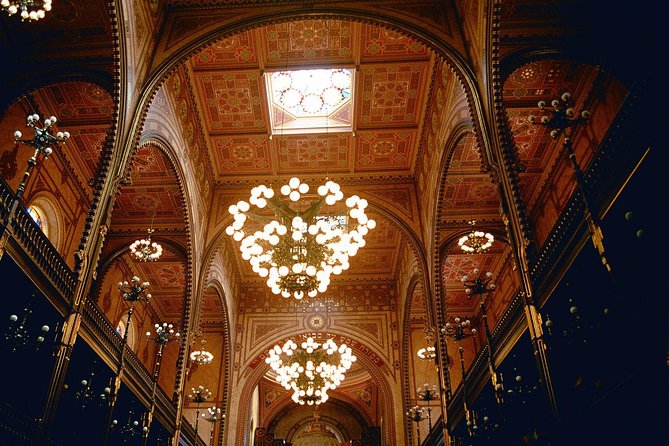
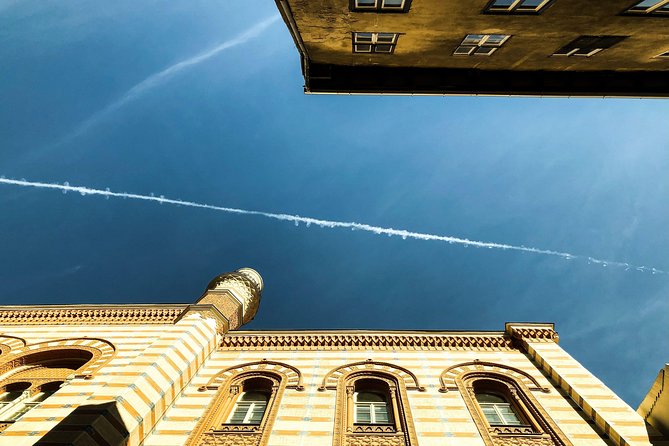
The Rumbach Street Synagogue follows at about 25 minutes. Here the guide explains the Status Quo Ante stream of Judaism, another part of Budapest’s divided and varied Jewish religious life.
Even if you are not familiar with the differences among Jewish denominations, this stop gives the tour needed structure. You are not simply collecting three ornate buildings. You are comparing communities, worship styles, and institutions that developed side by side in the same city.
The Rumbach synagogue is especially useful for understanding how Jewish identity in Budapest included several traditions. Its architecture and history add another point of contrast with the Dohány and Kazinczy synagogues.
The interior is visited when open to the public, and the admission fee is not included. That wording is important because synagogue opening conditions can affect what you see. The tour still provides historical explanation if an interior cannot be entered, but anyone focused mainly on architecture should check the access arrangements before booking.
The scheduled time at Rumbach is shorter than at the first stop. I would treat it as a focused historical visit rather than a long architectural inspection.
A few more Budapest trips to weigh up
- Budapest: Buda Castle Walk with Saint Stephen’s Hall
★ 4.5 · 3,012 reviews - Big Bus Budapest Hop-On Hop-Off Bus and Walking Tour
★ 3.5 · 2,206 reviews - Budapest: Buda Castle District Walking Tour
★ 4.6 · 2,108 reviews - Budapest City Landmarks Walking Tour in 2 Hours
★ 5.0 · 2,048 reviews
Walking toward the Danube memorial
The tour ends at the Shoes on the Danube Bank, with the listed memorial visit lasting about 20 minutes. The route from the Jewish Quarter to the river adds walking time and gives the experience a clear change of pace.
At the memorial, you learn how Jewish men, women, and children were forced to remove their shoes before being shot at the riverbank during World War II. Their bodies fell into the Danube, leaving the shoes behind. The iron shoes represent that absence.
This is a sober place, and the guide’s role is important. The memorial does not need elaborate staging. You have time to pay your respects, listen, and understand why this stretch of river has become one of Budapest’s most painful sites of memory.
The end point is practical as well as meaningful. The walk finishes at the Danube in central Budapest, rather than returning you to the café. You should plan your next activity from the riverbank. The listed end point is in the 1054 postal district.
The guides make the difference
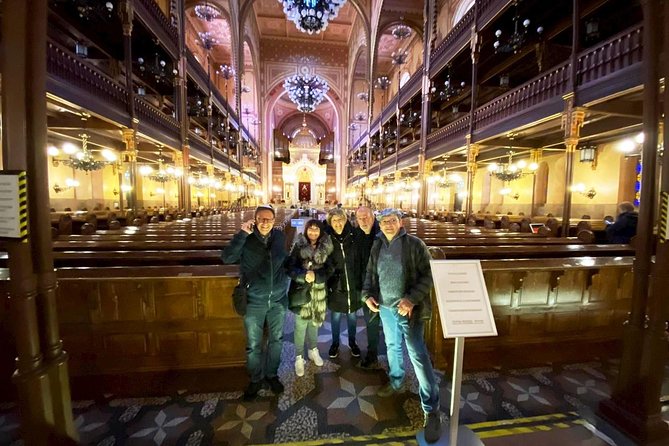
The experience depends heavily on the person leading it. Guides named in feedback include Orsolya, Veronika, Agi, and Endre, and each was credited with bringing clarity and warmth to difficult material.
Orsolya was especially valued for connecting Jewish history with the wider history of Hungary. She also added food context, including recommendations for flódni. That is a useful touch because Jewish Budapest is not only about synagogues and wartime memory. Food, family traditions, and neighborhood life also help you understand how communities shaped the city.
Agi was praised for explaining the three synagogues and the Jewish community from past to present. Endre was noted for taking visitors to several informative spots around the Jewish Quarter and for being attentive during the walk. Veronika was credited with presenting the tragic history of Hungarian Jewry with care, even though she was not Jewish.
You should not assume that one specific guide is guaranteed unless the operator confirms it. Still, the range of guide backgrounds suggests that the tour’s strength is its human interpretation. Ask questions. If you want architectural detail, say so. If you want more focus on wartime history, make that clear early in the walk.
What $126.16 buys you
At $126.16 per person, this is not a cheap orientation walk. The price reflects a private-feeling small group, a three-hour guide-led experience, and specialist historical interpretation. It does not cover the admission fees for the Dohány, Rumbach, or Kazinczy synagogues, so your final cost will be higher.
The value depends on how you like to travel. If you would otherwise visit the Jewish Quarter alone, you could see the outside of many buildings for little or no cost. You would miss the explanations about the different Jewish communities, the ghetto memorial, the mikve, and the connections between the sites.
For a family or small group that wants to ask questions, the format can be worth the extra money. The tour is advertised as limited to six people, while another detail gives a maximum of eight. Either way, it is far smaller than a standard city group, though you should confirm the actual size at booking.
The price makes less sense if you only want a quick photo stop at the synagogues. It also may not suit a strict budget if you have already paid for separate museum and synagogue visits. I see it as a specialist introduction for visitors who want a clear historical framework on their first day or two in Budapest.
Timing, clothing, and practical details
You can choose a morning or afternoon departure, although the supplied booking details specify a 10:00 a.m. start. A morning walk leaves your afternoon free for more sightseeing, while an afternoon option may work better if you prefer a slower start.
The tour lasts approximately three hours. The listed stop times add up to less than the full duration, which allows for walking between sites, explanations outdoors, and transitions through the neighborhood. Wear comfortable shoes and carry water, since this is a walking experience rather than a seated lecture.
Food and drinks are not included. The café is only the meeting point, so do not assume breakfast, lunch, or a tasting is part of the tour. Food may enter the conversation through local recommendations, and flódni is one specific example mentioned by a guide, but you should budget for your own meal.
The tour is offered in English and includes a mobile ticket. Confirmation arrives at booking. Most people can participate, and the route is near public transportation.
Free cancellation is available until 24 hours before the start time for a full refund. Changes or cancellations made within 24 hours are not accepted for a refund, with cut-off times based on Budapest local time.
Who should book this Budapest walk?
I would choose this tour if you want Jewish Budapest explained by someone who can connect architecture, religion, local life, and the Holocaust. It is also a good fit if you prefer a short, focused experience rather than a full-day history program.
Families can benefit from the small group because children can ask questions without speaking to a crowd. Adults with a personal or family connection to Jewish history may also appreciate the careful final stop at the Danube.
You should think twice if you want lots of free time inside each synagogue. The route moves through four main stops in three hours, and interior access depends on whether the buildings are open. You should also consider the extra ticket fees and the fact that the tour ends away from its starting point.
Should you book it?
Book this walk if you want serious historical context, a small group, and a guide who can explain why Budapest’s Jewish Quarter contains several distinct religious traditions. The combination of Dohány, Kazinczy, and Rumbach gives you a strong overview, while the Ghetto Wall Memorial and Shoes on the Danube Bank keep the story grounded in real places.
Skip it if you only want an inexpensive stroll or if you have already paid to visit all three synagogues and prefer to explore independently. For most visitors with a genuine interest in Budapest’s Jewish heritage, the guide’s interpretation is the reason to spend more. Just dress appropriately, confirm which synagogue interiors will be open, and set aside additional money for admission.
FAQ
How long does the walking tour last?
The tour lasts approximately three hours.
Where does the tour begin?
It begins at Kamara Café on Dohány Street, directly opposite the Great Synagogue, at Dohány u. 1b in Budapest.
Where does the tour end?
The tour ends at the Shoes on the Danube Bank memorial in central Budapest.
What time does the tour start?
The listed start time is 10:00 a.m. Morning and afternoon departures are offered.
Which synagogues are included?
The route includes the Dohány Street Synagogue, Kazinczy Street Synagogue, and Rumbach Street Synagogue. Interior visits take place when the synagogues are open to the public.
Are synagogue entrance tickets included?
No. Admission to the Dohány, Rumbach, and Kazinczy synagogues is not included in the tour price.
What should I wear?
Visitors to the Dohány and Kazinczy synagogues are asked to cover their shoulders and knees.
Is cancellation free?
Yes. You can cancel at least 24 hours before the experience start time for a full refund. Cancellations or changes made less than 24 hours before the start time are not refunded.
Just added around Budapest
- From Budapest: Guided Tour of Eger with Wine Tasting★ 4.5 · 6 reviews
- Budapest: Private Walking Tour with a Local Guide★ 3.6 · 6 reviews
- Budapest: Danube River Views Bike Ride★ 4.8 · 23 reviews
- Trash Art Museum: Hungary’s First Scrap Metal Exhibition★ 4.3 · 72 reviews
- Walk to recent and aged spiritual sanctuaries near Budapest★ 5.0 · 5 reviews
- Budapest: 3-Hour Trabant Sightseeing Tour★ 4.7 · 28 reviews
- True Crime Walking Tour in the Buda Castle district★ 5.0 · 26 reviews
- Audio visual multi-sensory chefs journey dinner experience★ 5.0 · 3 reviews
Jewish Heritage Tours, compared.
Budapest Jewish Heritage Memorial Walking Tour & Synagogue Entry
Read our review →
Jewish Heritage Guided Tour with Synagogue Ticket
Read our review →
Past and Present of Budapest Jewish District Tour
Read our review →
Budapest Dohany Synagogue & Hungarian Jewish Museum & free extras
Read our review →
Jewish History Guided Walking Tour with Historian
Read our review →Browse the lists this tour appears in