
Reviewed · WALKING TOURS
Downtown Pest Walking Tour
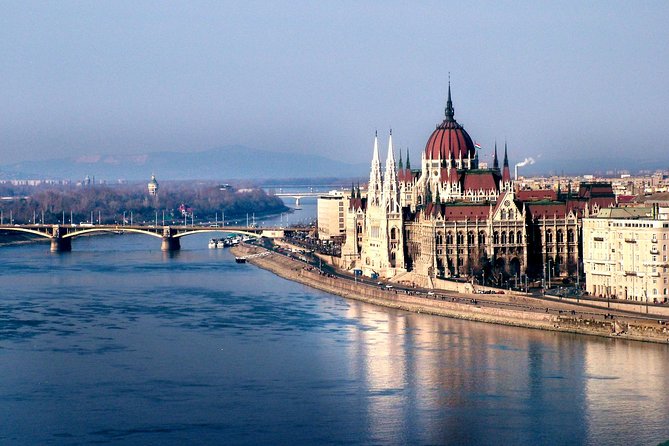
Budapest’s east-bank district comes into focus on this three-hour historian-led walk through Pest, where grand buildings reveal how Hungary built a modern national capital in the late 19th century. You begin at Parliament, pass the Danube Holocaust Monument, and finish at Heroes Square after following the city’s political, financial, religious, and artistic story.
I like the route’s clear sense of place, especially the contrast between the huge Stock Exchange Palace, quiet memorials, Art Nouveau details, and the noble scale of Andrassy Boulevard. I also like that guides such as András and Zsofia are praised for patient explanations, strong storytelling, and a willingness to answer questions.
The main consideration is the price: at $123 per person, this is not a bargain-priced orientation walk. You are paying for a private or small-group format and a historian rather than simply following a standard sightseeing route, so the value depends on how much historical context you want.
In This Review
- Key points at a glance
- Starting beside Parliament at Kossuth Square
- The Danube Holocaust Monument and the weight of the route
- Freedom Square and the money that built Pest
- St. Stephen’s Basilica and Budapest’s Art Nouveau details
- Andrassy Boulevard and the city’s grand ambition
- Finishing at Heroes Square in 1896
- What the historian guide adds
- Is $123 per person a fair price?
- Who will get the most from this walk?
- My verdict on the Downtown Pest Walking Tour
- FAQ
- Where does the Downtown Pest Walking Tour begin?
- How long does the walking tour last?
- What language is the tour offered in?
- Is the tour private or shared?
- What places are included on the route?
- Does the tour include admission to Parliament or other buildings?
- Can I cancel the booking?
Key points at a glance
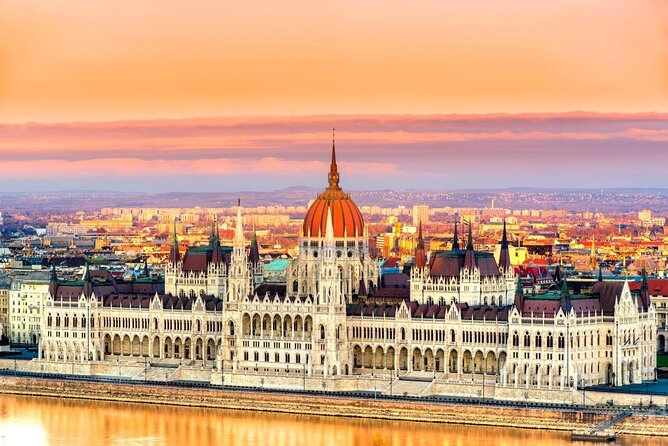
- Parliament begins the story: Start at Kossuth Square beside Hungary’s immense national legislature, opened for the millennium celebrations in 1896.
- Freedom Square shows financial Pest: See the Stock Exchange Palace, bank buildings, and the statue of Cardinal Mindszenty.
- The route links beauty with difficult memory: Visit the Danube Holocaust Monument and learn about Budapest’s murdered Jewish citizens.
- Art Nouveau appears in context: See Budapest’s decorative architecture while walking toward St. Stephen’s Basilica and the Great Synagogue.
- Andrassy Boulevard connects the city’s grand ideas: Follow the avenue designed for Hungary’s nobility, with a stop at the Opera House.
- Heroes Square is the fitting finish: End where Hungarians marked 1,000 years of their kingdom in 1896.
Starting beside Parliament at Kossuth Square
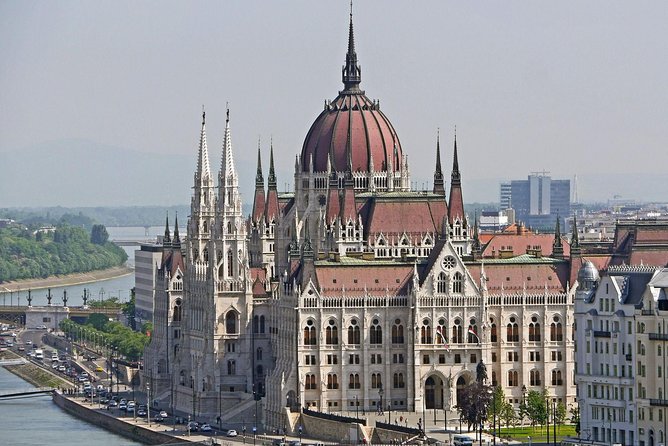
Meet your guide at Szamos Cafe, Budapest Kossuth Lajos tér 10, in front of Parliament. This is a strong starting point because the building immediately gives you the scale and ambition of late 19th-century Budapest.
When Parliament was inaugurated in 1896, it was the largest and most costly structure ever built in Hungary. From outside, its size is the first lesson. The building was meant to express the power of a newborn nation, and the setting around Kossuth Square reinforces that political message.
Your guide begins with the surrounding buildings and monuments, not just Parliament itself. Inside Parliament are works by nearly every major Hungarian painter and sculptor of the era, but this walking tour is built around the exterior setting and the larger story of Pest. If you want an interior visit, confirm that separately, since an entrance to Parliament is not listed as part of this walk.
I like this opening because it gives you a useful framework for the rest of the morning or afternoon. The grand avenues, banks, churches, and public squares ahead are easier to understand once you see them as pieces of a national capital created during a period of confidence and expansion.
A few more Budapest trips to weigh up
- Budapest: Buda Castle Walk with Saint Stephen’s Hall
★ 4.5 · 3,012 reviews - Big Bus Budapest Hop-On Hop-Off Bus and Walking Tour
★ 3.5 · 2,206 reviews - Budapest: Buda Castle District Walking Tour
★ 4.6 · 2,108 reviews
The Danube Holocaust Monument and the weight of the route
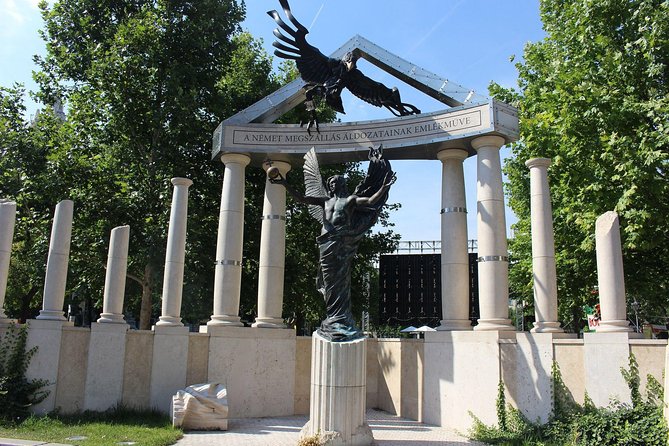
Behind Parliament, the walk reaches the Holocaust Monument on the bank of the Danube. This is one of the most serious stops, and your guide explains that it honors the many thousands of Jewish citizens of Budapest who were killed at this spot during the final months of World War II.
The location matters. You are not being asked to view a memorial in isolation, then move on to the next pretty building. The monument sits within the political heart of Budapest, close to Parliament and the institutions that shaped the country. That placement gives the stop a direct connection to the city’s civic story.
This part of the tour may slow the pace. That is appropriate, but it also means the experience is not simply an architecture walk. You should choose it if you want Budapest’s difficult 20th-century history included alongside its grand 19th-century buildings.
A historian guide can be especially useful here. The tour information promises an English-language guide, and András is described as objective, patient, and willing to answer questions. Those qualities matter at a memorial, where a careful explanation is more useful than a rushed list of dates.
Freedom Square and the money that built Pest
Freedom Square is the next major stop. It was created as the financial center of the city and is often considered Budapest’s most beautiful square. The important point is not only that the square looks impressive. It shows how money, politics, and architecture worked together as Pest grew into the center of the Hungarian nation.
The Stock Exchange Palace is the visual heavyweight here. You also see opulent bank buildings that still serve financial functions. Their grand facades tell you that banks once wanted to look permanent, powerful, and almost palace-like.
This is one of the places where a guide adds real value. Without context, you may notice a large building and take a photograph. With historical explanation, you can read the square as a statement about a rising capital and its wealthy bourgeois class.
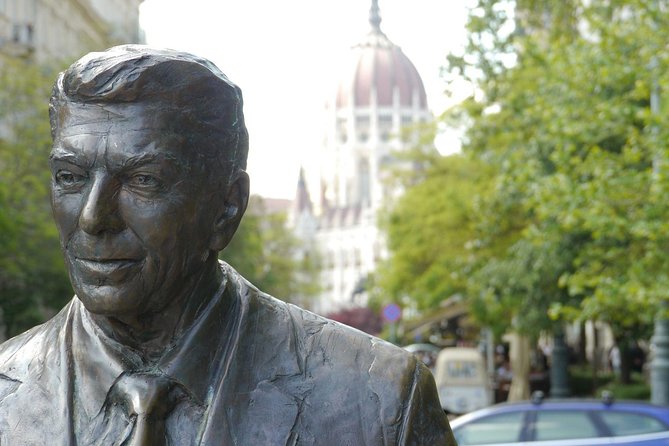
Freedom Square also includes a statue of Cardinal Mindszenty, head of the Catholic Church in Hungary. He lived hidden for 15 years in the United States embassy while avoiding the communist authorities. That detail shifts the focus from 19th-century prosperity to the political struggles that followed.
I like the way this stop broadens the route. You see finance, religion, and political pressure in one compact area. The drawback is that the square contains a lot to absorb, so you may want to keep questions focused if you hope to maintain the planned three-hour pace.
St. Stephen’s Basilica and Budapest’s Art Nouveau details
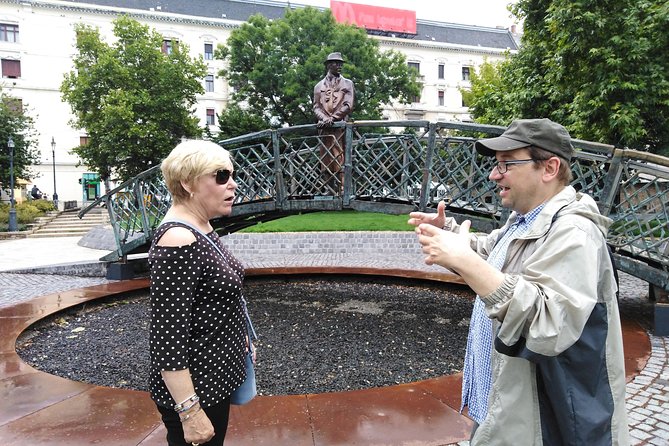
From Freedom Square, the walk continues toward St. Stephen’s Basilica. Along the way, your guide points out the Art Nouveau buildings that give Budapest its particular visual character.
This is a good part of the route for slowing down and looking up. Art Nouveau is easy to miss when you are walking with a destination in mind. Decorative facades, unusual lines, and carefully designed entrances can appear between the larger landmarks, and a local historian helps you notice why these buildings matter.
St. Stephen’s Basilica brings the religious story into view. The route does not list an interior visit, so you should expect to admire and discuss the basilica as part of the city walk rather than assume you will tour every building inside.
The walk then reaches Budapest’s second-largest synagogue. It represents the important role of the city’s Jewish population and wealthy bourgeois class in developing Budapest. This is one of the strongest connections in the itinerary, because the synagogue is not treated only as a religious site. It is also part of the story of commerce, urban growth, and civic life.
If you are interested in architecture, this stretch may be a highlight. If you prefer a tour built around entering major attractions, note that the listed experience focuses on a guided walk and exterior encounters. The value comes from the explanation and sequence of places rather than from included admission tickets.
Same riverbank, a completely different kind of day:
- Budapest: Unlimited Prosecco, Beer and Aperol Spritz Cruise
★ 4.8 · 25,310 reviews - Budapest: Széchenyi Spa Day Ticket with Optional Upgrades
★ 4.3 · 23,911 reviews - Budapest: Nighttime or Daytime Sightseeing Cruise
★ 4.2 · 21,062 reviews - Budapest: 1-Hour Evening Sightseeing Cruise with Drink
★ 4.5 · 8,330 reviews
Andrassy Boulevard and the city’s grand ambition
The route continues along and under Andrassy Boulevard, an esplanade designed for Hungarian nobility. Even the wording of the route tells you that this is more than an ordinary street. It was planned as a formal urban axis, giving Budapest a setting for status, ceremony, and elegant movement.
You see more of the architecture for which the city is famous, then make a short stop at the Opera House. The stop is brief, so you should not expect a full performance or extended interior visit. Instead, it works as a marker of the cultural ambitions behind the boulevard.
This is where the tour’s structure becomes clear. Parliament represents national government. Freedom Square represents finance and power. The basilica and synagogue represent religious and civic communities. Andrassy Boulevard and the Opera House bring in aristocratic taste and public culture.
I like this progression because it prevents the walk from becoming a disconnected list of Budapest sights. Each place answers part of the same question: how did Pest become a capital worthy of a modern European nation?
The route is three hours long, so comfortable shoes are a sensible choice. The experience is a walking tour through central Pest, not a bus ride with brief photo stops. The exact starting time depends on availability, and the tour is offered in English.
Finishing at Heroes Square in 1896
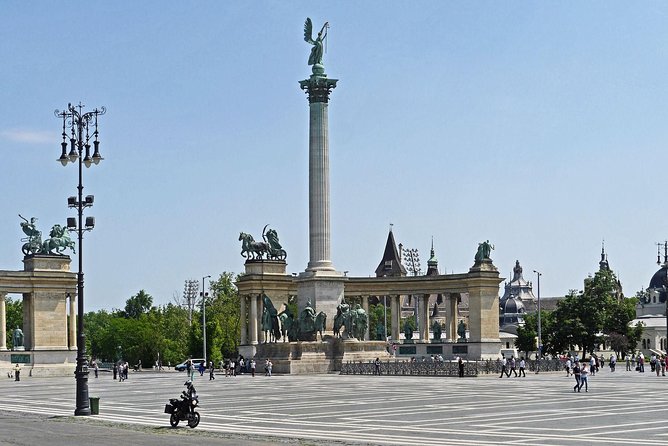
The final stop is Heroes Square, where Hungarians celebrated the 1,000-year anniversary of the founding of their kingdom in 1896. This ending echoes the opening at Parliament, which was also tied to the millennium celebrations.
Heroes Square gives the tour a broad visual finish. After several stops focused on individual buildings and institutions, you arrive at a space designed for national memory and public ceremony. It helps tie together the political and architectural program you have been following since Kossuth Square.
Ending here also gives you a clear sense of distance. You have crossed a large section of central Pest on foot, moving from the Danube and Parliament through financial and religious districts before reaching Andrassy Boulevard and the square.
The tour ends at Heroes Square rather than returning you to the cafe. That is useful if you plan to continue exploring this part of Budapest, though you should account for the fact that your walk back to your hotel or another central sight is not included in the tour.
What the historian guide adds
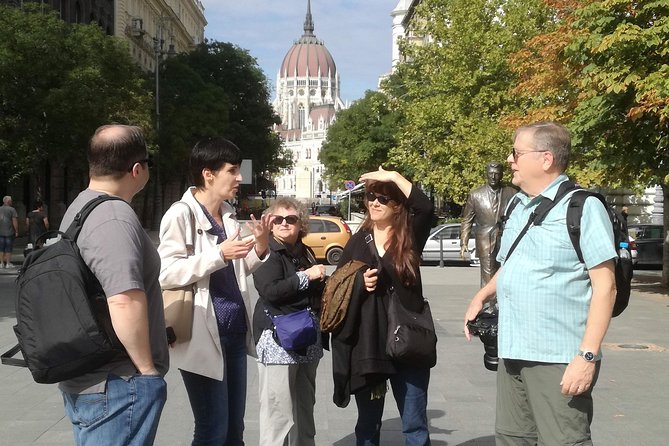
The guide is the heart of this experience. The advertised language is English, and private or small-group formats are available. A smaller group can make it easier to ask questions, hear explanations, and adjust the discussion to your interests.
The named guides associated with the experience include András and Zsofia. András is described as good-humored, patient, proud of Hungary, and exceptionally strong in English. Zsofia is praised for her storytelling and command of the subject.
Those details give you a practical sense of the tone to expect. This is not presented as a fast march from one landmark to another. The guide takes time to explain buildings and people, and the three hours can pass quickly when the conversation is engaging.
That also explains why the tour may suit you better than an audio guide. You can ask about a statue, a building, or a historical figure as the question occurs to you. If your main goal is to cover as many sights as possible without stopping for context, a self-guided route may cost less and give you more control.
Is $123 per person a fair price?
The listed price is $123 per person. That is a substantial amount for a three-hour walk, especially since entry fees are not listed among the inclusions.
The price makes more sense if you choose a private or small-group option and care about the quality of the guide. You are paying for a historian-led route that links major landmarks with the political, financial, religious, and cultural growth of Pest. For a first visit, that kind of structure can save you from seeing the city as a collection of impressive but unrelated facades.
The price is harder to justify if you mainly want photographs of Parliament, the basilica, the synagogue, and Heroes Square. You can see many of the exteriors independently. The real purchase is interpretation, pacing, and the chance to ask questions.
I would compare the cost with the size of your group. A private experience shared by two or several people may feel more worthwhile than a solo booking. The activity also allows you to reserve now and pay later, with free cancellation up to 24 hours in advance for a full refund. Those terms help if your Budapest schedule is still shifting, but they do not change the basic question of value: are you looking for a historian’s explanation or simply a route map?
Who will get the most from this walk?
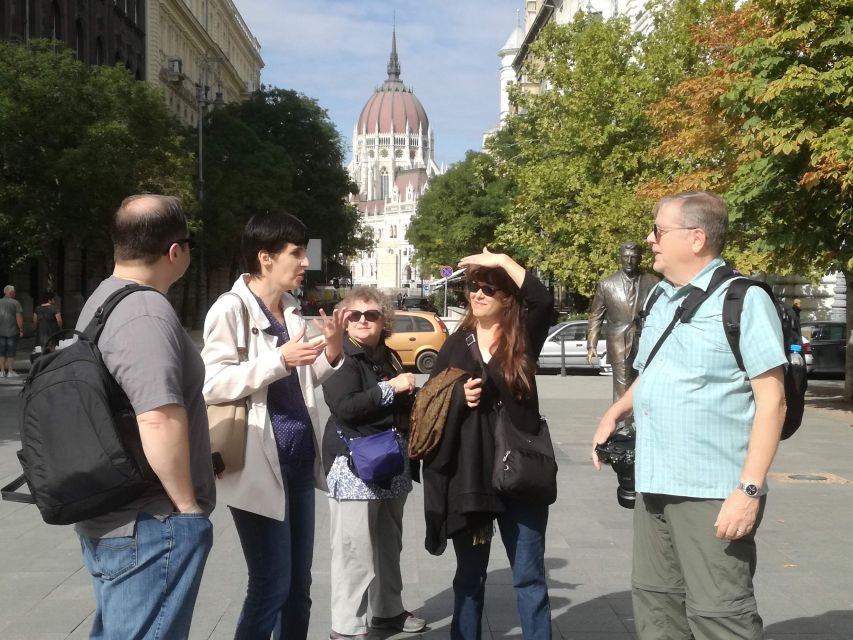
I would recommend this tour to you if you want a strong first look at central Pest and enjoy understanding why buildings were created, not just photographing them. It is especially useful for visitors interested in Hungarian nation-building, Budapest architecture, Jewish history, Catholic history, finance, and the communist period.
It also suits people who prefer a measured walking pace. The guide is expected to explain and answer questions rather than rush through every stop. András’s patient approach and Zsofia’s storytelling style suggest that the human side of the tour is a major part of its appeal.
You may want another option if your mobility limits a three-hour city walk, though specific accessibility details are not provided. You should also look elsewhere if you need included entry to Parliament, the Opera House, or the synagogue, since the listed inclusions cover the guided walk and historian guide only.
The route is a good choice early in a Budapest visit because it gives you a map of the city’s eastern bank and helps you decide which buildings deserve a later, longer visit. It can also work near the end of your stay, when you already know the sights and want their political and cultural connections explained.
My verdict on the Downtown Pest Walking Tour
Book it if the guide matters as much as the sights. The route covers major Budapest landmarks, but its real strength is the connection between them: Parliament and national identity, Freedom Square and finance, the Holocaust Monument and memory, the synagogue and Jewish civic life, Andrassy Boulevard and aristocratic design, and Heroes Square and the millennium celebration.
At $123, I would not call it the economical way to see Pest. I would call it a focused, guide-centered experience for someone who wants a thoughtful explanation and the chance to ask questions. If you choose it, confirm the group format and starting time, wear comfortable shoes, and arrive ready to look above street level.
FAQ
Where does the Downtown Pest Walking Tour begin?
The meeting point is Szamos Cafe at Budapest Kossuth Lajos tér 10, in front of Parliament.
How long does the walking tour last?
The tour lasts three hours.
What language is the tour offered in?
The tour is offered in English with a live guide.
Is the tour private or shared?
Private and small-group options are available.
What places are included on the route?
The walk includes Parliament and Kossuth Square, the Danube Holocaust Monument, Freedom Square, the Stock Exchange Palace, Cardinal Mindszenty’s statue, St. Stephen’s Basilica, the second-largest synagogue in the world, Art Nouveau buildings, Andrassy Boulevard, the Opera House, and Heroes Square.
Does the tour include admission to Parliament or other buildings?
The listed inclusions cover a three-hour guided walk and a historian guide. Admission to Parliament, the Opera House, or other buildings is not listed as included.
Can I cancel the booking?
You can cancel up to 24 hours in advance for a full refund. You can also reserve now and pay later.
Just added around Budapest
- From Budapest: Guided Tour of Eger with Wine Tasting★ 4.5 · 6 reviews
- Budapest: Private Walking Tour with a Local Guide★ 3.6 · 6 reviews
- Budapest: Danube River Views Bike Ride★ 4.8 · 23 reviews
- Trash Art Museum: Hungary’s First Scrap Metal Exhibition★ 4.3 · 72 reviews
- Walk to recent and aged spiritual sanctuaries near Budapest★ 5.0 · 5 reviews
- Budapest: 3-Hour Trabant Sightseeing Tour★ 4.7 · 28 reviews
- True Crime Walking Tour in the Buda Castle district★ 5.0 · 26 reviews
- Audio visual multi-sensory chefs journey dinner experience★ 5.0 · 3 reviews
Walking Tours, compared.
Budapest City Landmarks Walking Tour in 2 Hours
Read our review →
3-Hour Orientation Walking Tour of Buda and Pest
Read our review →
Budapest Historical Sightseeing – Free Walking Tour
Read our review →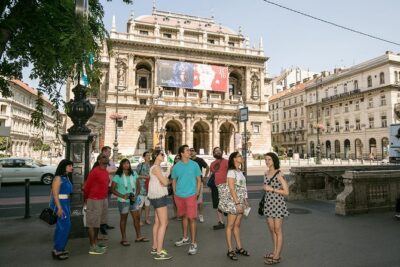
Budapest All in One Small Group Walking Tour with Strudel Stop
Read our review →
Buda Castle District Walking Tour with a Historian
Read our review →Browse the lists this tour appears in