Reviewed · TOURS
Café Wandering: An Excursion through Budapest’s Belle Epoque
Budapest’s grand cafés were more than places to drink coffee. They were offices, salons, newsrooms, lecture halls, and meeting places for the city’s writers and artists. This three-hour walk lets you see that world through Belle Epoque architecture and the cafés that helped shape it.
I like the small group, limited to eight people, and the fact that your guide is an art historian rather than a general sightseeing escort. I also like the range of interiors, from Gerbeaud’s polished Imperial-era style to the lavish New York Palace Café. The main consideration is price: at $123 per person, you are paying for specialist guiding, not a coffee-and-cake package, since refreshments are extra.
In This Review
- Key details to know before you book
- Why Budapest’s cafés matter
- Gerbeaud Café and the Imperial Budapest welcome
- Central Café, where coffee culture became a way of life
- Café Astoria and the look of a classic European coffee house
- Urania and the intellectual life of Rákóczi Street
- Művész Coffee House and the artist’s café tradition
- New York Palace Café and decorative excess
- The Kazinczy Street Synagogue and art nouveau detail
- What the $123 price really covers
- Who will enjoy this walk most
- Practical advice for getting the most from the tour
- Should you book Café Wandering?
- FAQ
- How long does Café Wandering last?
- Where does the tour meet?
- What language is the tour conducted in?
- How many people are in the group?
- Is an art historian included?
- Are coffee, cakes, and other refreshments included?
- Which cafés are included?
- Does the tour include the Kazinczy Street Synagogue?
- Can I cancel for a full refund?
Key details to know before you book
- Gerbeaud begins the story: Start at Vörösmarty Square and enter one of Budapest’s oldest and most famous café settings.
- Architecture is the main subject: Look for Asian motifs, decorative walls, grand interiors, and the visual language of late 19th and early 20th century design.
- The group stays small: With no more than eight participants, you should have a better chance to ask questions and hear the guide.
- Several famous cafés are included: The route features Central Café, Astoria, Művész, and New York Palace, along with other architectural sights described for the walk.
- The guide shapes the experience: Guides may be professors, doctoral students, historians, journalists, art critics, or published authors.
- Budget for your own café orders: Coffee, cakes, drinks, and meals are not included in the $123 price.
Why Budapest’s cafés matter
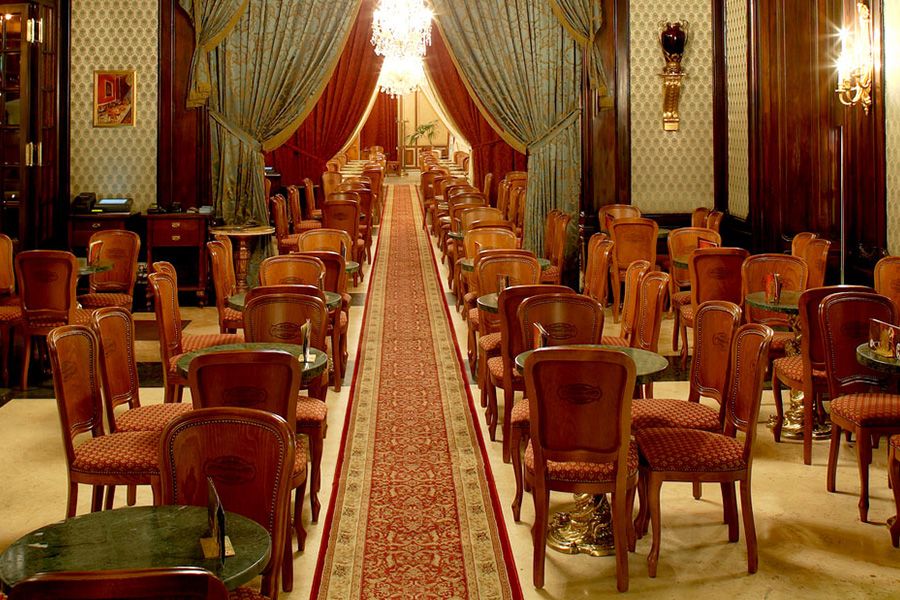
To understand this walk, it helps to forget the modern idea of a café as a quick stop for caffeine. In Budapest’s late 19th century, a café could function as a workplace and social club. Writers could spend hours at a table, artists could meet colleagues, and intellectuals could address large audiences.
That setting grew during the Habsburg period, when Budapest gained economic confidence and cultural ambition. The interiors were part of the message. Marble, mirrors, carved details, theatrical lighting, painted walls, and carefully chosen furniture told customers that they had entered a serious public room, even if they had come only for a pastry.
Your guide’s job is to connect those decorative choices with the people who used these places. That is where the walk earns its keep. You are not simply moving from one pretty room to the next. You are learning how café life worked and why these rooms became important to Hungarian cultural life.
The tour is conducted in English and lasts three hours. That gives you enough time for context without turning the outing into an all-day architectural course. Still, the schedule is fairly full, so do not expect a long sit-down meal at every stop.
Other Budapest days people book alongside this one:
- Budapest: Unlimited Prosecco, Beer and Aperol Spritz Cruise
★ 4.8 · 25,310 reviews - Budapest: Széchenyi Spa Day Ticket with Optional Upgrades
★ 4.3 · 23,911 reviews - Budapest: Nighttime or Daytime Sightseeing Cruise
★ 4.2 · 21,062 reviews
Gerbeaud Café and the Imperial Budapest welcome
The meeting point is Café Gerbeaud at Vörösmarty tér 7 to 8. This central square is a useful place to begin because the café immediately sets the tone for the tour.
Gerbeaud has more than a century of history and is presented as a key social hub of Imperial Budapest. Inside, you can expect an ornate setting that reflects the city’s desire to match the grand café culture of other European capitals. The appeal is not only the age of the café. It is the sense that this was a public stage where visitors and residents came to see and be seen.
Pay attention to the relationship between the room’s decoration and its purpose. A lavish interior was not wasted decoration. It helped turn an ordinary coffee break into a social occasion.
You can order a coffee, cake, or another refreshment here, but the cost is separate. If you enjoy classic café rituals, Gerbeaud may be the place where you choose to spend a little extra. If you are mainly interested in architecture, you can focus on the guide’s explanation and save your café budget for later.
Central Café, where coffee culture became a way of life
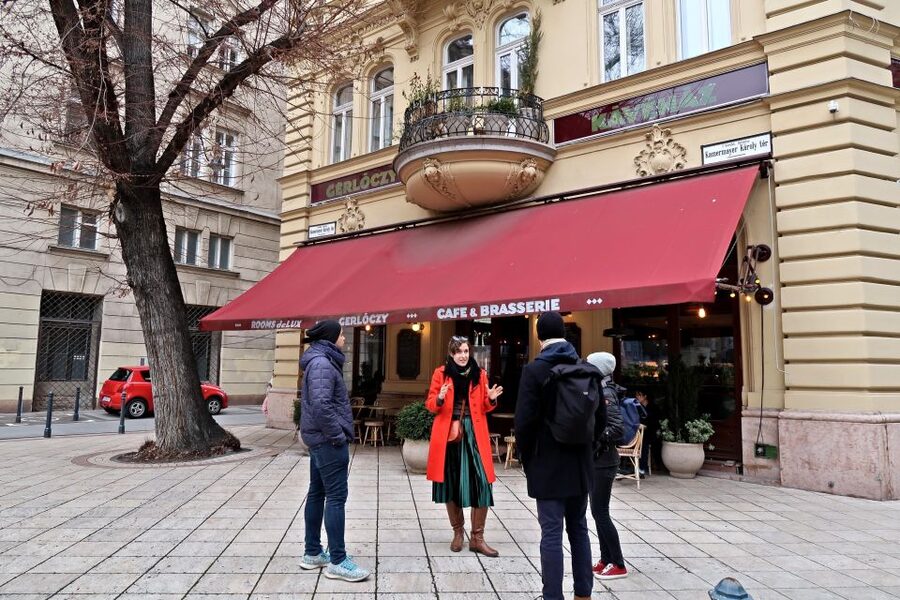
From Gerbeaud, the group takes a tram along the Danube toward Central Café. That short ride gives the walk a welcome change of pace and lets you connect the café interiors with Budapest’s wider city center.
Central Café and Restaurant 1887 is described as a particularly dignified example of café culture during the Habsburg Empire’s period of economic and cultural strength. The name itself points to its 19th century roots, and the room is treated as more than a restaurant stop.
Here, the details work together: the décor, meals, desserts, and drinks all help create a picture of a bygone public culture. You will hear how cafés could serve as meeting places for people involved in literature, journalism, art, and public debate.
This is also a good stop for understanding why food and drink matter on an architecture tour. A café interior does not exist apart from its menu or its service. The full setting was designed to encourage people to stay, talk, read, write, and return.
If you buy something here, remember that refreshments are not included. The tour can explain the role of the food and drink, but your own order is your responsibility.
Café Astoria and the look of a classic European coffee house
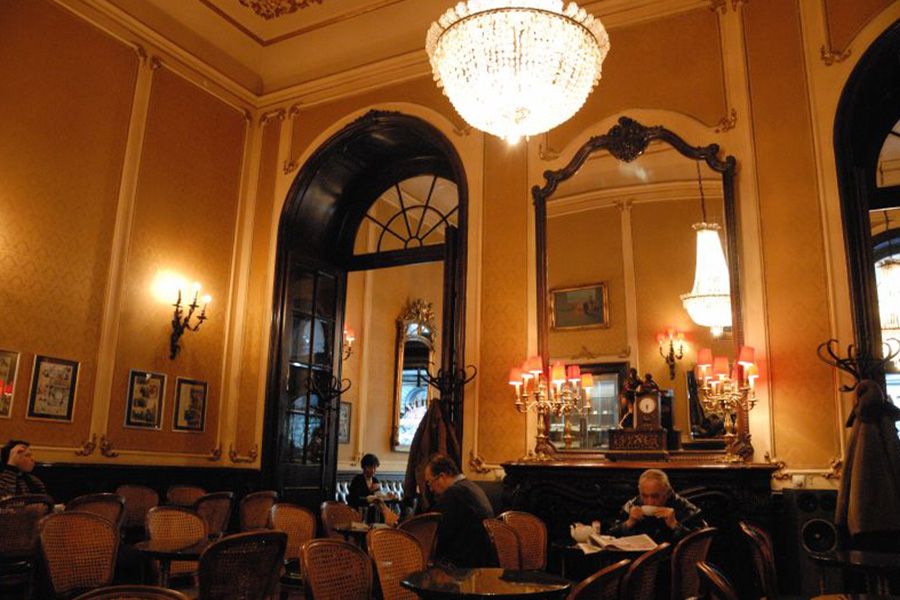
The next major stop is Café Astoria. Its more than century-old interior evokes the grandeur associated with classic European coffee houses.
Astoria is useful as a comparison point. Gerbeaud introduces you to Imperial-era elegance, while Central shows the café as a dignified cultural institution. Astoria adds another version of the grand coffee house, with an atmosphere shaped by age, scale, and decorative ambition.
This part of the walk should appeal to anyone who likes to compare interiors rather than view each building in isolation. Ask yourself which spaces feel formal, which feel theatrical, and which seem designed for long conversations. The guide can help you read those differences.
The drawback is that a three-hour tour cannot give every café equal attention. You will see several important locations, but you should not expect a long lecture on every chair, ceiling, or wall panel. The benefit is a broad look at Budapest’s café tradition without committing half a day to one building.
Same riverbank, a completely different kind of day:
- Budapest: 1-Hour Evening Sightseeing Cruise with Drink
★ 4.5 · 8,330 reviews - Budapest Danube Cruise and Dinner Options, Live Music and Dance
★ 4.5 · 7,428 reviews - Budapest: Historic Cruise with Welcome Drink
★ 4.7 · 6,512 reviews - Budapest: St. Stephen’s Basilica Entry with Terrace Option
★ 4.5 · 6,399 reviews
Urania and the intellectual life of Rákóczi Street
After another short walk, the route reaches Urania Café on Rákóczi Street. The building houses the city’s oldest film theater and is also associated with lectures by prominent intellectuals before large audiences.
That combination makes Urania especially interesting. It links café culture with film, education, and public speaking. Budapest’s café world was not limited to private conversation over coffee. It also helped create spaces where ideas could reach a large audience.
This stop adds variety to the tour. You are no longer looking only at café dining rooms. You are seeing how nearby cultural institutions supported the same network of writers, artists, lecturers, and thinkers.
The available route details also highlight Művész Coffee House, known as the Artist Café, and New York Palace Café. Since several named cafés appear across the route description, ask your guide at the start which locations will receive a full interior visit and which will be discussed from outside. That is a sensible question when a short tour covers so many major sites.
Művész Coffee House and the artist’s café tradition
Művész Coffee House, or Artist Café, fits naturally into a walk focused on writers and artists. Its name points directly to the creative community that made cafés such important places in Budapest.
The value here is less about checking off another grand room and more about seeing the social pattern repeated in a different setting. Café culture gave creative people a place to meet, exchange ideas, and spend time in public without needing a private office or club.
For you, this stop may be most rewarding if you are interested in the working habits behind literature and art. The guide can place the room within the wider story of the city’s intellectual life, rather than treating it as a decorative backdrop.
Do not assume that each café visit means a reserved table or included drink. The tour includes the guided walk and art historian, while coffee, cake, drinks, and meals are extra.
New York Palace Café and decorative excess
The New York Palace Café is the grand finale named for the guided portion of the walk. It is famous for its lavish interior and gives the tour a strong visual finish.
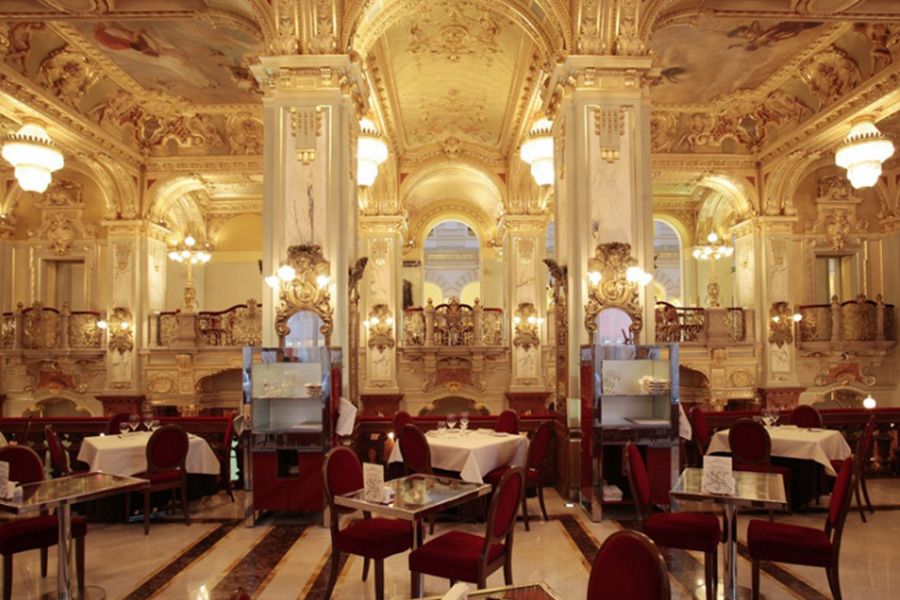
This is the place to look closely at the decorative program. The tour specifically draws attention to Asian motifs and other elements used by designers. Those details matter because Budapest’s Belle Epoque interiors did not rely on one simple national style. Designers borrowed, adapted, and rearranged influences to create rooms that felt fashionable and worldly.
The New York Palace Café can seem almost too ornate if you prefer restrained design. That is also why it works so well on this tour. The room gives you a clear example of how cafés used decoration to create a sense of occasion.
Bring your camera if you like architectural detail, but also give yourself time to listen. A quick photograph will record the ceiling. The guide can explain why the room looks the way it does and what that style meant to the people who entered it.
The Kazinczy Street Synagogue and art nouveau detail
The experience concludes at the art nouveau Orthodox Kazinczy Street Synagogue, one of the most unusual architectural points associated with the walk.
Its inclusion widens the subject beyond café interiors. You get to see how decorative ideas from the same broad period appeared in a religious building. The art nouveau character and Orthodox Jewish setting make this a useful final comparison with the cafés visited earlier.
The synagogue is especially relevant if you enjoy design details that cross cultural and architectural boundaries. The tour’s attention to Asian motifs and decorative elements prepares you to notice how designers used patterns, shapes, and visual references in different kinds of buildings.
The supplied route information names both this synagogue and the café stops listed above. Because the exact order and amount of time at each site are not fully specified, confirm the day’s sequence with your guide when you meet at Gerbeaud.
What the $123 price really covers
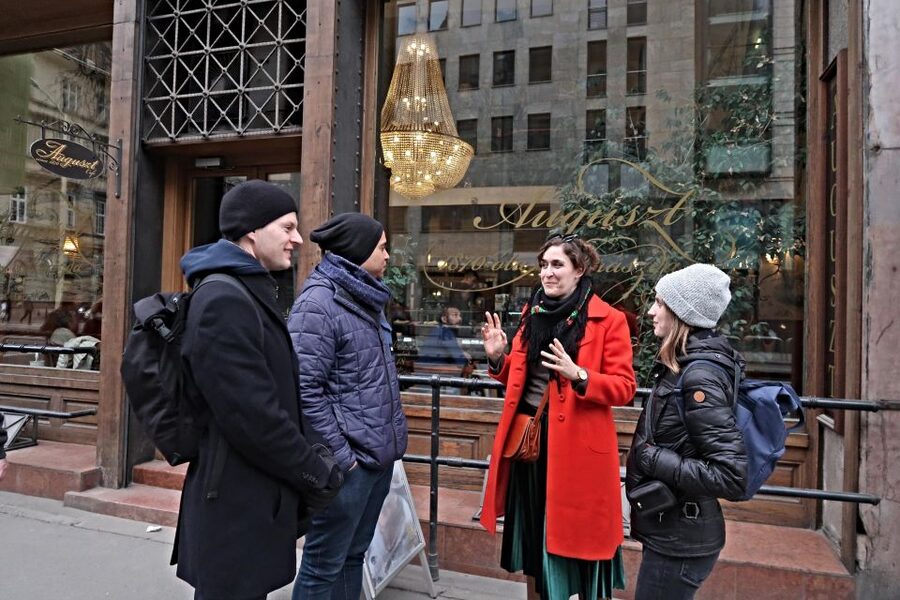
At $123 per person, this is not a bargain-priced orientation walk. The fee includes three hours with an art historian in a group of no more than eight. It does not include the cost of anything you eat or drink.
The price makes more sense if you care about architecture and cultural history and want a specialist to interpret what you are seeing. Guides may be professors, doctoral students, historians, journalists, art critics, or published authors. Kota, one named guide, received particularly strong praise for the quality of the tour, and another booking described the experience as informative.
That small group is important. A group of eight is easier to manage inside cafés, and you should have more room to ask about a design detail or a writer connected with a particular venue. It also makes the $123 fee easier to justify than it would be on a large coach-style outing.
The value is weaker if you mainly want to sample cakes and coffee. Your refreshments are extra, and the tour’s main product is explanation. You are paying for access to an informed guide and a carefully themed walk through Budapest’s architecture.
Who will enjoy this walk most
I would recommend Café Wandering to you if you have already seen Budapest’s main landmarks and now want a more focused look at the city’s cultural life. It also suits architecture fans, readers interested in writers and artists, and anyone who prefers small groups to large city tours.
The walk should work well for first-time visitors who want a strong introduction to central Budapest’s late 19th and early 20th century design. The route combines famous names with a clear theme, so you are less likely to forget what connects the buildings.
You may want to choose another activity if you dislike walking, do not care much about interiors, or want a relaxed café crawl with plenty of time to sit. Three hours and several stops call for attention and steady movement.
The English-only format is helpful for visitors who want detailed discussion in English. Since the guide may have an academic or professional background, you can expect the subject to receive more attention than a quick sightseeing commentary.
Practical advice for getting the most from the tour
Arrive at Café Gerbeaud in Vörösmarty Square with comfortable shoes. The route includes walking between stops and a tram ride along the Danube, so you will not spend the entire three hours seated.
Bring a small budget for coffee, cake, or drinks if you want to enjoy the café culture directly. You do not need to order at every stop, but one purchase can make the atmosphere more immediate.
Keep your questions focused on the things you notice. Ask about the Asian motifs, the writers connected with a café, or the reason a room feels more theatrical than another. A small group is most useful when you take advantage of that access.
The tour allows free cancellation up to 24 hours before departure, and you can reserve now while paying later. Starting times vary, so check availability for the date you want.
Should you book Café Wandering?
Book it if you want expert interpretation of Budapest’s café architecture, not simply a list of famous coffee houses. The strongest reasons are the small group, the specialist guide, and the chance to compare several grand interiors in one focused outing.
The excellent five-star score is based on a small number of bookings, so I would not treat it as the only measure of quality. Still, the specific praise for Kota and the description of the tour as informative fit what this activity promises: a serious, compact walk led by someone who understands art, architecture, and Budapest’s intellectual life.
Skip it if $123 feels high for a walking tour or if you expect refreshments to be included. For the right audience, though, this is a useful way to see the city’s café culture as part of its architecture and public life, rather than as a series of pretty rooms.
FAQ
How long does Café Wandering last?
The guided walk lasts three hours.
Where does the tour meet?
The meeting point is Café Gerbeaud at Budapest Vörösmarty tér 7 to 8, 1051.
What language is the tour conducted in?
The tour is conducted in English with a live English-speaking guide.
How many people are in the group?
The group is limited to eight participants.
Is an art historian included?
Yes. The activity includes a three-hour guided walk led by an art historian.
Are coffee, cakes, and other refreshments included?
No. The cost of refreshments, cakes, coffees, drinks, and meals selected at the cafés is not included.
Which cafés are included?
The named café stops include Gerbeaud, Central Café and Restaurant 1887, Café Astoria, Művész Coffee House, and New York Palace Café. The route description also includes Urania Café.
Does the tour include the Kazinczy Street Synagogue?
The experience concludes at the art nouveau Orthodox Kazinczy Street Synagogue.
Can I cancel for a full refund?
Yes. You can cancel up to 24 hours in advance for a full refund.
Just added around Budapest
- From Budapest: Guided Tour of Eger with Wine Tasting★ 4.5 · 6 reviews
- Budapest: Private Walking Tour with a Local Guide★ 3.6 · 6 reviews
- Budapest: Danube River Views Bike Ride★ 4.8 · 23 reviews
- Trash Art Museum: Hungary’s First Scrap Metal Exhibition★ 4.3 · 72 reviews
- Walk to recent and aged spiritual sanctuaries near Budapest★ 5.0 · 5 reviews
- Budapest: 3-Hour Trabant Sightseeing Tour★ 4.7 · 28 reviews
- True Crime Walking Tour in the Buda Castle district★ 5.0 · 26 reviews
- Audio visual multi-sensory chefs journey dinner experience★ 5.0 · 3 reviews
Tours, compared.

City Sightseeing Hop-On Hop-Off Bus Tour & Extras
Read our review →
Buda Castle District Vampires and Myths Night Tour
Read our review →
Budapest City Landmarks Walking Tour in 2 Hours
Read our review →
3-Hour Orientation Walking Tour of Buda and Pest
Read our review →