
Reviewed · COMMUNISM & MEMENTO PARK TOURS
Lives of Hungarians Under Communist and Capitalist system
Budapest’s Communist past becomes much clearer when it is explained through ordinary life. This walking tour moves beyond dates and political labels to ask practical questions: Could you travel abroad? How did families find housing? What happened to religious practice, education, sport, and the press? Personal memories give the subject a human scale.
I like the route’s useful everyday details, especially the old travel documents and Communist car stories. I also like the way it connects the 1956 uprising to visible bullet holes near Parliament, rather than treating the revolution as a distant textbook event. The main consideration is the payment system: the $4.65 booking fee only holds your place, and the guide depends on your tip, with €10 per person suggested as typical.
In This Review
- Key points to know before you book
- Why everyday life makes this Budapest history tour useful
- Starting beside the Budapest Eye
- Fröccsterasz and the rules of getting around
- St. Stephen’s Basilica and private religious life
- District V: housing, school, health care, and propaganda
- Szabadság tér and Budapest’s contested symbols
- Parliament and the 1956 uprising
- The real price: a small fee plus a meaningful tip
- Who will get the most from this walk
- Practical details for your afternoon
- Should you book Lives of Hungarians Under Communist and Capitalist System?
- FAQ
- How long does the tour last?
- Where does the tour start?
- Where does the tour end?
- What is included in the price?
- Do I need to tip the guide?
- What is the cancellation policy?
Key points to know before you book
- Personal stories from the Communist era: Your guide lived through the period and explains how policies affected family life.
- A practical 90-minute route: The walk goes from the Budapest Eye to Parliament, with six short stops and no admission tickets.
- More than political history: You’ll discuss travel, housing, health care, school, media, religion, sport, and transport.
- A serious look at 1956: The final stop near Parliament covers the uprising, its heroes, and the marks still visible on buildings.
- Small-group format: The maximum group size is 20 people, which should make discussion easier than on a large city walk.
- Budget price with a separate tip: The low upfront cost is an administrative fee, not the guide’s full payment.
Why everyday life makes this Budapest history tour useful
Many Communist-era tours focus on statues, government buildings, and grand political events. This one takes a more domestic route. You hear about the systems that shaped daily decisions, such as where you could live, what you could read, how you might travel, and how your family handled religion.
That focus is especially helpful if you are visiting Budapest with teenagers. A young person may understand the basic idea of Communism from school, but it can remain abstract. A story about travel documents, waiting for a flat, or growing up during the 1956 uprising gives the period a human face.
The tour also covers post-Communist Hungary. That matters because the story does not end when the political system changes. You’ll consider why some Hungarians feel nostalgia for parts of the old system, even while remembering its restrictions. The guide presents this tension rather than forcing a simple good-versus-bad conclusion.
The experience is advertised as about one hour and 30 minutes, and the listed stops add up to that time. One meeting-point description refers to a two-hour itinerary, so allow a little flexibility, but plan on roughly 90 minutes of walking and conversation.
More communism & memento park tours in Budapest:
- Budapest: Communist History Tour with House of Terror Option
★ 4.8 · 182 reviews - Communism in Hungary with a Historian
★ 5.0 · 70 reviews - Budapest: 3-Hour Walking Tour About Communism (Small Group)
★ 4.7 · 70 reviews
Starting beside the Budapest Eye
Meet your licensed guide about 20 meters from the Budapest Eye in Erzsébet tér at 3:30 p.m. This is a central location, close to public transportation and easy to combine with time in central Pest.
The first stop is not just a roll call of dates. You receive an interactive history lesson of about 15 minutes covering Hungarian and Central European Communism. That introduction gives you the basic political setting before the walk turns to personal experience.
This opening is valuable because Hungary’s Communist period was not one unchanging block. The guide’s job is to explain the broad system and then show how its effects shifted over time. You should expect an introductory talk rather than a museum-style presentation, with the chance to ask questions as the route develops.
Since the tour is outdoors, wear comfortable shoes and dress for the weather. There are no admission tickets included or required at the listed stops, so the focus stays on streets, buildings, stories, and discussion.
Fröccsterasz and the rules of getting around
At Fröccsterasz, the subject turns to travel in and out of Hungary. You’ll see basic travel documents and hear about the limits and procedures that shaped foreign trips. This is the kind of detail that helps you understand freedom of movement as a daily concern, not just a constitutional idea.
The stop also covers Communist-era cars and other forms of transport. That may sound like a lighter subject, but it offers a useful picture of supply, status, and practical life. The cars people drove could say something about what was available and how ordinary families moved around.
I like this section because it gives younger members of your group something concrete to picture. An old document or a familiar-looking car can make a political system easier to understand than a string of official terms.
The stop lasts about 10 minutes, so expect a brisk explanation rather than a long vehicle history. If transport and design are major interests for you, this part may feel short. Its purpose is to support the larger story of control, access, and daily routines.
St. Stephen’s Basilica and private religious life
The walk continues to St. Stephen’s Basilica, where the guide discusses the difficulties faced by different denominations during Communism. You’ll also hear how religious life varied from one family to another.
This is an important correction to the idea that everyone experienced the system in exactly the same way. Public policy, family tradition, personal belief, and caution could all affect how openly people practiced religion. The stop gives you room to think about the difference between official pressure and private choices.
The basilica provides a powerful setting for the discussion, but the tour does not include an admission ticket to the church. The scheduled talk lasts about 15 minutes, and the focus is on social experience rather than a detailed examination of the building’s art or architecture.
If you want a traditional basilica sightseeing tour, this is not that. If you want to understand how religion fitted into family life under the system, it adds a side of Budapest history that is easy to miss.
Same riverbank, a completely different kind of day:
- Budapest: Unlimited Prosecco, Beer and Aperol Spritz Cruise
★ 4.8 · 25,310 reviews - Budapest: Széchenyi Spa Day Ticket with Optional Upgrades
★ 4.3 · 23,911 reviews - Budapest: Nighttime or Daytime Sightseeing Cruise
★ 4.2 · 21,062 reviews - Budapest: 1-Hour Evening Sightseeing Cruise with Drink
★ 4.5 · 8,330 reviews
District V: housing, school, health care, and propaganda
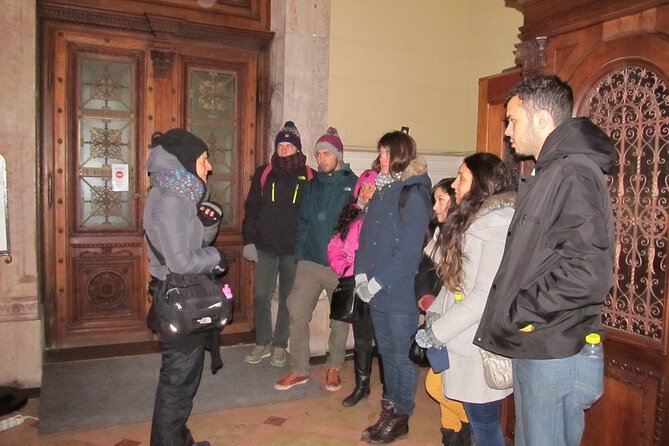
The District V section is the broadest part of the walk, lasting about 20 minutes. Here you discuss housing, health care, education, media culture, propaganda, sport, and the Olympic Games during Communism and after it.
This is likely the most useful stop for understanding why opinions about the past can be complicated. A political system can restrict freedom and still provide memories of stability, access, or predictability for some people. The guide explains why nostalgia exists without asking you to accept it uncritically.
Housing is a particularly practical subject. Where you lived, how much space you had, and how families managed their homes all reveal the reach of government policy. Health care and education show another side of the system, while media and propaganda explain how information was shaped.
Sport and the Olympics add a public, emotional element. Athletic success could become a source of national pride, even when political life was tightly controlled. By placing sport beside schooling, health care, and media, the tour shows how a government could touch nearly every part of life.
This section covers a lot in 20 minutes. You will not receive a full academic treatment of each topic, but you will get a connected overview that can guide further reading or museum visits.
Szabadság tér and Budapest’s contested symbols
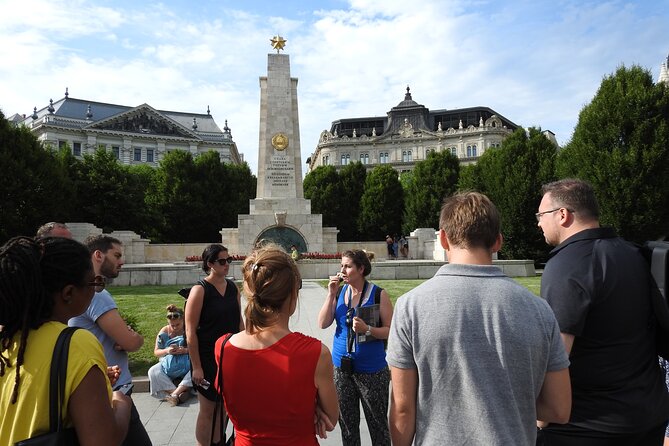
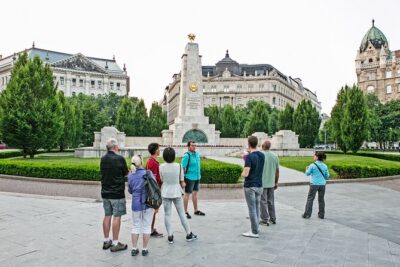
Szabadság tér brings the tour into the city’s modern argument with itself. The guide shows two controversial monuments, urban art, guerrilla statues, and the emergency exit of the F4 military nuclear bunker.
These details help you see that history in Budapest is not sealed behind glass. Monuments can present competing versions of the past, while unofficial art can challenge or mock those messages. The square gives the conversation a physical setting where memory, politics, and public space meet.
You’ll also hear about the second most guarded building in Budapest and the prominent Hungarian person who received shelter there for more than 15 years. The supplied details do not identify the person in advance, so the story works best as something to discover from the guide on site.
The stop lasts about 10 minutes. It is short, but the mix of monuments, bunker access information, and street art makes it one of the more visually varied parts of the route.
Parliament and the 1956 uprising
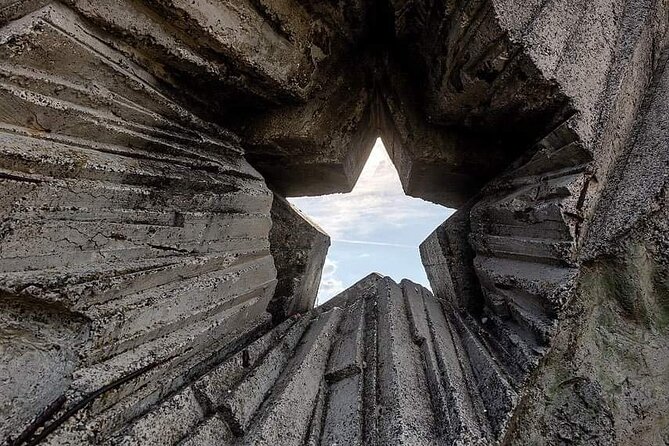
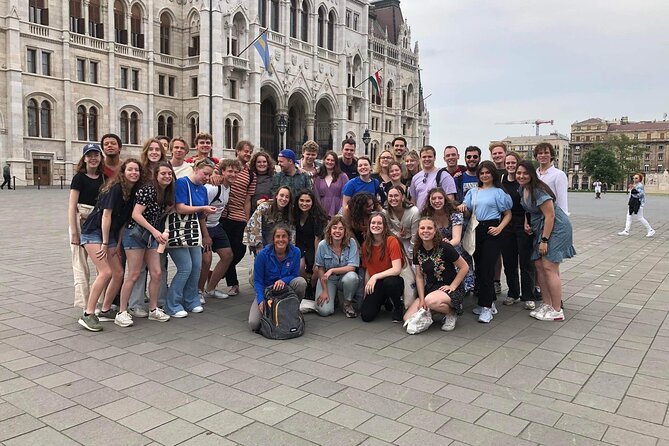
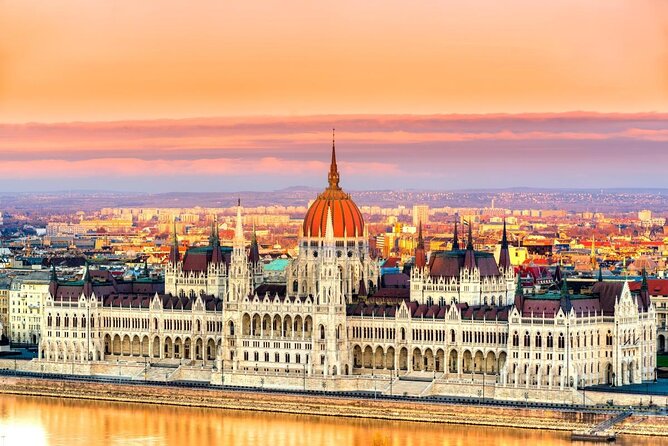
The walk ends at the Hungarian Parliament Building on Kossuth Lajos tér. This final 15-minute stop focuses closely on the 1956 uprising, its heroes, and the experience of people who lived through the revolution and the Communist period as children.
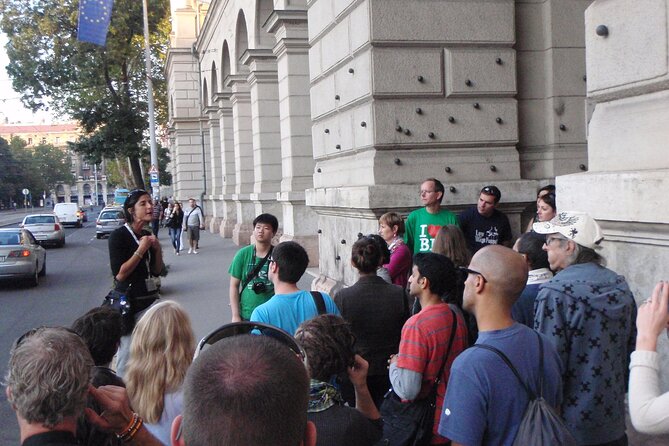
You’ll also see bullet holes on the facades of residential buildings around Parliament. These marks connect the political story to ordinary streets and homes. They remind you that the uprising was not confined to a ceremonial square or a page in a history book.
Ending here gives the route a strong sense of place. You begin with a broad explanation of Communism and finish with a specific moment of resistance, loss, and memory. The guide’s childhood stories are particularly valuable for families, since they show how major events were understood by people who were young at the time.
The tour finishes within 50 meters of the M2 red metro line. That makes it easy to continue sightseeing, return to your accommodation, or connect with another part of Budapest without arranging extra transport.
The real price: a small fee plus a meaningful tip
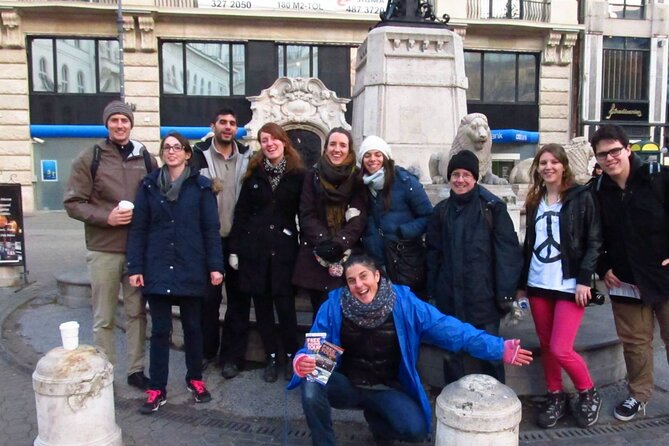
The advertised price is $4.65 per person, but you should not treat that as the complete cost. The booking fee covers administration and marketing and guarantees your place. It does not contribute to the guide’s earnings.
The guide depends entirely on donations at the end. You choose the amount, but €10 per person is described as the usual tip, and some people give more. At that level, the experience is still good value for a 90-minute small-group walk, particularly because it covers subjects that are difficult to grasp from a standard sightseeing route.
The payment arrangement also means you should arrive knowing what to expect. If you prefer a single all-inclusive price with no social pressure around tipping, this format may feel less comfortable. If you like the flexibility of deciding what the guide’s work was worth, the model can be appealing.
A group cap of 20 people helps keep the walk manageable. It is not a private tour, and the size can still affect how easily you ask questions, but it should be more personal than a large city excursion.
Who will get the most from this walk
I would choose this tour if you want modern Hungarian history explained through people and places rather than only through monuments. It suits adults who enjoy social history, families looking for a way to make school lessons real, and anyone curious about why memories of Communism remain mixed.
It is also a good choice early in your Budapest stay. The route gives you background that can sharpen later visits to museums, memorials, and political sites. The central start and Parliament finish make it easy to fit into a day of exploring Pest.
You may want something else if you mainly want interiors, art, or a long architectural tour. The experience is conducted outside, has no listed admissions, and moves at a steady pace between short talks.
The tone should also suit you if you want balance. The guide discusses restriction, propaganda, and the 1956 uprising, but also explains why some people remember certain parts of the system with nostalgia. That approach is more useful than a simple political lecture.
Practical details for your afternoon
The meeting point is at the Budapest Eye, Erzsébet tér, 1051 Budapest. The start time is 3:30 p.m., and the end point is the Parliament Building at Kossuth Lajos tér 1 to 3, 1055 Budapest.
Your mobile ticket is confirmed when you book. Public transportation is nearby, service animals are allowed, and most people can take part. The group maximum is 20.
Free cancellation is available if you cancel at least 24 hours before the start time. Changes or cancellations inside that window are not accepted for a refund.
Wear shoes suitable for a city walk and keep your schedule slightly open because one description gives a two-hour figure even though the timed stops total 90 minutes. Bring questions if you have family connections to the region or want to compare Hungarian Communism with another country’s experience.
Should you book Lives of Hungarians Under Communist and Capitalist System?
Book it if you want a personal, grounded explanation of how Communism affected travel, housing, religion, school, health care, media, sport, and family life. The strongest features are the guide’s lived perspective, the visible 1956 evidence near Parliament, and the route’s attention to ordinary choices.
Think carefully about the tip-based price before booking. The $4.65 fee is only the reservation charge, and you should budget around €10 per person if you plan to follow the usual tipping practice.
For a short, serious, central Budapest walk, I think it offers strong value. You leave with more than a list of political dates: you gain a clearer sense of how systems shape daily life, and why the past can still produce both pain and nostalgia.
FAQ
How long does the tour last?
The experience is listed as approximately one hour and 30 minutes. The timed stops total 90 minutes, although one description refers to a two-hour itinerary, so allow some flexibility.
Where does the tour start?
The tour starts about 20 meters from the Budapest Eye in Erzsébet tér, Budapest 1051, Hungary.
Where does the tour end?
The tour ends at the Hungarian Parliament Building, Kossuth Lajos tér 1 to 3, Budapest 1055. The endpoint is about 50 meters from the M2 red metro line.
What is included in the price?
The $4.65 payment is a booking fee for administration and marketing and guarantees your place. It does not contribute to the guide’s earnings.
Do I need to tip the guide?
Yes, tips are not included, and the guides depend entirely on donations at the end. The usual tip is €10 per person, though the amount is your choice.
What is the cancellation policy?
You can cancel for a full refund up to 24 hours before the experience start time. Cancellations or changes made less than 24 hours in advance are not accepted for a refund.
Just added around Budapest
- From Budapest: Guided Tour of Eger with Wine Tasting★ 4.5 · 6 reviews
- Budapest: Private Walking Tour with a Local Guide★ 3.6 · 6 reviews
- Budapest: Danube River Views Bike Ride★ 4.8 · 23 reviews
- Trash Art Museum: Hungary’s First Scrap Metal Exhibition★ 4.3 · 72 reviews
- Walk to recent and aged spiritual sanctuaries near Budapest★ 5.0 · 5 reviews
- Budapest: 3-Hour Trabant Sightseeing Tour★ 4.7 · 28 reviews
- True Crime Walking Tour in the Buda Castle district★ 5.0 · 26 reviews
- Audio visual multi-sensory chefs journey dinner experience★ 5.0 · 3 reviews
Communism & Memento Park Tours, compared.
Communist History Tour with House of Terror Option
Read our review →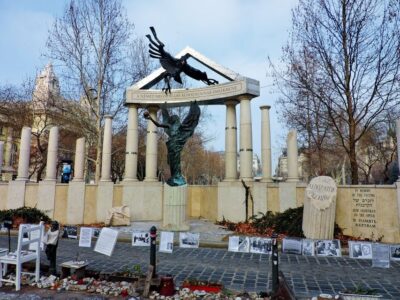
3-Hour Walking Tour About Communism (Small Group)
Read our review →
Private Budapest Hammer & Sickle Communist Times Tour
Read our review →
Browse the lists this tour appears in