
Reviewed · COMMUNISM & MEMENTO PARK TOURS
Born Under The Red Star – Communist tour with Coffee in a Retro Bar
Budapest’s Communist past is easiest to understand when you connect monuments, streets, and political symbols on foot. This three-hour tour does that well, linking Soviet memorials, the 1956 uprising, the House of Terror, Parliament, and a retro bar where history gives way to a classic soda.
I like the small maximum group of 15, which leaves room for questions, and I like the practical guidance, including maps and suggestions for places to visit on your own. The main drawback is that several stops receive only about 15 minutes, and admission to the House of Terror and St. Stephen’s Basilica is not included.
In This Review
- Key points to know before booking
- Why this tour gives Budapest a clearer political map
- Starting at the Hungarian State Opera
- The Soviet Heroic Memorial in a landscaped park
- The House of Terror and the building’s grim double history
- St. Stephen’s Basilica and the contrast between church and state
- Liberty Hill and the meaning of the Freedom Statue
- Liberty Square’s competing memories
- The 1956 Revolution memorial
- Looking toward the Hungarian Parliament Building
- Coffee, tea, and a classic soda in a retro bar
- Is $90.31 fair for three hours?
- Who will get the most from this walk?
- Booking details that matter
- Should you book Born Under The Red Star?
- FAQ
- How long does the Communist tour last?
- Where does the tour begin?
- Where does the tour end?
- What language is the tour offered in?
- What drink is included?
- Are museum and church admission fees included?
- Is food included?
- How large is the group?
- Can I cancel for a full refund?
Key points to know before booking
- A walking lesson in modern Hungarian history: Connects Soviet rule, the 1956 revolution, fascism, and present-day memorial politics.
- The retro bar stop adds local character: A classic soda, coffee, or tea is included in a Communist-themed setting.
- A compact English-language group: The tour lasts about three hours and accepts no more than 15 people.
- Several major sights are viewed from outside: Entry fees for St. Stephen’s Basilica and the House of Terror are not included.
- A useful starting point for further exploring: You receive maps and recommendations for independent sightseeing.
- Good weather matters: The experience can be moved or refunded if poor weather forces cancellation.
Why this tour gives Budapest a clearer political map
Budapest can look like a grand imperial capital until you notice how many streets and monuments tell a different story. Soviet victory, Hungarian resistance, Jewish memory, American diplomacy, and the Communist state all appear within a relatively small central area.
That is the strength of this walk. Instead of treating Communist-era history as a single museum visit, the guide uses the city itself as the classroom. You move between memorials and public buildings, seeing how different governments shaped the same streets.
The focus is not limited to nostalgia for the Communist period. You also encounter the damage caused by fascism and Communism, the 1956 Hungarian uprising, and the continuing arguments over how national suffering should be remembered. I find that approach more useful than a tour that simply points at old statues and labels them Soviet.
The group size matters here. With no more than 15 people, the walk should feel more personal than a large city tour, and there is a better chance to ask about details that catch your attention. Ferenc led one particularly well-liked departure, helping a couple understand Hungary’s political setting in a way that made their short Budapest break more meaningful.
More communism & memento park tours in Budapest:
- Budapest: Communist History Tour with House of Terror Option
★ 4.8 · 182 reviews - Communism in Hungary with a Historian
★ 5.0 · 70 reviews - Budapest: 3-Hour Walking Tour About Communism (Small Group)
★ 4.7 · 70 reviews
Starting at the Hungarian State Opera
The meeting point is the Hungarian State Opera at Andrássy út 22. This puts you on one of Budapest’s grandest avenues, close to the House of Terror and several central sights.
You do not need to arrange transportation between the listed stops. The experience is built as a walking route, and its value comes from seeing how the sites relate to one another. Wear comfortable shoes, especially if you plan to continue exploring after the tour.
The start also gives the guide a useful setting for explaining Budapest’s changing identity. Andrássy Avenue is associated with the city’s grand public face, while the nearby House of Terror reveals a far darker side. That contrast arrives early, before the tour turns toward memorials and state power.
The exact meeting instructions should be checked with your confirmation because the tour begins at a busy central address. Confirmation is provided when you book, and the tour is offered in English.
The Soviet Heroic Memorial in a landscaped park
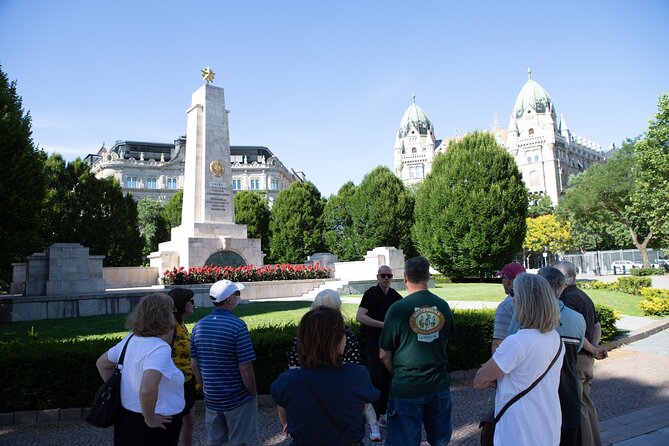
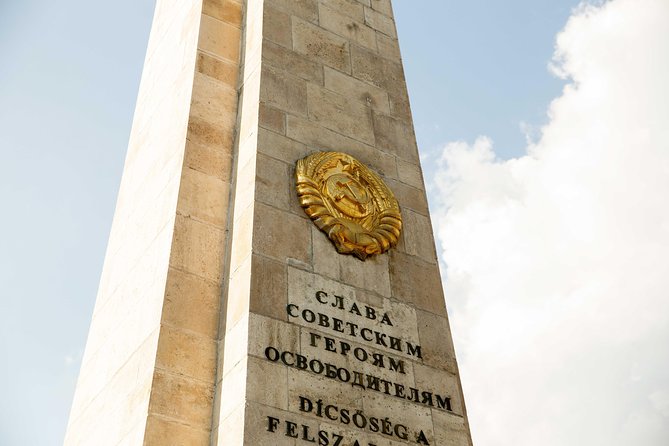
The first listed stop is a white obelisk in a landscaped park. It commemorates Russian military personnel who served in the Second World War, and admission is free.
The monument is important because it reflects the Soviet account of liberation. For the Soviet Union, the 1945 defeat of Nazi Germany brought freedom from fascism. For many Hungarians, the end of Nazi control was followed by another form of outside domination. That tension helps explain why Soviet memorials in Budapest can carry more than one meaning.
You spend about 15 minutes here, so do not expect a long stop for private exploration. The guide’s commentary is the main reason to pause. A good explanation can show you why the monument was placed here and how its meaning changed after the Communist period.
This is one of the tour’s better examples of historical value coming from context rather than admission. You can see the memorial independently, but understanding its political weight is harder without background.
The House of Terror and the building’s grim double history
At Andrássy út 60, the House of Terror Museum examines Hungary’s fascist and Communist regimes. It also remembers people who were detained, interrogated, tortured, or killed in the building.
The tour allows about 15 minutes at this stop, with admission not included. That timing suggests you should treat it as an exterior and orientation stop rather than a full museum visit. If you want to see the exhibitions, plan a separate visit and budget for your own entry.
This is an important distinction when judging the $90.31 price. You are paying for the guided route and interpretation, not for a museum ticket or a full afternoon inside the House of Terror.
Even a short visit can be useful. The building gives physical weight to the political story, showing that these systems were not abstract ideas discussed only in textbooks. They operated through offices, prisons, interrogations, and fear.
If the House of Terror is high on your Budapest list, I would not assume the tour replaces it. Use the walk to understand why the museum matters, then return independently if you want the full exhibition.
A few more Budapest trips to weigh up
- Grand Segway Tour of Budapest – Private Tour with Coffee Stop
★ 5.0 · 163 reviews - Budapest: City Bike Tour with Coffee Stop
★ 5.0 · 37 reviews - Castle District tour with Matthias Church Ticket & Cake & Coffee
★ 5.0 · 31 reviews - Buda Castle Walking Tour with Matthias church entry, Cake&Coffee
★ 4.5 · 21 reviews
St. Stephen’s Basilica and the contrast between church and state
The route also includes St. Stephen’s Basilica, one of Budapest’s major Catholic landmarks. It is named for Stephen, Hungary’s first king, and the church holds his right hand in a reliquary.
The basilica is not a Communist monument, which makes its place on this route useful. It represents older Hungarian religious and national traditions, while nearby sites speak about modern political rule. That contrast helps you see that Communist power had to operate within a country with deep religious and historical roots.
The stop lasts about 15 minutes, and admission is not included. You should therefore think of it as a brief exterior visit or orientation point. If you want to enter, inspect the interior, or see the reliquary, arrange that separately.
I like this change of subject because it prevents the tour from becoming a narrow parade of Soviet symbols. Budapest’s political story makes more sense when you see what existed before Communist rule and what the state sought to control or replace.
Liberty Hill and the meaning of the Freedom Statue
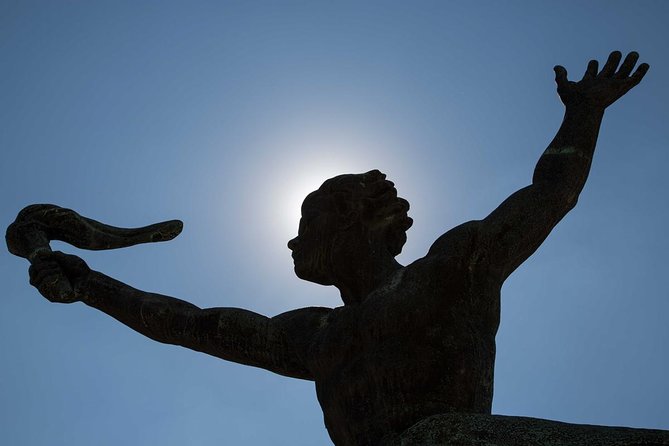
The Liberty Statue, also called the Freedom Statue, rises on Gellért Hill. It honors people who sacrificed their lives for Hungary’s independence, freedom, and prosperity.
The supplied route details do not give a duration or admission charge for this stop. It is included as part of the story, but you should not assume the tour spends a long period at the hill or includes a separate paid attraction.
The statue’s wording matters. A monument to freedom can be read differently depending on the political moment and the people looking at it. That is exactly the kind of question a guide can help you consider without reducing the subject to a simple good-versus-bad story.
Because the route ends at Liberty Square rather than at Gellért Hill, do not confuse these two locations. The Freedom Statue is one stop in the broader route, while Liberty Square is the final meeting point.
Liberty Square’s competing memories
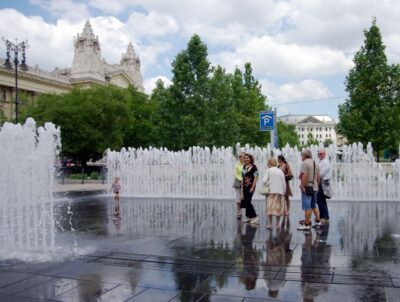
Liberty Square, or Szabadság tér, is one of the most revealing points on the walk. The square contains controversial memorials connected with the Holocaust and the Soviet soldiers who liberated Budapest from the Nazis.
It also sits near the United States Embassy and the historicist headquarters of the Hungarian National Bank. That mixture of monuments, finance, diplomacy, and public space makes the square a compact lesson in how nations present themselves.
The Soviet memorial recalls the Red Army’s role in defeating the Nazis. The Holocaust memorial addresses Hungarian Jewish victims. These memories do not always fit neatly together, and the square has become a place where public history is debated rather than quietly accepted.
You receive about 15 minutes here, with no admission charge. The stop is free to visit on your own, but the guide’s explanation can help you read the symbols and understand why the square is politically sensitive.
This is likely one of the most valuable stops for anyone interested in how countries remember difficult events. You are not simply photographing a monument. You are looking at competing versions of responsibility, liberation, suffering, and national identity.
The 1956 Revolution memorial
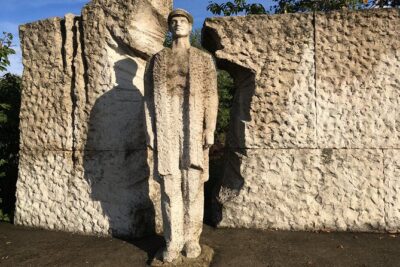
The next major subject is the memorial to the 1956 Hungarian Revolution and War of Independence. It honors the people who rose against the Communist regime.
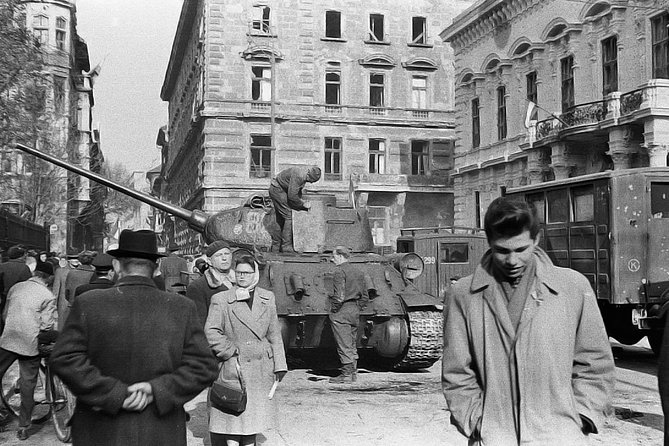
The uprising began as a national challenge to Soviet-backed rule and remains a key part of modern Hungarian identity. The memorial gives the tour a human focus after the larger state monuments. Instead of considering only armies and governments, you are asked to think about ordinary people who risked their lives against the system.
The listed timing is about 15 minutes, with free admission. As with several other stops, the benefit comes from the guide’s explanation rather than from a long visit inside a paid site.
For me, this is the point where the route’s themes connect most clearly. The Soviet memorial presents one version of liberation. The 1956 memorial presents resistance to the political order that followed. The tour lets you compare those ideas within the same city.
Looking toward the Hungarian Parliament Building
The Hungarian Parliament Building is the final major landmark named in the route. It is the seat of Hungary’s National Assembly and one of Budapest’s best-known buildings.
The stop lasts about 15 minutes, and entry is not included. The tour should therefore be understood as a guided look at the building and its political role, not as a Parliament interior visit.
That is still worthwhile. The Parliament is more than an ornate landmark. It represents the national government, making it a fitting place to discuss how Hungary moved from Communist rule toward its current political system.
If you want an interior tour, you will need to arrange that separately. The Communist walk gives you context for the building, but it does not cover the cost or details of entry.
Coffee, tea, and a classic soda in a retro bar
The indoor refreshment stop is a welcome change after the memorials and public squares. You receive a classic soda in a bar decorated with Communist themes, along with coffee and/or tea.
The description does not specify the exact drink, bar name, or food menu, so you should not book this expecting a full meal. Food and other drinks are not included unless specifically stated.
Still, the stop has real value. A retro setting gives the guide a chance to discuss everyday life rather than only official monuments. A drink also creates a natural pause for questions and informal conversation.
I would treat this as a light cultural extra, not the main reason to book. The tour’s substance is the route and commentary. The soda makes the experience more relaxed and gives the political material a social setting.
Is $90.31 fair for three hours?
At $90.31 per person, this is not a bargain-priced orientation walk. The price makes more sense if you value a small English-language group, focused historical commentary, a planned route, the included drink, and recommendations for further sightseeing.
You are not paying for museum admissions, a meal, or extended interior visits. St. Stephen’s Basilica and the House of Terror require separate budgeting if you want to go inside, and the Parliament stop does not include entry.
The value depends on your travel style. If you prefer to read plaques and move independently, you can visit several of these locations without a guide. If you want the connections explained, especially the relationship between Soviet liberation, Hungarian resistance, and disputed public memory, the guided format earns more of its price.
The maps and further recommendations also matter for a short visit. A good three-hour walk can help you decide which places deserve another hour or an entire afternoon.
Who will get the most from this walk?
I would recommend it most strongly to anyone interested in twentieth-century European politics, memorials, or the daily effect of changing regimes. It also suits a first visit to Budapest if you want a serious historical frame alongside the usual architecture and food stops.
It is a good choice for couples, solo visitors, and small groups who like to ask questions. Children may participate, but they must be accompanied by an adult, and the subject matter may be better suited to older children and teenagers.
You should be comfortable walking for about three hours and spending time outdoors. The tour is near public transportation, service animals are allowed, and most people can participate, but no special mobility details are provided.
Book it if you want interpretation more than admission tickets. Skip it if you mainly want long museum visits, a meal, or a relaxed sightseeing pace with plenty of time at each monument.
Booking details that matter
The tour is offered in English and normally accepts a maximum of 15 people. It is booked, on average, about 18 days ahead, so reserving early is sensible if your Budapest dates are fixed.
The start is at the Hungarian State Opera, Andrássy út 22. The end is at Liberty Square, Szabadság tér. That central finish makes it easy to continue sightseeing, though no onward route is included.
Free cancellation is available if you cancel at least 24 hours before the start time. Changes or cancellations inside that window are not accepted for a refund, and cut-off times use Budapest local time.
Good weather is required. If poor weather cancels the experience, you are offered another date or a full refund.
Should you book Born Under The Red Star?
Book this tour if you want Budapest’s Communist past explained through real places, not just a list of dates. The strongest parts are the links between the Soviet Heroic Memorial, the House of Terror, Liberty Square, and the 1956 memorial, plus the chance to ask questions in a group capped at 15.
The main caution is the cost relative to what is included. At $90.31, you receive guidance, a retro soda or coffee and tea, maps, and recommendations, but not museum or basilica admission, food, or a full interior tour.
For a visitor who wants context and a thoughtful walk, I think the format is worthwhile. For someone focused on entering Budapest’s major buildings, plan separate visits and treat this as the historical framework that helps those visits make more sense.
FAQ
How long does the Communist tour last?
The experience lasts approximately three hours.
Where does the tour begin?
It begins at the Hungarian State Opera, Budapest, Andrássy út 22, 1061 Hungary.
Where does the tour end?
The tour ends at Liberty Square, Budapest, Szabadság tér, Hungary.
What language is the tour offered in?
The tour is offered in English.
What drink is included?
The experience includes a classic soda in a Communist-themed retro bar, as well as coffee and/or tea.
Are museum and church admission fees included?
No. Admission to the House of Terror Museum and St. Stephen’s Basilica is not included.
Is food included?
Food is not included. Other food and drinks are excluded unless specifically stated.
How large is the group?
The tour has a maximum group size of 15 people.
Can I cancel for a full refund?
Yes, if you cancel at least 24 hours before the experience start time. Cancellations made less than 24 hours before the start are not refunded.
More Drinking Tours in Budapest
- Budapest: Unlimited Prosecco, Beer and Aperol Spritz Cruise
★ 4.8 · 25,310 reviews - Budapest: Unlimited Prosecco, Beer & Aperol Spritz Cruise
★ 4.5 · 3,371 reviews - Budapest: Bar Crawl with a Local Guide
★ 4.9 · 1,112 reviews - Budapest: Ruin Bar Pub Crawl with Entry Tickets
★ 4.7 · 1,028 reviews
Just added around Budapest
- From Budapest: Guided Tour of Eger with Wine Tasting★ 4.5 · 6 reviews
- Budapest: Private Walking Tour with a Local Guide★ 3.6 · 6 reviews
- Budapest: Danube River Views Bike Ride★ 4.8 · 23 reviews
- Trash Art Museum: Hungary’s First Scrap Metal Exhibition★ 4.3 · 72 reviews
- Walk to recent and aged spiritual sanctuaries near Budapest★ 5.0 · 5 reviews
- Budapest: 3-Hour Trabant Sightseeing Tour★ 4.7 · 28 reviews
- True Crime Walking Tour in the Buda Castle district★ 5.0 · 26 reviews
- Audio visual multi-sensory chefs journey dinner experience★ 5.0 · 3 reviews
Communism & Memento Park Tours, compared.
Communist History Tour with House of Terror Option
Read our review →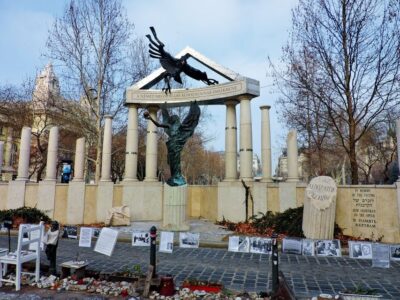
3-Hour Walking Tour About Communism (Small Group)
Read our review →
Lives of Hungarians Under Communist and Capitalist system
Read our review →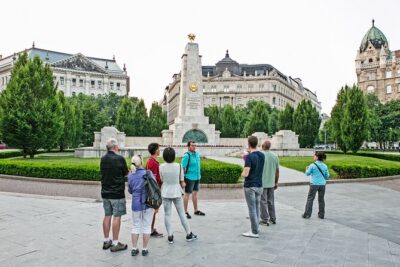
Private Budapest Hammer & Sickle Communist Times Tour
Read our review →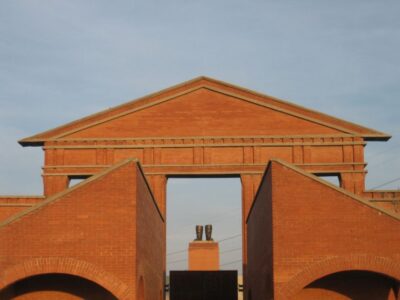
Browse the lists this tour appears in