
Reviewed · COMMUNISM & MEMENTO PARK TOURS
Life Under Communism” with optional visit to the House of Terror
Budapest’s communist past is easiest to understand on foot, where Soviet memorials, revolution sites, and ordinary city streets reveal how politics shaped daily life. This private tour connects those places with personal stories, then pauses at Bambi Presszó, a café remembered as one of the last pockets of communist-era culture.
I like the way the route links the 1956 uprising to real locations, from Parliament to Corvin köz. I also like the private format, which lets guides such as Miklós or Balázs adjust the discussion to your questions. The main consideration is that the tour has several options, and the difference matters: Memento Park and the House of Terror are not automatic stops unless you select them.
In This Review
- Key points to know before booking
- Why communist Budapest is best read in the street
- Liberty Square and the Soviet memorial
- Parliament and the tragedy of Kossuth Square
- Petőfi Statue and Március 15. Square
- Corvin köz and the 1956 resistance
- Bambi Presszó and an everyday look at communism
- Crossing the Danube to Gellért Square
- Choosing Memento Park, one hour with the old statues
- Choosing the House of Terror Museum
- Price, private format, and what is included
- Who will get the most from this tour
- Should you book the communist Budapest tour?
- FAQ
- How long does the tour last?
- Is the House of Terror included in every booking?
- Is Memento Park included?
- What language is the tour offered in?
- How many people can join the private tour?
- What is the cancellation policy?
Key points to know before booking
- See the Soviet memorial in Liberty Square, one of Budapest’s clearest reminders of the postwar power shift.
- Stand on Kossuth Square, where the 1956 massacre helped push Hungary toward open revolt.
- Visit Bambi Presszó, a surviving café tied to the city’s communist-era social life.
- Walk through Corvin köz, a key center of armed resistance during the 1956 uprising.
- Choose Memento Park or the House of Terror, each adding a different kind of museum experience.
- Book it as a private group, with space for up to five people and pickup available.
Why communist Budapest is best read in the street
A museum can explain dates and leaders. A walking route shows you where fear, protest, and resistance actually unfolded. That is the value of this experience. You move through central Budapest while the guide points out memorials, squares, statues, and surviving traces of a political system that ended in 1989.
The focus is not only on government policy. You hear about everyday life behind the Iron Curtain, including the ways people managed shortages, restrictions, propaganda, and uncertainty. The strongest guides bring personal experience to this subject. Miklós has described his own experience of surviving dictatorship, while guides including Balázs and Agy have been praised for making the subject easy to discuss.
The tone can vary by guide, so it is worth asking questions early. This is not a theatrical show, and it does not pretend that communist Budapest survives untouched. Much of what you see is a memorial, reconstruction, or preserved object. That honesty is useful. The city today is modern, but its public spaces still carry political scars.
More communism & memento park tours in Budapest:
- Budapest: Communist History Tour with House of Terror Option
★ 4.8 · 182 reviews - Communism in Hungary with a Historian
★ 5.0 · 70 reviews - Budapest: 3-Hour Walking Tour About Communism (Small Group)
★ 4.7 · 70 reviews
Liberty Square and the Soviet memorial
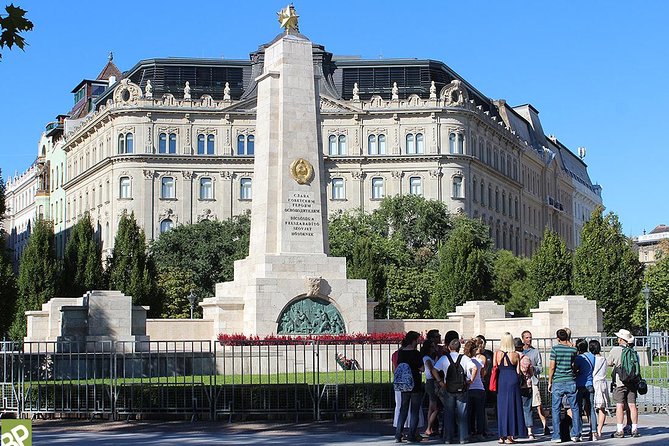
The tour begins at Liberty Square, or Szabadság tér. The square is large, leafy, and unusually open for central Budapest. Its peaceful appearance hides a difficult past.
Here you see the memorial to the Soviet army, built in connection with the Siege of Budapest near the end of World War II. Soviet forces encircled the capital for 50 days, and the memorial presents the Soviet role in grand, official terms. It remains one of the most politically charged monuments in the city.
Your guide can help separate the memorial’s message from the wider story. The Soviet army defeated Nazi Germany and ended the siege, but Soviet victory also led to decades of political control. That tension is central to understanding Hungarian memory. One monument can represent liberation to some and the start of another form of domination to others.
Liberty Square itself also helps explain the city’s earlier history. Its broad proportions date to the Habsburg period, when the large Újépület complex occupied the area. The square later became a place of state power, public ceremony, and competing historical messages.
I would give this first stop your full attention. It is not simply a photo stop. Look at the size, position, and language of the memorial, then ask how its meaning changed after 1989.
Parliament and the tragedy of Kossuth Square
From Liberty Square, the route continues to Kossuth Square, home of the Hungarian Parliament Building. The building is one of Budapest’s grandest sights, but this stop is about the square and the violence that took place there in 1956.
During the revolution, demonstrators gathered in front of Parliament. The crowd included civilians of different ages, including women, children, and older people. A firefight broke out, and the exact number of people killed remains uncertain.
That uncertainty is part of the story. The massacre became a turning point because news of the deaths helped push Budapest and the rest of Hungary toward armed revolt. The square was not just a ceremonial center. It became a place where public anger met state violence.
You have about 20 minutes at the Parliament stop, and admission to the building is not included. This is an outdoor history stop, not a Parliament tour. If you expect to go inside the Parliament, you will need a separate ticket and a different plan.
The setting makes the discussion especially effective. You can see the ministries and the Museum of Ethnography facing the square, then picture the same space filled with civilians during a tense autumn day. A good guide will help you understand the sequence of events without turning the tragedy into a rushed list of dates.
Petőfi Statue and Március 15. Square
The route then reaches the Petőfi Statue and Március 15. Square near Erzsébet Bridge. The area sits at the foot of the oldest church of Budapest and was renovated in 2011.
This stop shifts the mood. Március 15. Square is a social place as well as a historical one, with people gathering near the river and bridge. The Petőfi Statue recalls Sándor Petőfi, a major figure in Hungary’s 1848 revolution, and gives the guide a chance to connect different generations of protest.
The value here comes from comparison. Hungary’s public memory did not begin with communism, and resistance in 1956 drew on older ideas of national independence. You see how monuments to earlier struggles share space with the later story of Soviet control.
The route also brings you through central Budapest rather than isolating the subject in a distant museum. That makes the experience useful if you want to understand how the city’s famous sights connect to political history.
Same riverbank, a completely different kind of day:
- Budapest: Unlimited Prosecco, Beer and Aperol Spritz Cruise
★ 4.8 · 25,310 reviews - Budapest: Széchenyi Spa Day Ticket with Optional Upgrades
★ 4.3 · 23,911 reviews - Budapest: Nighttime or Daytime Sightseeing Cruise
★ 4.2 · 21,062 reviews - Budapest: 1-Hour Evening Sightseeing Cruise with Drink
★ 4.5 · 8,330 reviews
Corvin köz and the 1956 resistance
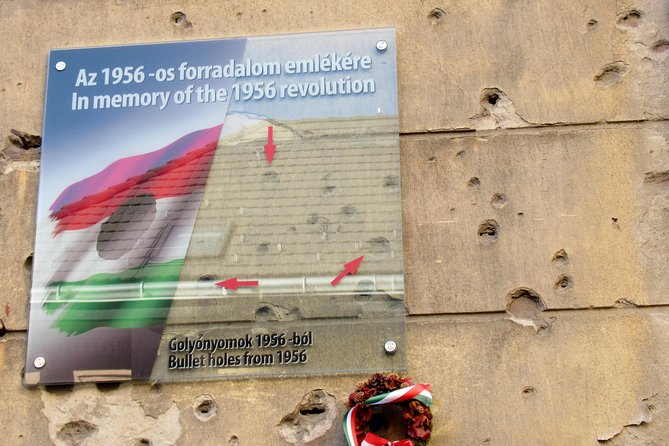
Corvin köz is one of the most important places on the route. In 1956, local young people used the area as a major resistance center. They fought Soviet forces with guns taken from soldiers and Molotov cocktails, confronting Soviet tanks with weapons that were crude but effective in close street fighting.
This is where the uprising becomes especially human. The revolution was not only a movement of officials, writers, or organized political groups. Young people in a neighborhood took enormous risks against a military power far stronger than they were.
The guide discusses the invasion and what followed after the resistance was defeated. You may find this more affecting than the grand monuments because Corvin köz shows the scale of ordinary courage. It also helps explain why 1956 remains such a powerful part of Hungarian identity.
Do not expect a preserved battlefield. The importance is in the location and the explanation. Buildings and streets have changed, but the guide’s account gives the place a historical charge that a passing walk would miss.
Bambi Presszó and an everyday look at communism
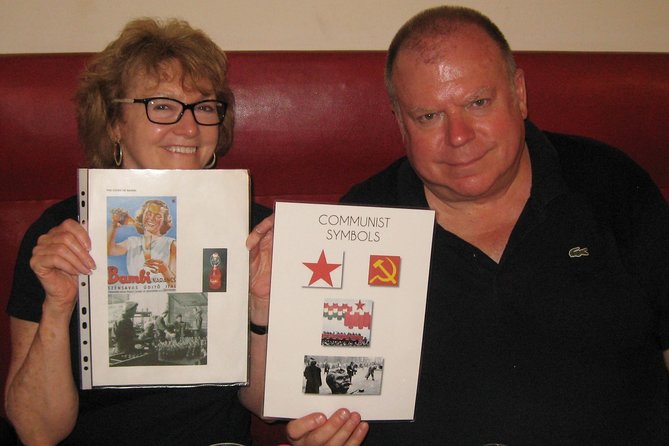
The coffee stop at Bambi Presszó gives the tour a welcome change of pace. Instead of another monument, you sit in a café associated with communist-era Budapest.
The point is not the drink itself. It is the chance to discuss how people actually lived. Public monuments tell you what governments wanted people to remember. A café can open a conversation about habits, social life, small comforts, and the ways people created normal routines under an abnormal political system.
I would use this pause to ask practical questions. What was difficult to buy? How did people spend free time? What did official slogans mean in daily life? How did families talk about politics at home? The value depends partly on your curiosity and on how much personal experience your guide brings to the conversation.
Food and drink beyond the included coffee are not covered, so budget for anything extra. The stop also provides a useful rest point during a route that involves several city-center walks and public transport connections.
Crossing the Danube to Gellért Square
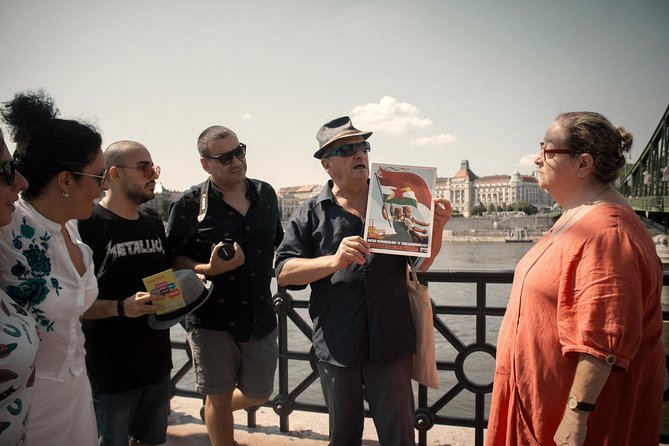
The walk crosses one of Budapest’s beautiful bridges toward the foot of Gellért Hill. The bridge crossing is more than a scenic break. It shifts you from Pest to Buda and gives you a broad view of the river and the city.
At St. Gellért Square, the guide explains the square’s connection to Bishop St. Gellért, also known as the Martyr for Hungarian Christendom. From here, you also get a good view of the Liberty Statue on Gellért Hill.
The Liberty Statue was erected in 1947 to remember the Soviet liberation of Hungary. Like the memorial in Liberty Square, it carries a complicated meaning. Its original message celebrated Soviet victory, but the statue later became part of Budapest’s wider visual identity.
This is a good place to think about how monuments survive political change. A government can remove symbols, rename places, or rewrite explanations, but some statues remain because cities decide to preserve them and attach new meanings. The guide can help you see that process without treating public memory as fixed.
Choosing Memento Park, one hour with the old statues
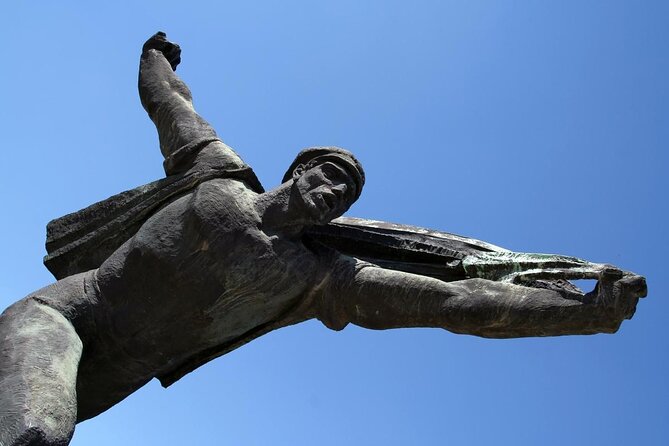
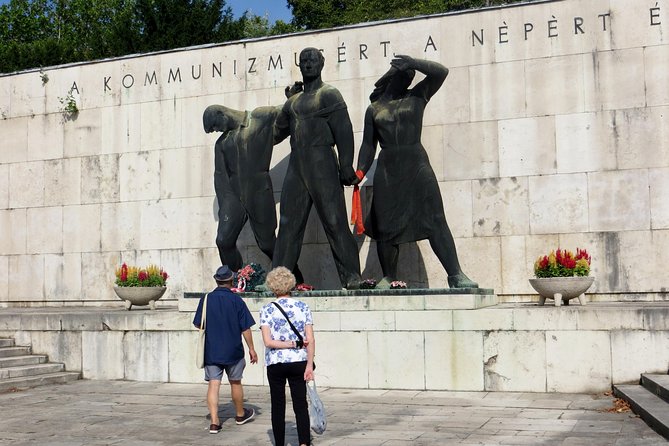
If you choose Memento Park, you spend about an hour among public sculptures saved after communism collapsed in 1989. Four years later, Budapest decided to preserve many of these works rather than destroy them, creating a park outside the central city.
Memento Park is useful because it gathers statues that once stood in prominent public places. You see the old political imagery in one setting instead of encountering it accidentally around town. The effect can be strange, educational, and occasionally darkly funny.
The park does not recreate communist Budapest. It is a collection of removed symbols, displayed after the political system they served had ended. That distinction matters. You are looking at propaganda as an object of study, not walking through a living communist-era neighborhood.
Transportation and timing deserve attention here. The tour description lists a visit of about one hour, but the overall experience is advertised at roughly three hours, so confirm how your selected option fits the day’s route. One past group found that transport costs and ticket expectations affected the value they received. Ask clearly what is included before you pay, especially if your booking page displays several choices.
Choosing the House of Terror Museum
The House of Terror offers a different experience from Memento Park. Located on Andrássy Avenue, it occupies a renovated building with a dark exterior frame, blade-like walls, a granite footpath, and a T-54 tank inside.
The museum examines the terror of both fascist and communist regimes in Hungary. The building itself is part of the presentation, and the heavy exterior makes a sharp visual contrast with the surrounding avenue.
You are given about an hour for this option, with admission included when selected. The time is enough for a focused visit, but it is not a long museum day. If you are especially interested in the exhibits, tell the guide at the start so expectations are clear.
This option also needs careful booking. The experience has a city walking option, a Memento Park option, and a House of Terror option. Do not assume that mentioning the House of Terror in the general description means it is included in every booking. Check the exact choice on your confirmation.
Price, private format, and what is included
The listed price is $280.33 per group of up to five people. For a full group, that works out to about $56 per person before any extra transport or food costs. For one or two people, the per-person price is much higher.
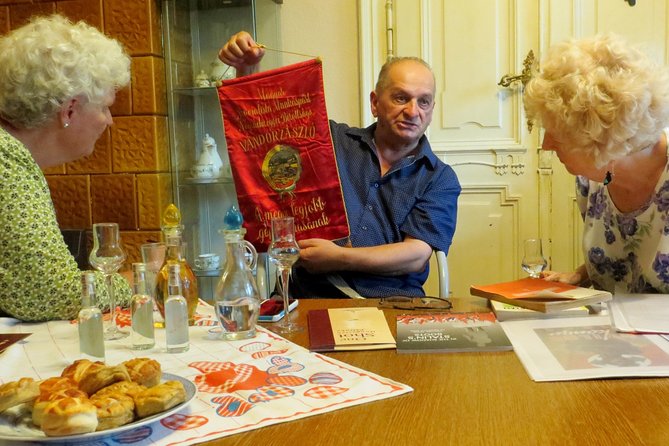
The private format is the strongest reason to consider the cost. You are not sharing the guide with a large group, and you can ask about family stories, public memory, transport, or the 1956 uprising without waiting for a crowd to move along. Several guides, including Miklós and Balázs, have been praised for answering questions and offering practical help with Budapest’s public transport.
The value is less clear if you mainly want a cheap overview or a standard museum visit. One past participant felt the cost was high because transport and admission were not clear enough. The supplied details say admission is included for the selected visit options, but additional food and drink, hotel pickup and drop-off, and tickets not listed are excluded.
Pickup is offered, yet hotel pickup and drop-off are listed as not included, so treat pickup as something to confirm rather than a guaranteed door-to-door service. Mobile tickets, English guiding, and informative handouts are provided.
Who will get the most from this tour
I would choose this tour if you want political history tied to actual Budapest streets. It suits adults, older children, and anyone who enjoys asking questions rather than simply collecting sightseeing photos.
It is especially useful early in your stay because guides may help you learn the public transport system and suggest ways to get around on your own afterward. The route involves walking and public transportation, and a moderate level of fitness is expected.
The private format also works well for families or small groups with different interests. You can spend more time on personal stories or ask for a shorter explanation at a monument. Children must be accompanied by an adult, and service animals are allowed.
The main mismatch would be someone seeking a polished, tightly scripted performance. Guide style matters here. One guide may give lively personal context, while another may speak too softly or provide less detail than you hoped. If sound, pace, or museum time is important, state that clearly before the walk begins.
Should you book the communist Budapest tour?
Book it if you want to understand what Budapest’s memorials mean, not just where to take pictures. The strongest parts are Liberty Square, Kossuth Square, Corvin köz, and the Bambi café conversation. Add Memento Park if you want political sculpture in one place, or choose the House of Terror for a museum setting focused on state terror.
I would confirm three things before booking: the guide assigned to your group, the exact option selected, and which admission and transport costs are included. With those details settled, this can be a thoughtful private introduction to Hungary’s 20th-century past. If you want only a brief city walk, the price may feel steep. If you value local perspective and time for questions, the format makes a stronger case.
FAQ
How long does the tour last?
The walking tour lasts about three hours. Memento Park or the House of Terror option is listed as taking about one hour, so confirm the total timing for your selected version.
Is the House of Terror included in every booking?
No. The House of Terror is an optional visit. You must select that option when booking.
Is Memento Park included?
Memento Park is included only if you choose the Memento Park option. The visit is listed as lasting one hour, with admission included for that option.
What language is the tour offered in?
The tour is offered in English.
How many people can join the private tour?
The price covers one private group of up to five people. Only your group participates.
What is the cancellation policy?
You can cancel for a full refund up to 24 hours before the experience begins. Changes or cancellations made less than 24 hours before the start time are not accepted for a refund.
Just added around Budapest
- From Budapest: Guided Tour of Eger with Wine Tasting★ 4.5 · 6 reviews
- Budapest: Private Walking Tour with a Local Guide★ 3.6 · 6 reviews
- Budapest: Danube River Views Bike Ride★ 4.8 · 23 reviews
- Trash Art Museum: Hungary’s First Scrap Metal Exhibition★ 4.3 · 72 reviews
- Walk to recent and aged spiritual sanctuaries near Budapest★ 5.0 · 5 reviews
- Budapest: 3-Hour Trabant Sightseeing Tour★ 4.7 · 28 reviews
- True Crime Walking Tour in the Buda Castle district★ 5.0 · 26 reviews
- Audio visual multi-sensory chefs journey dinner experience★ 5.0 · 3 reviews
Communism & Memento Park Tours, compared.
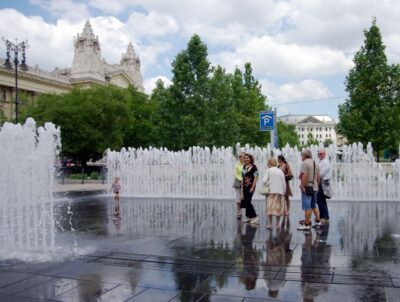
Communist History Tour with House of Terror Option
Read our review →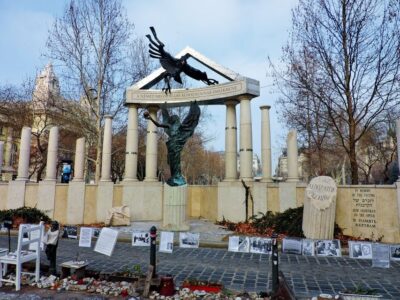
3-Hour Walking Tour About Communism (Small Group)
Read our review →
Lives of Hungarians Under Communist and Capitalist system
Read our review →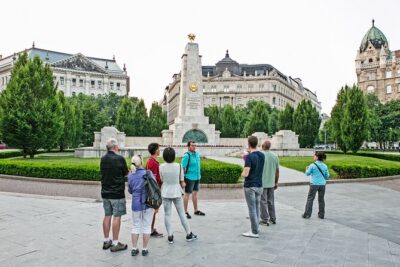
Private Budapest Hammer & Sickle Communist Times Tour
Read our review →
Browse the lists this tour appears in