
Reviewed · COMMUNISM & MEMENTO PARK TOURS
Communist Budapest Walking Tour
Budapest’s communist past is easiest to understand when you see it in ordinary places: a square where crowds gathered, a coffeehouse frozen in its 1960s style, a housing estate once seen as a prize, and a stadium lined with heroic worker statues. This tour links those places into a clear story about Goulash Communism, the Hungarian system that allowed modest personal freedoms while demanding obedience on major political matters.
I like the way the route joins political events with daily life, rather than stopping at monuments alone. I also like the use of old photographs on an iPad, which lets you compare Stalin-era Budapest with the streets you see today. The main consideration is pace: three hours covers a lot of ground, including metro and trolley-bus rides, and one past participant found the amount of walking and information tiring.
In This Review
- Key points at a glance
- Why this tour makes communist Budapest easier to understand
- Starting at Bem József Square and the 1956 uprising
- Kossuth Square and the violence of 1956
- Four Cold War symbols at Freedom Square
- The 1970s housing estates and a change in daily life
- Socialist Realism at the former People’s Stadium
- Riding a Stalin-era trolley bus along the parade route
- The House of Terror and the Berlin Wall fragment
- The guide’s role and the level of history
- Is $123 a fair price for three hours?
- Practical advice before you go
- Who will get the most from this Budapest walk?
- Should you book the Communist Budapest Walking Tour?
- FAQ
- How long is the Communist Budapest Walking Tour?
- Where does the tour begin?
- What language is the tour conducted in?
- Are metro, tram, and trolley-bus tickets included?
- Is the tour private or shared?
- Can I cancel for a full refund?
Key points at a glance
- Bem József Square begins the story: This was the site of the first large demonstration of the 1956 uprising.
- Kossuth Square connects politics with tragedy: In front of Parliament, you’ll examine places tied to the revolution’s political and armed conflicts.
- Freedom Square compresses the Cold War into four sights: The US embassy, Soviet monument, Ronald Reagan statue, and atomic-shelter entrance face one another in a powerful setting.
- 1970s housing blocks reveal everyday life: The gray apartment estates once offered elevators and modern conveniences that many older Budapest homes lacked.
- Puskás Stadium preserves Socialist Realism: Statues of workers, soldiers, and intellectuals present the official vision of a bright communist future.
- The route ends near the House of Terror: The former secret-service headquarters and a piece of the Berlin Wall provide a sobering final note.
Why this tour makes communist Budapest easier to understand
A city tour about dictatorship can easily become a parade of dates and stern-looking statues. This one has a more useful aim: to show how politics shaped apartments, transport, public ceremonies, coffeehouses, and the streets where people gathered.
The phrase Goulash Communism refers to Hungary’s softer version of Soviet-style rule, especially after the crushing of the 1956 revolution. The system was still authoritarian, and major political choices were not open to public debate. Yet daily life could offer more consumer goods and small personal freedoms than in some other communist countries.
That contrast is the heart of the tour. You are not simply shown where the government once operated. You are encouraged to think about why some Hungarians accepted the system, how families lived within it, and why the period cannot be described as either wholly bleak or wholly comfortable.
The route also helps explain why Hungary’s path to democracy felt less like a single dramatic break than a long shift. One participant with prior knowledge of Hungary after 1968 felt the tour stayed close to the basics, while another praised the way the guide adapted the route to add context. That difference is useful to keep in mind: this tour is likely strongest as an introduction, or as a way to put familiar events into physical surroundings.
More communism & memento park tours in Budapest:
- Budapest: Communist History Tour with House of Terror Option
★ 4.8 · 182 reviews - Communism in Hungary with a Historian
★ 5.0 · 70 reviews - Budapest: 3-Hour Walking Tour About Communism (Small Group)
★ 4.7 · 70 reviews
Starting at Bem József Square and the 1956 uprising
Meet at Bambi Espresso on Frankel Leó út. The café is more than a convenient starting point. Its interior has retained a 1960s appearance, giving you an immediate look at the sort of public place associated with Budapest’s communist decades.
From there, the focus turns to Bem József Square. On October 23, 1956, a large demonstration gathered here, helping launch the uprising against the Hungarian communist government and Soviet control. The square lets you begin with people rather than institutions. Crowds, slogans, and public space mattered greatly in a period when open political opposition was tightly restricted.
Your guide should help you separate the early hope of the uprising from its violent suppression. This is also a good point to ask questions about how the revolution is remembered in Hungary today, since the same event can be viewed as a national revolt, an anti-Soviet struggle, and a failed attempt to create a freer political system.
Bambi Espresso is a particularly fitting place to begin because the tour is interested in ordinary life as well as major events. The preserved interior is not a grand monument, but it gives the period texture. You can imagine how a café, apartment, workplace, or tram ride might have formed part of a person’s daily experience while political choices remained out of reach.
Kossuth Square and the violence of 1956
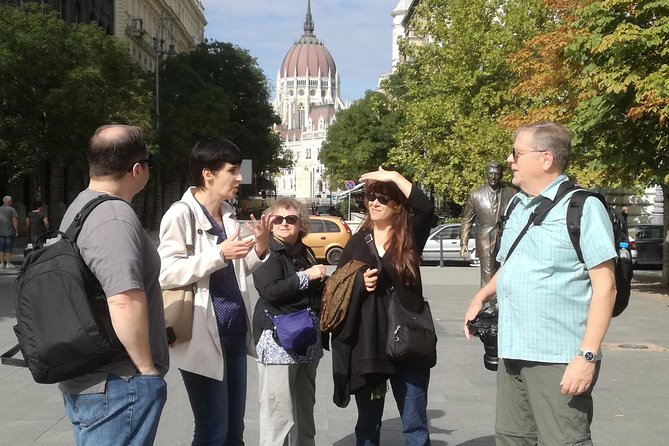
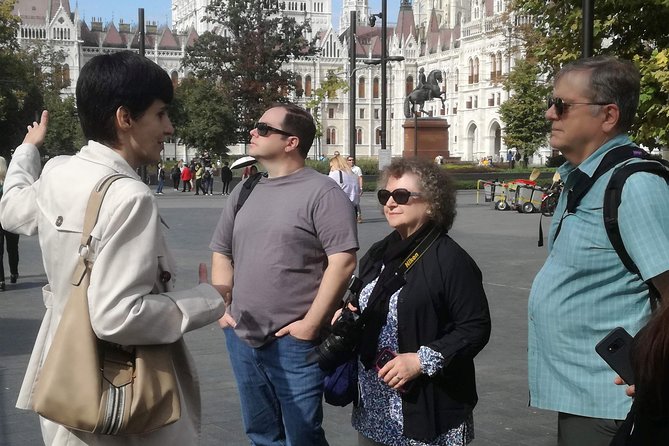
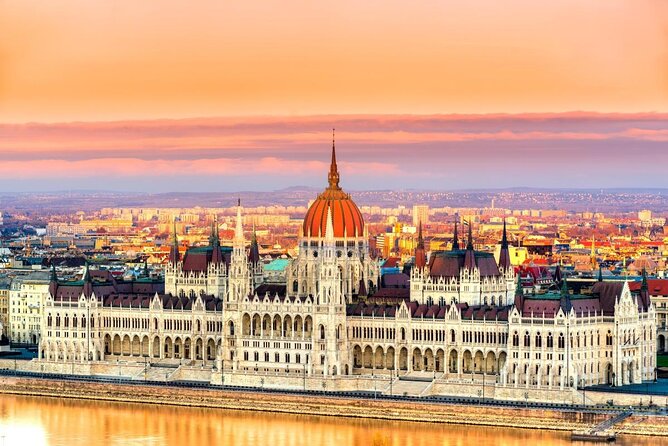
The next section uses the metro to reach Kossuth Square, directly in front of Parliament. Your transport tickets are not included, so keep that small cost in mind and ask the guide what tickets you need before the tour begins.
Kossuth Square is one of the most important stops because it places the 1956 revolution beside the seat of national government. Monuments in the square bear witness to the political and armed conflicts that unfolded during the uprising. The setting makes the basic question impossible to avoid: who had the right to rule Hungary, and what happened when large numbers of people challenged that authority?
This stop is likely to work best if you already know a little about the revolution, but the guide’s job is to supply the order of events. The first demonstration, the spread of resistance, the government crisis, and the eventual armed response all become easier to follow when connected to real streets and buildings.
I would not expect a long visit inside Parliament. The tour is focused on the surrounding public spaces and their political meaning. That is useful for a history-focused walk, but you should book a separate Parliament visit if you want an interior tour.
Four Cold War symbols at Freedom Square
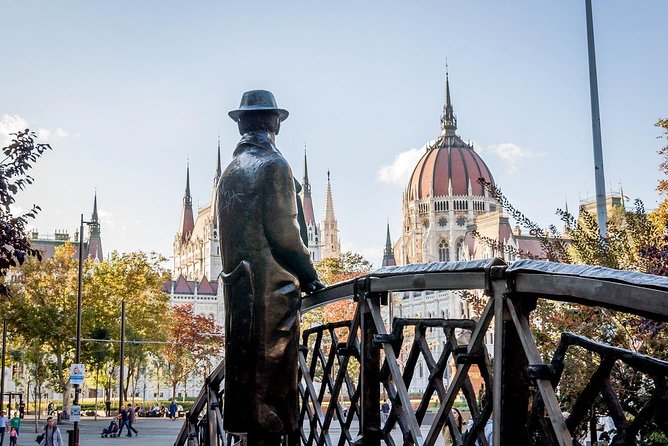
A short walk takes you to Freedom Square, where four structures put the Cold War into a compact urban frame. You’ll see the US embassy, a monument to the Soviet army, a statue of President Ronald Reagan, and the entrance to a secret atomic shelter.
Each sight points to a different side of the postwar struggle. The Soviet monument recalls the power that shaped Hungary’s political system. The US embassy represents the western bloc, while the Reagan statue reflects the later American role in challenging Soviet authority. The atomic-shelter entrance adds a physical reminder of how military tension reached beneath the city streets.
This is one of the tour’s best stops for visitors who want more than a simple good-versus-bad story. Freedom Square shows competing memories sharing the same public space. It also offers a chance to discuss how Budapest has chosen to remember the communist period since 1989.
The square is not presented as a museum exhibit with every answer neatly arranged. Its value comes from the guide’s explanation of how the objects relate to one another. Pay attention to the position of each monument, not just its appearance. The square works as a map of Cold War loyalties and fears.
A few more Budapest trips to weigh up
- Budapest: Buda Castle Walk with Saint Stephen’s Hall
★ 4.5 · 3,012 reviews - Big Bus Budapest Hop-On Hop-Off Bus and Walking Tour
★ 3.5 · 2,206 reviews - Budapest: Buda Castle District Walking Tour
★ 4.6 · 2,108 reviews - Budapest City Landmarks Walking Tour in 2 Hours
★ 5.0 · 2,048 reviews
The 1970s housing estates and a change in daily life
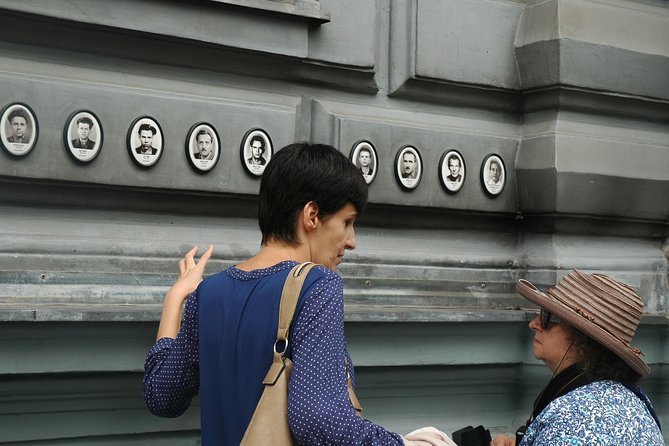
The metro then carries you toward one of Budapest’s 1970s housing estates at the edge of the city center. This part of the route leaves behind the grand political squares and looks at the practical side of state planning.
Today, the apartment blocks may seem gray and plain. In the 1970s, though, receiving one of these flats could be a major improvement for a young family. The buildings offered elevators and modern conveniences that were missing from many older Budapest constructions.
That contrast is central to understanding Goulash Communism. A system could limit freedom while also improving housing for some people. It could produce drab neighborhoods and still give families a kitchen, bathroom, elevator, and more reliable utilities than they had before.
I like this stop because it pushes you past the easy image of communist life as only shortages and repression. You’ll see the physical result of an era that tried to solve housing problems through large-scale construction. At the same time, the blocks can feel impersonal, and the tour does not turn them into romantic relics.
This section may be less visually exciting than Parliament or Freedom Square. Its importance is social rather than spectacular. If your main interest is architecture, you’ll get a useful glimpse of 1970s planning. If your main interest is political history, listen for how housing, work, family life, and public obedience fit together.
Socialist Realism at the former People’s Stadium
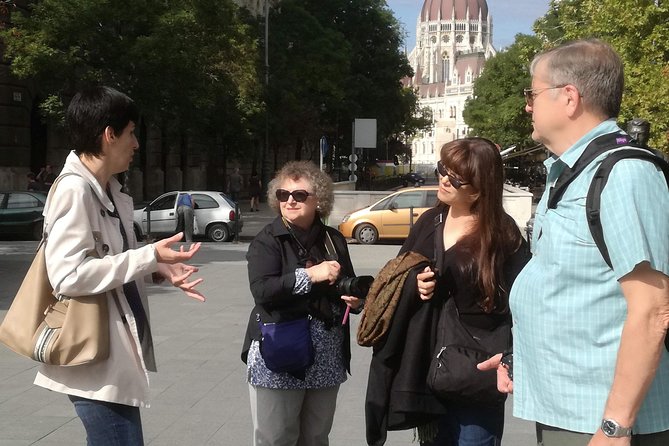
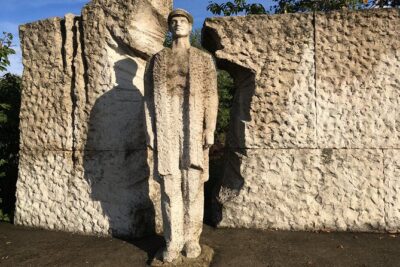
The route continues to the former People’s Stadium, now known as Puskás Soccer Stadium. This is one of the few places in Budapest where you can see typical Socialist Realist statues in one group.
The figures show heroic workers, soldiers, and intellectuals, all pointing toward a promised bright future. Their style is direct and idealized. Muscles, uniforms, tools, books, and upright poses turn political values into stone.
These statues matter because they show how public art worked under communist rule. Art was not only decoration. It helped present the model citizen the state wanted people to admire: productive, disciplined, educated, and loyal.
The stadium setting also links ideology with mass spectacle. Sports grounds were useful places for public gatherings, ceremonies, and political display. A monument can tell you what a government believed, or wanted people to believe. A stadium can show how those beliefs were staged before large crowds.
The site may not offer a polished museum experience, and you should expect to view the statues as part of the city rather than in a dedicated gallery. That is also the advantage. You see the public art where it was meant to work, along a route used by ordinary residents.
Riding a Stalin-era trolley bus along the parade route
A short ride on one of Stalin’s trolley buses takes you to Dózsa György Street, a broad boulevard once used for May Day parades. Public transport is not just a way to move between stops here. It becomes part of the subject.
The boulevard’s width and scale make sense when you think about parades. May Day events allowed the state to present unity, discipline, and industrial progress in front of organized crowds. The route lets you consider how streets can be designed for ceremonies as well as traffic.
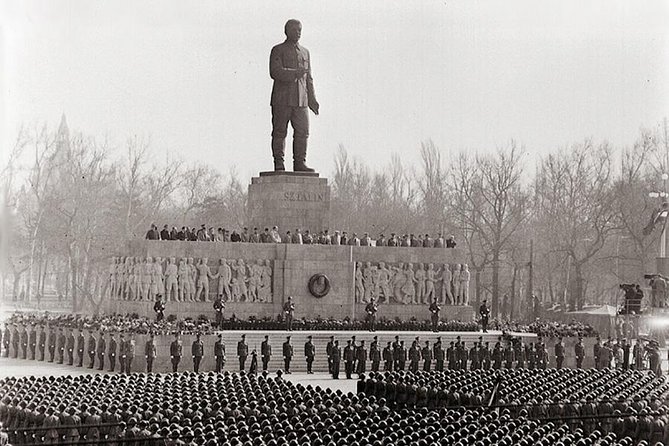
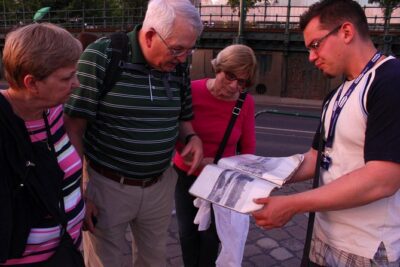
Your guide uses an iPad and old photographs to compare the present-day view with images from the Stalin period. This is a practical tool, especially when communist-era buildings and monuments have been altered, removed, or simply absorbed into modern Budapest.
The photo comparisons should be among the most useful parts for visual learners. You do not have to rely on dates alone. You can look at the same road, skyline, or public space in two different political eras and ask what changed.
The trolley ride does add another ticket expense, since tram and metro tickets are not included. It also means the tour is not a continuous walk. You’ll be switching between walking and public transport, so comfortable shoes and a little attention to the route will help.
The House of Terror and the Berlin Wall fragment
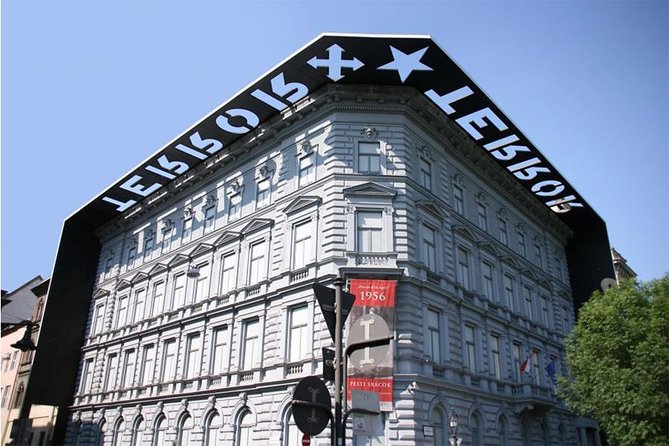
The final stop is near the House of Terror, a museum housed in the former headquarters of Hungary’s secret services. The building commemorates crimes committed during the communist period, with particular attention to the Stalinist years.
In front of the building is a slab of the Berlin Wall. It gives the tour a wider European frame. Hungary’s communist experience was national, but it was also part of a larger Soviet-led system that divided Europe for decades.
The House of Terror is an important endpoint because the earlier stops have shown how the system worked in public life. Here, the focus turns toward coercion, surveillance, and the punishment of political opposition. The tone becomes darker, and appropriately so.
The tour does not state that museum admission is included, so treat the House of Terror as an exterior stop unless you arrange a separate visit. If you want to go inside, allow additional time beyond the three-hour route. The museum can require more attention than a quick stop allows.
Ending here also creates a useful balance. The tour has shown improved housing, cafés, public art, and organized leisure, but it does not let those features hide the violence behind the system.
The guide’s role and the level of history
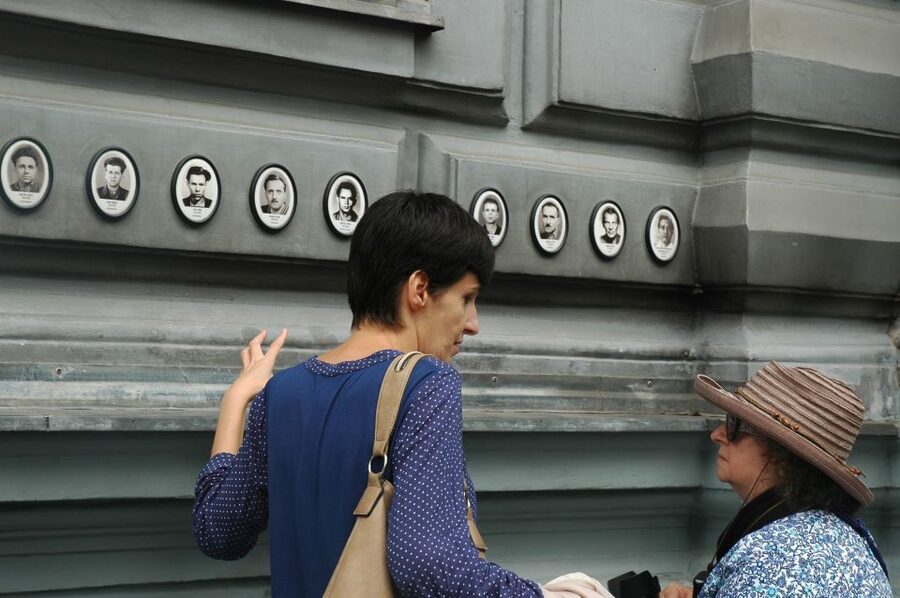
The guides are professors, doctoral students, historians, journalists, art critics, and published authors. That background suggests a more academic approach than you might get on a general city walk, though the actual experience can depend on who leads your group.
Andras, one guide associated with the tour, has been praised for a conversational style and a relaxed pace. He has also adapted the route when participants had already seen some of the main sites, using related places to explain the complicated history more fully.
That flexibility matters. Some people want dates, names, and political milestones. Others want to know what it meant to be awarded an apartment, ride public transport, attend a parade, or live with political limits while enjoying small personal freedoms.
The tour is conducted in English and can be arranged privately or in a small group. A private format may be the better choice if your group has a specific interest in the 1956 revolution, housing, Soviet influence, public art, or the transition to democracy.
If you have already taken similar communist-era tours in Prague or Berlin, set your expectations carefully. Hungary’s transition is often described as more gradual than revolutionary, and the experience may feel less dramatic than tours focused on the Berlin Wall or the fall of Czechoslovakia. The value here is in the Hungarian differences, not in copying another city’s story.
Is $123 a fair price for three hours?
At $123 per person, this is not a budget walking tour. The price needs to be judged against the guide’s background, the private or small-group option, and the amount of ground covered.
You are paying for a specialist-led interpretation, not just directions between monuments. The route uses several public spaces, two forms of public transport, preserved period interiors, housing estates, statues, and old photographs. A good guide can turn those separate stops into a connected explanation of how politics affected ordinary life.
The cost is harder to justify if you already have a firm grasp of Hungarian history after 1945. One participant with prior background felt the tour did not add much beyond the basics. If that sounds like you, a private booking with specific questions may offer better value than joining a general introduction.
Remember that metro, tram, and trolley-bus tickets are extra. The three-hour duration also means the fee is for a focused historical route, not a full-day experience or a museum visit.
Practical advice before you go
Start with a basic timeline: the end of World War II, the rise of communist rule, the 1956 uprising, the later Goulash Communist period, and the transition to democracy in 1989. You do not need to memorize names, but a little preparation will help you ask sharper questions.
Wear comfortable shoes. The route includes substantial walking, metro transfers, and a trolley-bus ride. One person found the combination of walking and information tiring, so do not schedule this immediately before another demanding activity.
Bring a small amount of local currency or another way to purchase public transport tickets. Those fares are not part of the tour price.
You may also want to visit the House of Terror separately if its subject interests you. The walking tour uses the building as a final point in the story, but the information provided does not include museum entry.
Who will get the most from this Budapest walk?
This tour suits you best if you are new to Hungary’s communist past and want a structured introduction. It is especially useful if you prefer to connect political events with streets, homes, cafés, art, and transport instead of spending three hours inside a museum.
It also suits visitors curious about everyday life under an authoritarian system. The housing estate and café help explain why some people could feel genuine material progress even while political freedom remained narrow.
The tour may be less satisfying if you already know the period well and want detailed analysis of the fall of communism, economic policy, or post-1968 Hungary. In that case, ask for a private format and tell the guide what you already know.
Should you book the Communist Budapest Walking Tour?
Book it if you want to understand Budapest beyond its imperial avenues and grand cafés. The strongest parts are the links between 1956, Cold War symbols, apartment living, Socialist Realist art, and the darker work of the secret services.
The main tradeoffs are the $123 price, extra public transport fares, and a brisk itinerary that can leave you tired. Still, for a first look at Hungary between the end of World War II and 1989, the route offers a useful mix of politics and ordinary life.
I would choose this tour early in a Budapest visit, then return to the House of Terror or other sites with better preparation. If you can arrange Andras as your guide, his conversational approach and willingness to adjust the route may suit you well. If not, the listed academic and writing backgrounds of the guides make this a strong choice for history-minded visitors who want context, not just photo stops.
FAQ
How long is the Communist Budapest Walking Tour?
The tour lasts three hours.
Where does the tour begin?
It begins at Bambi Espresso, Frankel Leó út 2/4, 1027 Budapest.
What language is the tour conducted in?
The live tour guide speaks English.
Are metro, tram, and trolley-bus tickets included?
No. Public transport tickets are not included in the tour price.
Is the tour private or shared?
Private or small-group options are available.
Can I cancel for a full refund?
Yes. You can cancel up to 24 hours in advance for a full refund. You can also reserve now and pay later.
Just added around Budapest
- From Budapest: Guided Tour of Eger with Wine Tasting★ 4.5 · 6 reviews
- Budapest: Private Walking Tour with a Local Guide★ 3.6 · 6 reviews
- Budapest: Danube River Views Bike Ride★ 4.8 · 23 reviews
- Trash Art Museum: Hungary’s First Scrap Metal Exhibition★ 4.3 · 72 reviews
- Walk to recent and aged spiritual sanctuaries near Budapest★ 5.0 · 5 reviews
- Budapest: 3-Hour Trabant Sightseeing Tour★ 4.7 · 28 reviews
- True Crime Walking Tour in the Buda Castle district★ 5.0 · 26 reviews
- Audio visual multi-sensory chefs journey dinner experience★ 5.0 · 3 reviews
Communism & Memento Park Tours, compared.
Communist History Tour with House of Terror Option
Read our review →
3-Hour Walking Tour About Communism (Small Group)
Read our review →
Lives of Hungarians Under Communist and Capitalist system
Read our review →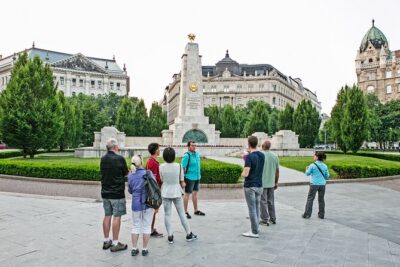
Private Budapest Hammer & Sickle Communist Times Tour
Read our review →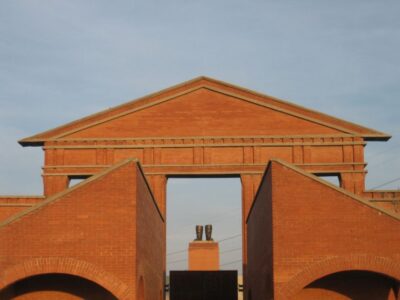
Browse the lists this tour appears in